
3.6 C
New York
Thursday, February 19, 2026
Home Blog Page 226

Controversy Surrounding Nigeria’s Benin Bronzes and The Museum of West African Art (Mowaa)

0

Todah OpeyemiBBC Africa, Benin City
AFP/Getty Images Guests look out of a window as protesters storm the Museum of West African Art in Benin City - 9 November 2025AFP/Getty Images

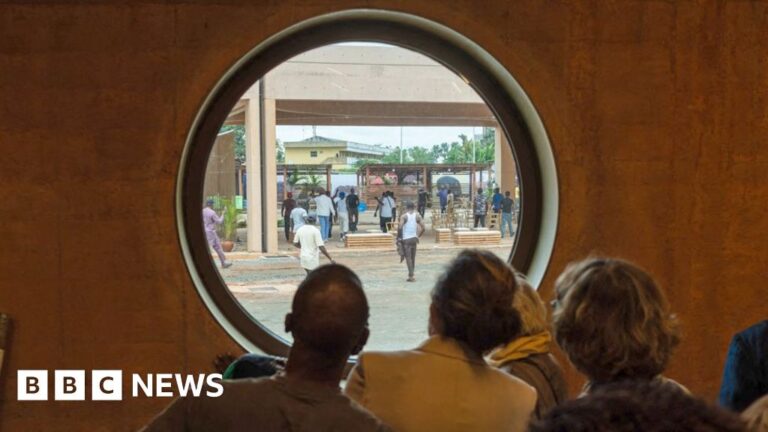
Guests and dignitaries looked on as protesters stormed the Museum of West African Art in Benin City on Sunday

Nigeria’s stunning new Museum of West African Art (Mowaa) has found itself in the crosshairs of local power politics on the week it was supposed to – but failed – to open its doors to the public for the first time.

The six-hectare (15-acre) campus sits in the heart of Benin City, capital of the southern state of Edo – and includes an archaeological dig and buildings designed by high-profile British-Ghanaian architect Sir David Adjaye, best known for the National Museum of African American History and Culture that opened in Washington in 2016.

It has been five years in the making – and is envisioned to celebrate both the past and the present of creativity in the region famous for the Benin Bronzes, artworks looted from the city’s royal palace by British soldiers in the 19th Century.

It is impressive – and ahead of the planned opening, Mowaa was buzzing with staff determined to prove it is a place that can rival established museums and galleries in the West.

Inside conservators carefully unwrapped artworks from protective packaging, inspecting each piece and taking meticulous records before positioning them on walls and plinths.

Technicians fine-tuned climate control systems. In the materials science laboratory, officers calibrated equipment meant to preserve centuries-old artefacts.

The project has been the brainchild of businessman Phillip Ihenacho – now Mowaa’s executive director.

“I want us to have a significant economic impact on communities around here,” he told the BBC, adding that he hoped to make Benin City “a cultural destination”.

Mowaa, a non-profit Nigerian institution, sees itself creating more than 30,000 direct and indirect jobs and contributing more than $80m (£60m) annually to the regional creative economy through partnerships and programming.

It has taken $25m (£19m) to get here – money raised from various donors, including the French and German governments, the British Museum and the Edo state government.

But now the local government has pulled the rug from under it – revoking the use of the land on which the museum was built.

An Edo state spokesperson told the BBC this was because in the original paperwork it had called itself Edo Museum of West African Art – and it had since dropped “Edo” from its name.

This announcement followed protests on Sunday, when people stormed the campus demanding it be called the Benin Royal Museum.

A rowdy group insulted foreign guests at the museum ahead of the opening – forcing them to be hurried away under police escort.

President Bola Tinubu has even stepped in to try and resolve the tensions, setting up a high-level committee to do some damage control.

But how has this become so politicised – and such a PR disaster?

Much of it comes down to internecine rivalries at a local state level, as it was Edo’s previous governor Godwin Obaseki – whose term in office ended last year – who was a major backer of the museum.

And it seems the administration of the new governor, a close ally of the local traditional ruler, known as the Oba, may want more of a stake in the project. The protesters on Sunday, for example, were demanding that the museum be placed under the control of Oba Ewuare II.

This brings into focus the contentious issue of the Benin Bronzes, one of Africa’s most celebrated cultural treasures.

Because even if the museum does eventually open, these bronzes will be conspicuously absent.

They are brass, ivory and wooden sculptures that once adorned the royal palace of the Benin Kingdom before British soldiers looted them in 1897 during a punitive expedition.

Today, thousands remain scattered across museums in Europe and North America — including the British Museum, Berlin’s Humboldt Forum and the Metropolitan Museum of Art.

Their return has become one of the most contested debates in the global art world. About 150 have now made their way home – and more are due to follow.

When plans for the museum in Benin City were first announced in 2019, the movers and shakers on Nigeria’s art scene hoped it would become their natural home – a state-of-the-art complex to show them off to the world.

But the waters were muddied two years ago after the federal government announced that the Oba would be the rightful owner and custodian of any returned bronzes – and the palace pushed for a museum under the royal family’s direct control, against the wishes of Obaseki, the former governor.

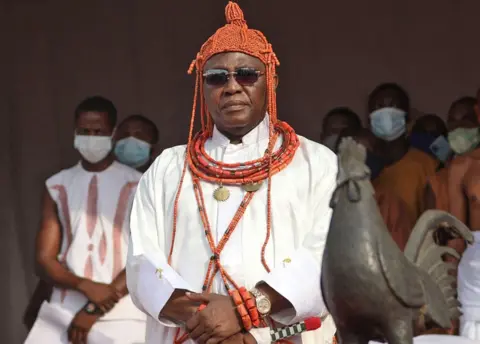
AFP/Getty Images Oba Ewuare II in royal regalia by Benin Bronze cockerel that was returned AFP/Getty Images

The Oba of Benin at a ceremony in 2022 receiving one of the looted Benin Bronzes

This left Mowaa in a delicate position: asserting a clear stance on restitution while remaining diplomatic on custodianship – and emphasising its broader vision, which led to it dropping “Edo” from its name.

“One of the frustrations I’ve always had is that from the beginning we have said we will be about the modern and contemporary,” said Mr Ihenacho.

“But because of the Western story about the return of the Benin Bronzes, everyone kept referring to us as the museum where they will go. The problem with that is we are not the owners, nor do we have any legal title to the bronzes.”

His goal is to build a haven for contemporary African creativity, including film, photography, music, dance and fashion – not just visual art.

“Yes, we want to focus on the historical, but the purpose is to inspire the contemporary,” he said.

“What we have become is a museum that is really about creating an ecosystem to support creatives in West Africa.”

From a young Nigerian artist who relocated from the US to work as a conservator, to a recent graduate undergoing his one-year mandatory national youth service programme, to a Ghanaian PhD candidate conducting research, Mowaa has already become a hub of regional collaboration.

Eweka Success, a 23-year-old sculpture graduate from the University of Benin who has had a tour of Mowaa, welcomed this opportunity.

He noted that while many residents of the city “don’t care” about the restitution conversation, the museum still offered something valuable.

“Many of us have never seen the originals, but there we can study their design, technique and history more closely,” he told the BBC.

Cultural specialist Oluwatoyin Sogbesan agrees that the conversation has grown increasingly elitist.

“The everyday person is concerned about making a living, going to work, and feeding their family. Many don’t even know about the bronzes,” she told the BBC.

For her, restitution must move beyond just the return of artefacts to also restore memory and language.

“We need to decolonise the term ‘Benin Bronzes’ itself,” she explained.

“Call them by their original Edo name – ‘Emwin Arre’ [meaning ‘Cultural Things’] – what the people who made them would have called them.”

This is something that chimes with the museum’s inaugural exhibition – Homecoming – should it open to the public.
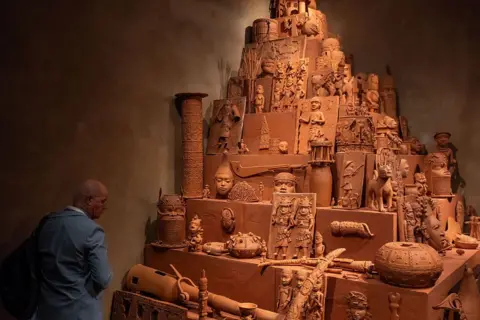
AFP/Getty Images Someone looking at Yinka Shonibare's Monument to the Restitution of the Mind and Soul - a pyramid-shaped unit featuring more than 150 clay replicas of the Benin Bronzes.AFP/Getty Images

Yinka Shonibare’s installation features more than 150 clay replicas of the Benin Bronzes

It features works by acclaimed artists such as Yinka Shonibare, Toyin Ojih Odutola, Precious Okoyomon, and Tunji Adeniyi-Jones – many of whom live in the diaspora and have rarely exhibited in Nigeria.

Shonibare’s Monument to the Restitution of the Mind and Soul has pride of place – a pyramid-shaped unit featuring more than 150 clay replicas of the Benin Bronzes.

“Creating a monument like this is acknowledging the trauma caused by the looting of those spiritual artefacts,” he told the BBC. “It’s a deeply emotional engagement with the trauma of the invasion.”

He chose clay deliberately, as a metaphor for connection with the land of Benin itself.

“In the modern world, we seem to have become increasingly distanced from nature, whereas our ancestors had a deep connection and respect for it.”

The pyramid evokes Africa’s ancient wonders while the replicas speak to absence and memory.

“The work is conceptual – about the meaning of absence, the spiritual meaning of the bronzes,” Shonibare explained. “In a way, the work is cathartic. It is almost mourning.”
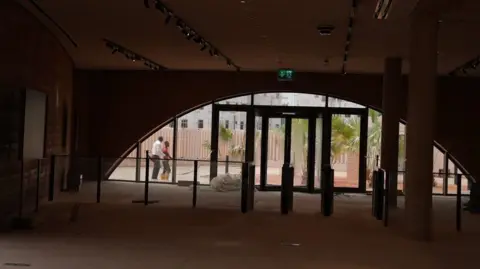
View of workmen seen from inside the new Museum of West African Art

Staff at the museum hope the government will resolve the dispute that has marred the excitement there was last week over the opening

Also commanding attention is Ndidi Dike’s 2016 mixed-media work National Grid, which reflects on power, both electrical and political.

Nigerians experience power outages so frequently they have become an accepted part of daily life – a metaphor Dike uses to question the nation’s broader failures in governance and infrastructure.

It is something likely to resonate all too well for those working at Mowaa this week.

Though they may take heart from the words of the culture minister, who is chairing the presidential committee that wants to resolve the dispute.

“Cultural institutions are pillars of our national identity and must be protected through collaborative approaches that respect both traditional custodianship and modern institutional structures,” Hannatu Musawa said.

There are fears the row may damage ongoing efforts to reclaim Africa’s stolen art, with Western museums feeling justified about their concerns over the conservation of returned works.

But many working within the walls of Mowaa remain determined to show that their creativity can redefine what a modern African museum can be – with or without historic artefacts.

More from the BBC on Nigeria’s Benin Bronzes:
Getty Images/BBC A woman looking at her mobile phone and the graphic BBC News AfricaGetty Images/BBC

Daly, CareCloud director, offloads $51k worth of CCLD stock

0


CareCloud director Daly sells $51k in CCLD stock

Indigenous Protesters Engage in Confrontation with Guards at U.N. Climate Summit

0

new video loaded: Indigenous Protesters Clash With Guards at U.N. Climate Summit

transcript

transcript

Indigenous Protesters Clash With Guards at U.N. Climate Summit

Dozens of Indigenous protesters burst into the COP30 summit in Brazil on Tuesday, demanding preservation of their lands. Other Indigenous leaders who took part in the summit said the protesters did not represent the broader movement.

“They’re going through. Doors are knocked down.” “They were not doing this because they are bad people. They are doing this because they are desperately trying to protect their lands. They are desperately trying to protect the river, their riverside communities that have so many limitations where they live.”

Dozens of Indigenous protesters burst into the COP30 summit in Brazil on Tuesday, demanding preservation of their lands. Other Indigenous leaders who took part in the summit said the protesters did not represent the broader movement.

By Jorge Mitssunaga

November 12, 2025

Analysis: Americans Face Significant Cost Increases Due to Trump’s Trade Policies, Says Top Bank

0

“Bust or boom?” That’s the big question at the heart of UBS’ big forecast for the U.S. economy for 2026 through 2028. But the team led by economist Jonathan Pingle also tackles a question that economists have been raising throughout 2025: the fact that tariffs amount to a large tax increase in all but name. Their analysis finds that the tariffs are acting as a substantial drag on growth and are actively contributing to persistent inflation, eroding real income gains for consumers.

“The tariffs are a big tax increase,” the report states simply. According to UBS, the current tariff policies imply a weighted-average tariff rate of 13.6%, based on 2024 import shares, a fivefold jump from just 2.5% at the beginning of the year. This steep rate effectively translates to a tax on imports representing 1.2% of GDP.

The most immediate impact of the trade regime is felt in rising prices, which are “keeping things elevated.” UBS estimates that the new trade regime will add 0.8 percentage points to core PCE inflation in 2026, enough to erase a year’s worth of disinflation progress and keep prices climbing at roughly 3.5% even if other pressures like housing or energy ease.

Over the longer term, UBS expects the tariffs to have a cumulative direct impact of 1.4 percentage points on the level of core PCE through 2028, rising to nearly 1.9 points once knock-on effects like supply chain rerouting and domestic producers raising prices under tariff protection are factored in. Simply: tariffs alone could account for nearly two-thirds of the remaining gap between current inflation and the Fed’s 2% target.

Inflationary Headwinds Hit Households

This tariff-related price pass-through is already translating into pressure on American households. With average hourly earnings growth having slowed to roughly 3.5% annualized over the past six months, and aggregate payroll income running at about 3.25% annualized, this inflationary surge is proving costly. Economists expect quarterly annualized PCE inflation to run between 3% and 4% over the next two quarters, effectively wiping out those income gains.

The report highlights that most households are less able to weather inflation now than they were two years ago. While upper-income households are supported by AI-driven equity market wealth, households below the top 20% of the income distribution suffer from historically low liquid assets. Rising costs, coupled with a slowing labor market, are diminishing consumer perceptions of future prospects.

This headwind is particularly concerning because the U.S. economic expansion is already characterized as “narrowly driven” and “precarious.” The current economic outlook is essentially described as “a big bet on AI,” where the only obvious areas of growth are investment in software and computers (AI-driven) and consumption supported by upper-income equity market wealth. “A decent chunk of the US economy is in recession,” UBS adds, including real residential investment and non-residential construction, is in recession or declining outright.

Returning money back to the people?

As inflation pressures mount, President Donald Trump is touting his tariffs not only as a shield for American industry but also as a new source of household income. He has floated the idea of a “tariff dividend”—a payout of “at least $2,000 a person (not including high-income people!)”—claiming the surge in tariff revenue is big enough to share directly with Americans.

The headline numbers are certainly striking. The Treasury took in $195 billion in tariff revenue in fiscal 2025, up 153% from $77 billion the year before. The Committee for a Responsible Federal Budget projects that Trump’s broad “reciprocal tariffs” could raise $1.3 trillion through 2029 and $2.8 trillion by 2034. That would lift tariffs from about 2.7% of total federal revenue to nearly 5%, roughly comparable to imposing a new payroll tax or trimming one-fifth of the defense budget.

But analysts say the math behind Trump’s proposed dividend doesn’t hold up. John Ricco of Yale’s Budget Lab estimates a $2,000 payment for every American would cost around $600 billion, far more than the government’s tariff take.

“The revenue coming in would not be adequate,” Ricco told the Associated Press. Even Treasury Secretary Scott Bessent appeared caught off guard, telling ABC’s This Week that he hadn’t discussed the idea with Trump and suggesting any “rebate” would more likely appear as a future tax cut.

Economists also warn that while tariffs generate revenue, they do so by driving up prices. Importers typically pass those costs to consumers, making the policy function more like a regressive tax than a dividend.

Economists find that what’s emerging is a feedback loop: tariffs designed to revive industrial strength are now helping to sustain inflation, which in turn weakens real income growth and constrains the very consumers meant to benefit from the policy. UBS calls it a “narrow expansion,” but it may be narrower still: an economy whose growth depends on circular AI investments and government revenue creation schemes as opposed to the broad spending power of its citizens.

Trump’s funding cuts jeopardize efforts to empower Haiti’s farmers | Food News

0

Oanaminthe, Haiti – It’s a Monday afternoon at the Foi et Joie school in rural northeast Haiti, and the grounds are a swirl of khaki and blue uniforms, as hundreds of children run around after lunch.

In front of the headmaster’s office, a tall man in a baseball cap stands in the shade of a mango tree.

Antoine Nelson, 43, is the father of five children in the school. He’s also one of the small-scale farmers growing the beans, plantains, okra, papaya and other produce served for lunch here, and he has arrived to help deliver food.

“I sell what the school serves,” Nelson explained. “It’s an advantage for me as a parent.”

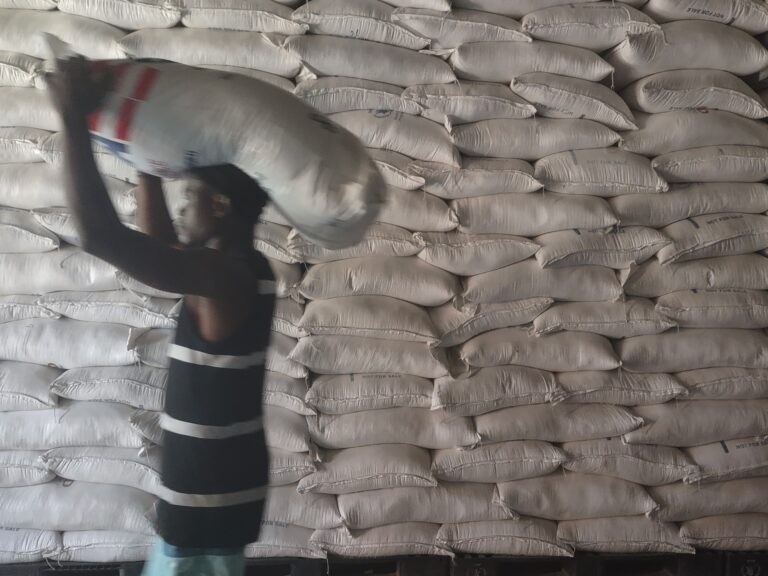
Nelson is among the more than 32,000 farmers across Haiti whose produce goes to the World Food Programme, a United Nations agency, for distribution to local schools.

Together, the farmers feed an estimated 600,000 students each day.

Their work is part of a shift in how the World Food Programme operates in Haiti, the most impoverished country in the Western Hemisphere.

Rather than solely importing food to crisis-ravaged regions, the UN organisation has also worked to increase its collaborations with local farmers around the world.

But in Haiti, this change has been particularly swift. Over the last decade, the World Food Programme went from sourcing no school meals from within Haiti to procuring approximately 72 percent locally. It aims to reach 100 percent by 2030.

The organisation’s local procurement of emergency food aid also increased significantly during the same period.

This year, however, has brought new hurdles. In the first months of President Donald Trump’s second term, the United States has slashed funding for the World Food Programme.

The agency announced in October it faces a financial shortfall of $44m in Haiti alone over the next six months.

And the need for assistance continues to grow. Gang violence has shuttered public services, choked off roadways, and displaced more than a million people.

A record 5.7 million Haitians are facing “acute levels of hunger” as of October — more than the World Food Programme is able to reach.

“Needs continue to outpace resources,” Wanja Kaaria, the programme’s director in Haiti, said in a recent statement. “We simply don’t have the resources to meet all the growing needs.”

But for Nelson, outreach efforts like the school lunch programme have been a lifeline.

Before his involvement, he remembers days when he could not afford to feed his children breakfast or give them lunch money for school.

“They wouldn’t take in what the teacher was saying because they were hungry,” he said. “But now, when the school gives food, they retain whatever the teacher says. It helps the children advance in school.”

Now, experts warn some food assistance programmes could disappear if funding continues to dwindle — potentially turning back the clock on efforts to empower Haitian farmers.

MixedByAli, Grammy Award winner, introduces ‘EngineEars Direct’ music distribution platform.

0

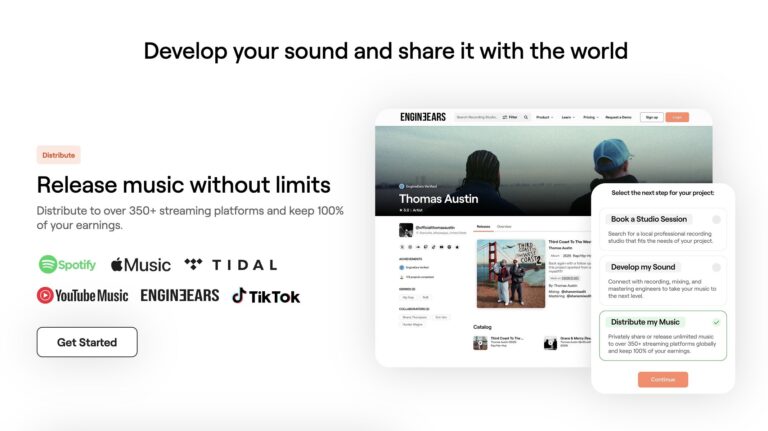
Audio engineer marketplace EngineEars has launched a new distribution service, EngineEars Direct, which enables artists to upload music directly to all major digital service providers through its platform.

The feature is powered by EMPIRE‘s white label distribution platform, Supply Chain.

The new offering marks a significant expansion for EngineEars, which its founder, multiple Grammy-winning audio engineer Derek “MixedByAli” Ali, says represents the company entering “phase two” of its development.

In a video introducing the new feature, EngineEars CEO Derek Ali said that when he launched the company, its “mission was simple: to build the music industry’s first true operating system for music creators”.

EngineEars raised $7.5 million in seed funding in February 2024, led by VC firm Drive Capital, with participation from 645 Ventures, as well as existing investors Slauson & Co. and FLÜS Investment Group (the venture arm of SALxCO).

Other investors in the startup include Kendrick Lamar, EMPIRE founder and CEO Ghazi, Alex da Kid, Roddy Ricch, Mustard, and more.


The platform initially focused on what Ali describes as “phase one” – providing audio engineers and studio owners with tools for instant booking, file sharing, transparent payments, and project management.

EngineEars positions itself as a comprehensive browser-based platform enabling artists to hire engineers, schedule recording sessions, run promotional campaigns via SymphonyOS integration, and now handle music distribution.

EngineEars Direct, accessible through the EngineEars platform, uses Supply Chain’s white label technology to let artists release music to over 350 streaming platforms while retaining 100% of their earnings.

Artists can now “book recording sessions, get your songs mixed and mastered, sell direct to your fans right on your engineer’s profile, and now distribute unlimited releases,” Ali said in the video.

The new distro service includes real-time analytics showing how music performs across platforms, tools to launch advertising campaigns, built-in CRM functionality for managing fan relationships, and detailed “artist playbooks” offering step-by-step guidance on release strategies.

“This is more than a product launch. It’s a continuation of our mission to give music creators the power, control, and transparency they’ve always deserved.”

Derek ‘MixedByAli’ Ali

“Derek and the EngineEars team have built an incredible platform for engineers, artists and consumers to collaborate and promote their music worldwide,” Ghazi Shami told Billboard. “We are happy to provide a robust white label distribution platform in Supply Chain for all creativity to thrive.”

EngineEars enters a competitive independent distribution space dominated by the likes of TuneCore, DistroKid, UnitedMasters, and more, betting that its end-to-end approach, from booking studio time to digital distribution, will appeal to artists seeking a unified workflow within one platform.

“This is more than a product launch. It’s a continuation of our mission to give music creators the power, control, and transparency they’ve always deserved,” Ali said in the video, adding that his team remains committed to “building the tools that make [the] music industry more equitable, connected, and creative first.”

MixedByAli (aka Derek Ali), is a multiple Grammy-winning audio engineer who has worked with Kendrick Lamar, SZA, Killer Mike, Childish Gambino, Nipsey Hussle and others.

EngineEars raised its first $1 million in 2021.Music Business Worldwide

Trump urges Israel’s president to pardon PM Netanyahu in letter

0

David Gritten and

Sebastian Usher,Jerusalem

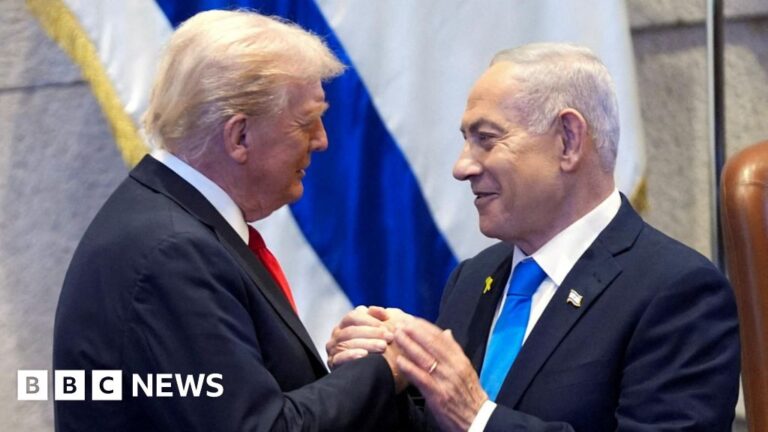
Reuters US President Donald Trump (L) shakes hands with Israeli Prime Minister Benjamin Netanyahu (R) during an address to the Israeli parliament in Jerusalem (13 October 2025)Reuters

Donald Trump has repeatedly asked for a pardon for his close ally Benjamin Netanyahu

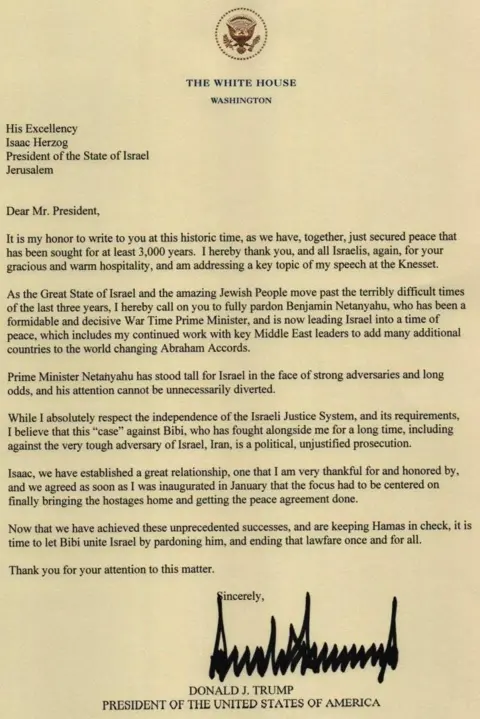
Israel’s President Isaac Herzog has received a letter from US President Donald Trump formally urging him to “fully pardon” Prime Minister Benjamin Netanyahu.

Netanyahu has been standing trial for the past five years on charges of bribery, fraud and breach of trust in connection with three separate cases. He has denied any wrongdoing.

In the letter, Trump writes that he “absolutely” respects the independence of Israel’s justice system, but that he believes Netanyahu is facing “a political, unjustified prosecution”.

Herzog’s office said he held Trump “in the highest regard”, but that anyone seeking a pardon had to submit a formal request.

Netanyahu later thanked Trump for the “incredible support”.

“As usual, you get right to the point and call it like it is,” he wrote on X. “I look forward to continuing our partnership to bolster security and expand peace.”

In 2020, Netanyahu became the first serving Israeli prime minister to stand trial.

In the first case, prosecutors have alleged that he received gifts – mainly cigars and bottles of champagne – from powerful businessmen in exchange for favours.

He is accused in the second case of offering to help improve the circulation of an Israeli newspaper in exchange for positive coverage.

And in the third, prosecutors have alleged that he promoted regulatory decisions favourable to the controlling shareholder of an Israeli telecoms company in exchange for positive coverage by a news website.

Netanyahu has pleaded not guilty to all the charges and branded the trial as a “witch-hunt” by political opponents.

Last month, after helping to broker the ceasefire in Israel’s two-year with Hamas in Gaza, Trump said Herzog should pardon his close ally in a seemingly off-the-cuff remark during a speech to the Israeli parliament.

“Cigars and Champagne, who the hell cares about that?” he asked.

In his letter to the president, Trump writes: “As the Great State of Israel and the amazing Jewish People move past the terribly difficult times of the last three years, I hereby call on you to fully pardon Benjamin Netanyahu, who has been a formidable and decisive War Time Prime Minister, and is now leading Israel into a time of peace.”

He adds: “While I absolutely respect the independence of the Israeli Justice System, and its requirements, I believe that this ‘case’ against Bibi [Netanyahu], who has fought alongside me for a long time, including against the very tough adversary of Israel, Iran, is a political, unjustified prosecution.”

The response from Herzog’s office is diplomatic, saying that he “holds President Trump in the highest regard and continues to express his deep appreciation for President Trump’s unwavering support for Israel”.

It also politely points out that “anyone seeking a Presidential pardon must submit a formal request in accordance with the established procedures”.

According to Israel’s Basic Law, the president “has the power to pardon criminals and reduce or transmute their sentence”.

However, the High Court of Justice has previously ruled that the president could pardon an individual before they are convicted, if it is in the public interest or if there are extreme personal circumstances.

A pardon would also need to be requested by the accused or a close relative.

There has been no public indication of this so far, although there is speculation in the Israeli media that this could happen.

Israel GPO Letter from US President Donald Trump to Israel's President Isaac HerzogIsrael GPO

Israel’s far-right National Security Minister, Itamar Ben-Gvir, urged Herzog to “listen to President Trump”, saying Netanyahu’s trial had “become an indictment against the prosecution itself, whose carelessness and crimes are revealed in court every day”.

However, Israel’s opposition leader and former prime minister, Yair Lapid, wrote on X: “Reminder: Israeli law stipulates that the first condition for receiving a pardon is an admission of guilt and an expression of remorse.”

He later told Israel’s parliament: “There comes a moment when people must tell themselves… we must also say ‘no’ to an American president. We are a sovereign country; there’s a limit to interference.”

For Netanyahu’s right-wing Likud party and his supporters, a pardon has long been sought since his trial began.

But for many in Israel – especially on the left – it would be seen as another move away from the country’s sense of itself as a robust democracy with a strong legal system.

It was fears that this was under attack with the government’s plans for judicial reforms that brought hundreds of thousands out onto the streets in protest for many months before the Hamas-led attacks of 7 October 2023 that triggered the Gaza war.

Challenging Client

0


Client Challenge


JavaScript is disabled in your browser.

Please enable JavaScript to proceed.

A required part of this site couldn’t load. This may be due to a browser
extension, network issues, or browser settings. Please check your
connection, disable any ad blockers, or try using a different browser.

Doncic and Reaves Prepared for Thunder Challenge

0

Healthy Backcourt Ready for a Challenge


The Los Angeles Lakers continue to adjust to life without LeBron James, but Luka Doncic and Austin Reaves are showing why their backcourt can still dominate. When healthy, the two form one of the league’s most effective guard duos.

They’ll have another chance to prove it Wednesday as the Lakers face the defending NBA champion Oklahoma City Thunder on the road. Both players are finally healthy after Reaves returned from a groin injury that sidelined him for three games.

“I was pushing him to get back,” Doncic said. “I needed him back. … He’s an amazing player.”

Strong Chemistry Leads to Wins


The chemistry between Doncic and Reaves has already translated into success. The duo combined for 62 points and 14 assists in Monday’s 121-111 win over Charlotte. Reaves struggled from deep, hitting just two of ten three-point attempts, but he impacted the game with his passing and defense.

The Lakers are 4-1 this season when both guards are available. Head coach JJ Redick praised Reaves’ value to the lineup.

“He’s an All-Star level player,” Redick said. “He’s, along with Luka, an incredibly dynamic offensive player. I think our depth increases, the lineup optionality increases, so not having him really hurts us.”

Without LeBron: Doncic and Reaves Ready for Thunder TestWithout LeBron: Doncic and Reaves Ready for Thunder Test

Facing the League’s Toughest Defense


The matchup against Oklahoma City will test the Lakers’ offense. Los Angeles leads the league in field goal percentage at 51.2%, but the Thunder are holding opponents to a league-low 42.1%.

Thunder rookie big man Chet Holmgren continues to impress after a perfect 9-for-9 shooting night with 23 points and 11 rebounds in Tuesday’s win over Golden State.

“It takes time to learn the speed of closeouts and spacing,” Thunder coach Mark Daigneault said. “All that has grown for him over time. … All he cares about is getting better.”

Holmgren and MVP Shai Gilgeous-Alexander both sat the fourth quarter Tuesday as Oklahoma City cruised to victory.

A Statement Game Ahead


The Thunder have won 11 of their first 12 games. Lakers forward Rui Hachimura knows what’s at stake. “They’re the No. 1 team right now,” he said. “So we got to be ready for war on Wednesday.”