

3.5 C
New York
Thursday, February 19, 2026
Home Blog Page 219

PA cautions against ‘forces causing displacement’ in Gaza following South Africa flight | Israel-Palestine conflict updates

0

Palestinians, especially those in the Gaza Strip, must be wary of networks that seek to remove them from their homes in line with Israeli interests, the Palestinian Authority’s Ministry of Foreign Affairs has warned.

The warning came a day after 153 Palestinians, who left Gaza without knowing their final destination and without proper paperwork, arrived in South Africa on board a flight from Kenya on Friday and were held up for 12 hours as authorities investigated the issue.

Recommended Stories

list of 4 itemsend of list

South Africa, which is advancing a genocide case against Israel at the International Court of Justice (ICJ), gave the war-ravaged Palestinians 90-day visas.

The Palestinian ministry on Saturday expressed “deep appreciation” for the support from the South African authorities and people, as well as the decision to grant temporary visas for the people who it said departed from Ramon airport in southern Israel.

The Palestinian embassy in Pretoria said it is working to assist the travellers who have “endured over two years of Israeli genocidal war, killing, displacement, and destruction”.

But it warned that companies, unofficial entities and unregistered intermediaries inside Israeli-occupied Palestinian territory are trying to mislead Palestinians and incite them towards leaving.

“The ministry calls upon our people, especially our people in the Gaza Strip, to exercise caution and not fall prey to human trafficking, to merchants and companies of blood, and to agents of displacement,” it said.

According to South Africa’s Border Management Authority, 130 Palestinians ended up entering the country, while 23 were transferred from South Africa to other destinations from the airport itself. Most are expected to apply for asylum.

A South African humanitarian aid organisation, Gift of the Givers, said it was committed to accommodating the visitors during their stay.

Charity founder Imtiaz Sooliman told public broadcaster SABC that he did not know who had chartered the aircraft, and that the first plane carrying 176 Palestinians had landed in Johannesburg on October 28, with some of the passengers departing for other countries.

He said accounts from the Palestinian arrivals indicate that Israel appears to be removing people from Gaza and putting them on a plane without stamping their passports, in order to leave them stranded in third countries.

The Israeli Ministry of Foreign Affairs and Prime Minister Benjamin Netanyahu’s office have not reacted to the incident, but Israel and the United States have repeatedly pushed to move as many Palestinians out of Gaza as possible, holding negotiations with many countries over this.

The Coordinator of Government Activities in the Territories (COGAT), the Israeli military organisation in charge of the Gaza border crossings, was quoted as saying by Israeli media that it received approval from a third country to receive the Palestinians as part of an Israeli government policy allowing Gaza residents to leave. The third country was not named.

After facing nonstop bombing and famine in Gaza, the Palestinians were told to leave behind all their belongings and hop on a flight to an unknown destination.

Antony Loewenstein, author of The Palestine Laboratory, a book about Israel’s arms and surveillance industry, said the transit scheme could have been operating weeks or months before being noticed.

He told Al Jazeera from Indonesia’s capital Jakarta that there have been rumours about companies making such flights, which apparently “requires Israeli permission as well as other countries’ permissions”.

“This is the concept of people making money out of other people’s misery,” he said, also pointing to the murky operations and website of the company that ran the scheme.

“I see it as a form of ethnic cleansing,” Loewenstein said. “The issue is people providing [the transit] and the Israeli state facilitating it, a state where many ministers in the Israeli government, and frankly the Israeli public, want no Palestinians left in Gaza, and I fear this is part of that mission.”


Napco Security Stock Skyrockets 63% Following InvestingPro’s Undervalued Recommendation

0


Napco Security stock soars 63% after InvestingPro’s undervalued call

Proposed Trade Could See Hornets Acquire Mavericks’ 2027 Draft Pick

0

Quinn’s Proposal Centers on Value Over Draft Position

A recent mock trade from Sam Quinn sparked discussion around the Charlotte Hornets’ future assets. In his scenario, Charlotte sends Collin Sexton and the 2027 first-round pick originally owned by the Dallas Mavericks back to Dallas. In exchange, the Hornets receive Max Christie and Daniel Gafford. Quinn views the return as a strong blend of youth, affordability, and immediate rotation help.

He explained the logic by noting that “Max Christie and Daniel Gafford are both solid, affordable role players.” He also argued that each could fetch a late first-round pick on the trade market. With that in mind, he questioned the value of holding multiple underwhelming selections instead of securing players who already fit Charlotte’s needs.

Daniel Gafford MCL sprain

Why Charlotte Might Consider the Deal

Quinn believes Charlotte may prefer the players over a mid-to-late first-rounder. “Would the Hornets rather have, say, the 17th pick in 2027, or two good, affordable, and relatively young role players who fit them quite well?” he asked. He sees Gafford’s rim threat as an ideal complement to LaMelo Ball and views Christie as a needed point-of-attack defender.

Christie’s on-ball defense and growing offensive comfort make him an interesting target for a team trying to build a stronger guard and wing rotation. Gafford brings vertical spacing and rim protection, though Charlotte already has depth at center.

Why Dallas Might Say Yes

From the Mavericks’ standpoint, the logic is different but clear. Dallas has leaned on Cooper Flagg at point guard early in his rookie season, and that experiment has been rocky. Quinn wrote that they “can’t keep trying Cooper Flagg at point guard,” making Collin Sexton a natural fit. Sexton’s ability to create advantages and handle primary ball-handling duties could stabilize Dallas’ offense and help Flagg develop.

Taking back their 2027 pick also gives the Mavericks flexibility. If they control their own draft position, they can ease the pressure to chase wins and focus on long-term growth.

Why the Hornets May Decline

The idea is intriguing, but Charlotte may hesitate. Gafford does not have a clear role with Ryan Kalkbrenner viewed as the future at center. Moussa Diabate has also been dependable off the bench. Christie would help, but not enough to justify giving up Sexton and a first-round pick.

To make the deal worthwhile, Charlotte would likely need extra compensation, possibly in the form of second-round picks. As constructed, the trade seems unlikely to materialize.

Ancient Civilization Views Transformed by Early Maya Site Discovery

0

For a long time, archaeologists believed that large buildings required large bosses. The idea was simple: only societies with strong hierarchies (kings, priests, and planners) could organize massive construction projects.

But recent discoveries in the Maya region are rewriting that script. Archaeologists previously pictured early Maya life as simple and small-scale: people making pottery, living in scattered villages from 1000 to 700 BCE. They thought big cities developed much later.

But that old story began to crack when archaeologists uncovered massive early structures at sites such as Ceibal, Cival, Yaxnohcah, and Xocnaceh. However, it was a site called Aguada Fénix, with a giant man-made monument from over 3,000 years ago, that truly shook things up. Suddenly, experts were rethinking the origins of early Mesoamerican civilizations.

Unlike the Olmec centers of San Lorenzo and La Venta, early Maya sites show no signs of top-down power. Yet people still came together to build big. Why?

Their story sparks fresh thinking on how modern societies might organize large-scale efforts, without deep divides or towering hierarchies.

A new study published in the journal Science Advances, by an international team led by a University of Arizona archaeologist, is suggesting Aguada Fénix wasn’t just a giant platform; it was a cosmic map. By studying how Aguada Fénix was built and used, researchers uncovered strong evidence that it was designed as a cosmogram, a symbolic map of the universe.

That means it wasn’t just ancient; it may have been one of the most spiritually important places in the entire Maya world.

Inomata and his colleagues first found clues of Aguada Fénix in 2017 using lidar, or light detection and ranging, which uses lasers from an airplane flown overhead to scan through jungle and forest to create 3D maps of humanmade structures.

Takeshi Inomata/University of Arizona

In 2020, archaeologists made an amazing discovery in Tabasco, Mexico. They found Aguada Fénix, a giant Maya platform nearly a mile long that dates back to 1000 BCE. It is now seen as the largest known monument in the Maya world. The story didn’t end there though. In the following years, researchers uncovered nearly 500 smaller, similar sites across southeastern Mexico.

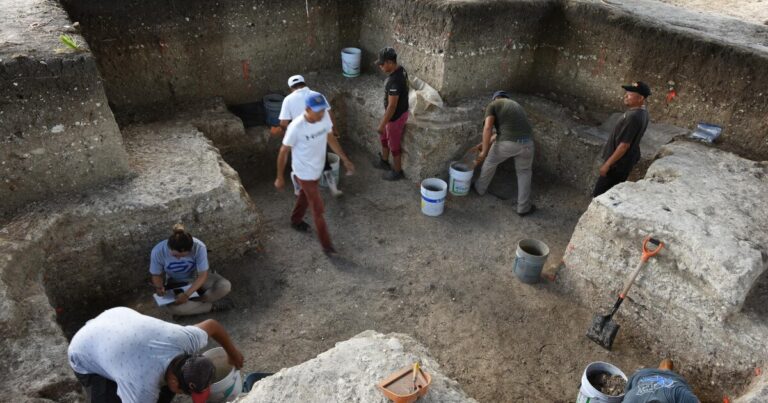
In a recent dig at Aguada Fénix, archaeologists uncovered a cruciform pit. This cross-shaped cavity was filled with ceremonial treasures. These artifacts provide rare and powerful insights into the sacred rituals of the early Maya.

To determine the age of the cruciform pit, researchers used radiocarbon dating and ceramic fragments. Their first big find? Ceremonial jade axes.

The team excavated jade axes and ornaments that were likely left later, in return trips to the site, after builders made offerings to the cruciform cache and filled it in.

Takeshi Inomata/University of Arizona

“That told us that this was really an important ritual place,” explained Takeshi Inomata, Regents Professor of anthropology .

Digging deeper into the cruciform pit, archaeologists uncovered jade carvings, a crocodile, a bird, and possibly a woman in childbirth, echoes of myth and life. At the very bottom lay a smaller cross-shaped chamber, where colored soils – blue, green, and yellow – were carefully placed to match the four cardinal directions.

A jade artifact found in the cruciform likely represents a woman giving birth, researchers said.

Takeshi Inomata/University of Arizona

“We’ve known that there are specific colors associated with specific directions, and that’s important for all Mesoamerican people, even the Native American people in North America,” Inomata stressed. “But we never had actual pigment placed in this way. This is the first case that we’ve found those pigments associated with each specific direction. So that was very exciting.”

Researchers think early Maya builders placed colored pigments and sacred items as offerings. They buried these offerings under layers of sand and soil with care. Radiocarbon dating indicates this ritual took place between 900 and 845 BCE. Later generations probably came back and added jade objects to honor the past and renew the sacred bond.

Mineral pigments in the cruciform cache were arranged to correspond with cardinal directions, according to recorded rituals: Blue azurite to the north, green malachite to the east and yellow ochre with geothite to the south. The western side of the cache included soil and likely other material that began as red and faded over time.

Takeshi Inomata/University of Arizona

Inomata suggests these recent findings challenge current archaeological ideas around how certain cultures expanded over time.

“The study is further evidence opposing the long-held belief that Mesoamerican cultures grew gradually, building increasingly larger settlements, such as Tikal in Guatemala and Teotihuacan in central Mexico, whose pyramid monuments are icons for Mesoamerica today,” he explains. “Aguada Fénix predates the heydays of those cities by nearly a thousand years – and is as large or larger than all of them.”

In 2017, Inomata’s team first spotted clues of Aguada Fénix using lidar. Later, researchers saw that the monument’s center line points to the sunrise on October 17 and February 24. These two dates are 130 days apart, half of the 260-day sacred calendar used in ancient Mesoamerican rituals. It seems as if the builders carved a cosmic calendar into the land itself, aligning their world with the rhythms of the sky.

“This arrangement is similar to other Maya sites that also had ceremonial caches, hinting that they might find something similar at Aguada Fénix, on what is now rural ranchland in eastern Tabasco,” says Inomata.

The new investigation also revealed raised causeways, sunken corridors, and water canals that stretched up to six miles (9.7 km), guiding people and water alike. All of it mirrored the monument’s solar orientation, blending movement, ritual, and cosmic design into the landscape.

University of Arizona archaeologist Takeshi Inomata (left) and archaeologist Melina Garcia excavate a cache of ceremonial artifacts that include mineral pigments associated with cardinal directions.

Atasta Flores

Unlike Tikal in Guatemala, where kings ruled with grandeur, Aguada Fénix shows no signs of royal command. Instead, Inomata suggests its leaders were thinkers: astronomers and planners who shaped the site with cosmic insight, not political power.

And these findings have clear implications for how modern society can evolve.

“People have this idea that certain things happened in the past – that there were kings, and kings built the pyramids, and so in modern times, you need powerful people to achieve big things,” Inomata said. “But once you see the actual data from the past, it was not like that. So, we don’t need really big social inequality to achieve important things.”

Aguada Fénix shows what people can build together. Its sheer scale is stunning, especially for a region with few earlier monuments. Some builders may have been seasonal visitors, returning for rituals and processions. Yet even this grand design had limits: the northern corridors, carved through wetlands, likely flooded during rainy months. Still, the site stands as a powerful reminder of what shared purpose can achieve.

Olmec sculptures often glorified rulers and gods. But at Aguada Fénix, the art tells a different story, carvings of animals and a woman, grounded in everyday life. These humble symbols suggest that massive monuments and waterworks weren’t just elite visions; they were community creations.

Xanti S. Ceballos Pesina, a Ph.D. candidate in the School of Anthropology and a co-author on the study, helped excavate a smaller complex within Aguada Fénix.

Takeshi Inomata/University of Arizona

Study co-author Xanti S. Ceballos Pesina said she was blown away at how extensive Aguada Fénix is, and surprised at how it eluded researchers for so long.

“I think it’s very cool that new technologies are helping to discover these new types of architectural arrangements,” she said. “And when you see it on the map, it’s very impressive that in the Middle Preclassic Period, people with no centralized organization or power were coming together to perform rituals and to build this massive construction.”

The new study was published in the journal Science Advances

Source: University of Arizona

Tensions Rise Between China and Japan Over Taiwan: What You Need to Know

0

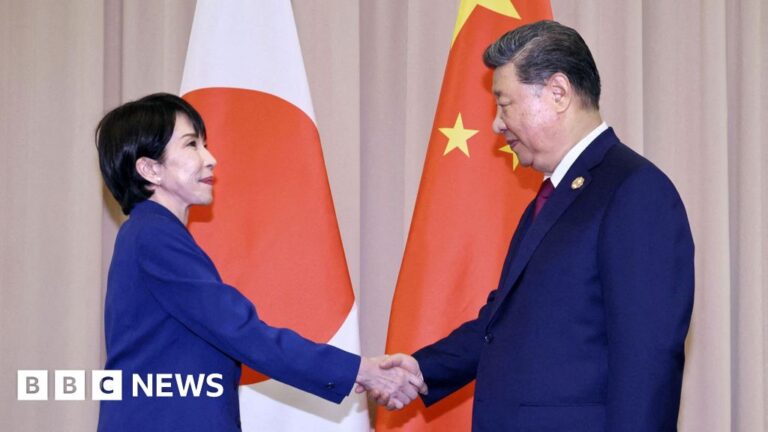
Kyodo via Reuters Japanese prime minister Sanae Takaichi (left) shakes hands with Chinese President Xi Jinping in front of the Japanese and Chinese flags in South Korea on 31 October.Kyodo via Reuters

Japanese prime minister Sanae Takaichi (left) met with Chinese President Xi Jinping in South Korea on 31 October

China has urged its citizens not to travel to Japan and summoned the country’s ambassador in Beijing over Prime Minister Sanae Takaichi’s comments on Taiwan.

China and Japan have been locked in an escalating war of words this week, set off by Takaichi’s suggestion that Japan could respond with its own self-defence force if China attacked Taiwan.

Both countries’ foreign ministries have lodged serious protests with each other. A Chinese diplomat also made a comment which some interpreted as a threat to behead Takaichi.

The spat touches on the historical animosity between China and Japan, as well as longstanding “strategic ambiguity” on the sovereignty of self-governed Taiwan.

Here’s what else you need to know about it:

What happened? A timeline

The current tensions were sparked at a parliamentary meeting in Japan last Friday, when an opposition lawmaker asked Takaichi what circumstances surrounding Taiwan would count as a survival-threatening situation for Japan.

“If there are battleships and the use of force, no matter how you think about it, it could constitute a survival-threatening situation,” Takaichi responded.

A “survival-threatening situation” is a legal term under Japan’s 2015 security law, referring to when an armed attack on its allies poses an existential threat to Japan. In such a situation, Japan’s self-defence forces can be activated to respond to the threat.

Takaichi’s remarks drew immediate ire from Beijing, with China’s foreign ministry describing them as “egregious”.

Last Saturday, Xue Jian, China’s consul general in the Japanese city of Osaka, reshared a news article about Takaichi’s parliamentary remarks on X. But he also added his own comment that “the dirty head that sticks itself in must be cut off”.

While the intent of Xue’s remarks “may not be clear”, they were “highly inappropriate”, Japan’s chief cabinet secretary Minoru Kihara told reporters on Monday.

Tokyo lodged protests with China over Xue’s remarks, while Beijing lodged its own with Japan over Takaichi’s.

Xue’s post has since been taken down – but the dust from the barbed exchanges hasn’t settled yet.

On Tuesday, Takaichi declined to retract her remarks, which she defended as “consistent with the government’s traditional position”. She did note, however, that she would be careful about commenting on specific scenarios from now on.

Then on Thursday, China’s foreign ministry posted in Japanese and English on its X account, warning Japan to “stop playing with fire” and added that it would be an “act of aggression” if Japan “dares to meddles in the cross-Strait situation”.

Chinese Vice Foreign Minister Sun Weidong also summoned the Japanese ambassador to China that same day to express their unhappiness.

Sun called Takaichi’s remarks “extremely wrong and dangerous” and demanded that Japan withdraw the comments, according to state media Xinhua. He also warned that “otherwise all consequences must be borne by Japan”.

Japan’s ambassador explained that their position on Taiwan “has not changed” and refuted Beijing’s remarks, Chief Cabinet Secretary Minoru Kihara told reporters on Friday.

“It is the consistent position of the Japanese government that we hope for a peaceful resolution of issues surrounding Taiwan through dialogue,” he said during the daily news briefing.

Kihara also added that Japan “strongly urged China to take appropriate action” over Xue’s social media comment.

Then on Friday night, the Chinese embassy in Japan published a statement urging citizens “to avoid traveling to Japan in the near future” over what it called “blatantly provocative remarks regarding Taiwan”.

A long history of animosity

There is longstanding animosity between the two countries, which can be traced back to a series of armed conflicts in the 1800s and Japan’s brutal military campaign in China during World War Two.

This was referenced in a statement released by China’s Ministry of Foreign Affairs on Thursday when it said that “should Japan fail to draw lessons from history and dare to take reckless risks, even resorting to military intervention in the Taiwan Strait situation, it will inevitably suffer heavy losses and pay a bitter price in the face of the iron wall of the Chinese People’s Liberation Army”.

Historical grievances have remained sore spots in bilateral relations ever since. But the recent ascension of Takaichi, a protégé of the late former prime minister Shinzo Abe, suggests more tensions may lie ahead.

The conservative leader is pursuing closer ties with the US and has pledged to increase Japan’s defence spending – raising some alarm in Beijing.

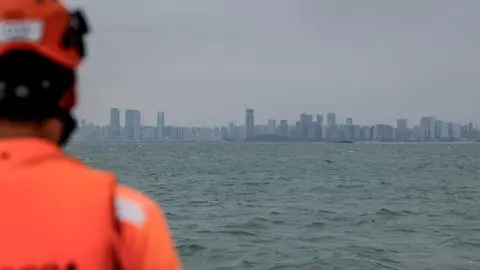
Getty Images A Taiwanese coast guard in orange attire looks out to sea. In the distance is the a city skyline.Getty Images

The US and Japan have been deliberately ambiguous on how they would respond, should China invade Taiwan

Takaichi is also famously hawkish on China and a longtime supporter of Taiwan.

She had previously said that a blockade of the island could threaten Japan, and that Japan could mobilise its troops to stop a Chinese invasion.

China is especially touchy about Taiwan, the self-governed island that Beijing claims as part of its territory. China has not ruled out the use of force to take Taiwan – a posture that has unsettled Taipei and its allies in the region.

Earlier this month, Beijing accused Takaichi of violating the one-China principle, after she posted photos of herself meeting a senior Taiwanese official on the sidelines of the Apec summit in South Korea.

Why Takaichi’s recent comments caused such a stir

The Japanese prime minister’s recent comments mark a departure from the equivocal position that the country has traditionally adopted on the status of Taiwan.

This is in line with the policy of “strategic ambiguity” that the US has long maintained: remaining vague about what it would do to defend Taiwan in the event of a Chinese invasion.

For decades, this ambiguity has kept China guessing – a form of deterrence – while leaving room for economic ties to flourish.

The Japanese government’s official stance is that it hopes the Taiwan issue can be resolved peacefully through dialogue – and Japanese officials have typically avoided mentioning Taiwan in public discussions about security.

On the occasions where they have, they have been met with sharp rebuke from Beijing.

In 2021, when then deputy prime minister Taro Aso said that Japan would need to defend Taiwan alongside the US in the event of an invasion, Beijing condemned his remarks and told Japan to “correct its mistakes”.

In this more recent flare-up, China’s foreign ministry said that Takaichi’s remarks were “a gross interference in China’s internal affairs”.

“Taiwan is China’s Taiwan,” ministry spokesperson Lin Jian told a press briefing on Monday, adding that China would not “tolerate any foreign interference” on the matter.

“What signal is the Japanese leader trying to send to ‘Taiwan independence’ separatist forces?” he added. “Is Japan up to challenge China’s core interests and stop its reunification?”

Get to know the 73-year-old man who divides his time between Panama and the U.S. and lives on just $500 a month, including food expenses.

0

With so many Americans burnt out from U.S. hustle culture and high living costs, expats are finding that Panama is a solution for their long-awaited golden years.

Alan Wells, 73, counts himself among the Americans who’ve looked abroad for a simpler, more affordable retirement.

Wells, retired for 14 years, took up a permanent residence in Boquete, Panama, in 2015. In 2016, he bought what he described as a modest 900-square-foot house in a neighborhood about 30 miles from the Costa Rican border. After purchasing it for around $100,000, he immediately doubled the home’s size to around 2,000 square feet. 

“It’s probably worth a couple of hundred thousand dollars today,” he said. 

As many retirees debate moving abroad, Wells shared his perspective with Fortune on how the experience overseas has been for him. 

Why make the move?

Growing up in Cincinnati, Ohio, Wells had never been to a foreign country before his move to Panama, but said his experience was magical when he moved. 

His daughters’ weddings in Panama introduced him to the community, and after meeting a widow at one of the receptions, Wells began considering a move to Central America as a single retiree.

“They [my daughters] decided they preferred the U.S. to Panama; I decided I prefer Panama to the U.S. So we switched,” Wells said. “I tell them, ‘Thank you for your welfare contributions to my Social Security fund so that I can live down there.’” 

Throughout his career, Wells spent most of his time in Memphis, Tennessee, at FedEx. After moving to Panama, Wells used to spend just a week each year in Louisville, Kentucky.

But life changes—such as COVID and grandkids—turned him into a snowbird. Today, he commutes between Louisville and Boquete twice a year, spending six to nine months in Panama a year now.

Courtesy of Alan Wells

Can you afford more in Panama than in the U.S.?

That depends on the particular the part of the U.S., he said. Panama is not a great deal different spending-wise compared to Louisville. However, he said if he lived in a bigger city, such as Miami or Los Angeles, it would be different. 

Housing in Louisville is about 20% cheaper than the U.S. average, where the typical household spends $61,334 a year and roughly $1,784 a month on housing. In L.A., the cost of living is about 49% higher than the national average.

Wells said he has friends who moved to Panama from L.A. because they couldn’t afford to live there anymore, and a now living “very nicely.”

“I can afford a great deal more in Panama than I can in the U.S., but I do maintain residences in both countries,” he explained, adding that, “$500 is my cost of living, plus food, in Panama.”

The rest of his expenses in Panama are as follows:

Home insurance: $300 per year 

Car: $250 per year 

Electric bill: $40 a month 

Trash and water: $11 a month 

Internet: $70 a month (includes cable)

One important factor in his expenses in Panama is that Wells does not pay for heat or air conditioning, because “the climate is perfect.” 

Meanwhile, his U.S. expenses are three to four times higher. Annually, he pays roughly $1,000 for homeowners insurance, $1,500 in property taxes, and about $1,000 for car insurance.

How long did the process take to become a permanent resident? 

Wells said the process in total took him about seven to eight months to complete (including paperwork, background checks, income verification, and flights to Panama City for the final government appointments). 

Especially for those retiring, recent shifts in visa rules, tax policies, and local costs mean the process is more complex than you’d think, experts say. 

In order to get a residency in Panama, Wells said you have to demonstrate a minimum income of $1,000 a month. His income is split evenly between Social Security payments, investment returns, and required minimum IRA distributions. 

How did you spend your days when you moved compared to now? 

The first few years in Panama, Wells spent most of his time exploring the mountains of the country. Today, he goes to the gym, and links his computer systems (as an IT guy) from Kentucky to Panama.  

The culture in Panama reminds him of his Southern lifestyle back home. 

“Panama’s the size of Tennessee, so in the first few years you travel a lot there’s a lot to see,” he said. “It’s a very small, very narrow country, but you go from plains to mountains to coastline, it’s awesome.”

In fact, he can reach the Pacific Ocean in about an hour and the Caribbean in about three.

How do you prepare for language barriers and medical care?

Wells said medical care is cheap and sufficient for certain things, but “good and cheap is not really a thing.” 

“If something serious happened, my kids would put me on an airplane and take me back to the States,” he added.

For the language barrier, Wells said he is disappointed he hasn’t learned as much Spanish as he hoped, but “any educated Panamanian learns English as a mandatory second language, and most adults I meet speak some English.”

A successful retirement or move overseas requires careful planning, thorough research, and flexibility to navigate evolving financial, legal, and lifestyle challenges. Wells’ advice: “Don’t jump in. You really want to take a couple of sample trips before you make any decisions.”

“People come down here, take a tour, buy a house, and then realize they’re 4,200 feet up a mountain and freezing every night,” he said. 

“We stayed in a little casita just to see how things were and to look around at the real estate to find something we could actually live in.”

UN renews peacekeeping mission in contested Abyei region for one more year | Updates on Border Disputes

0

The UN Security Council says further extensions would hinge on real progress between Sudan and South Sudan.

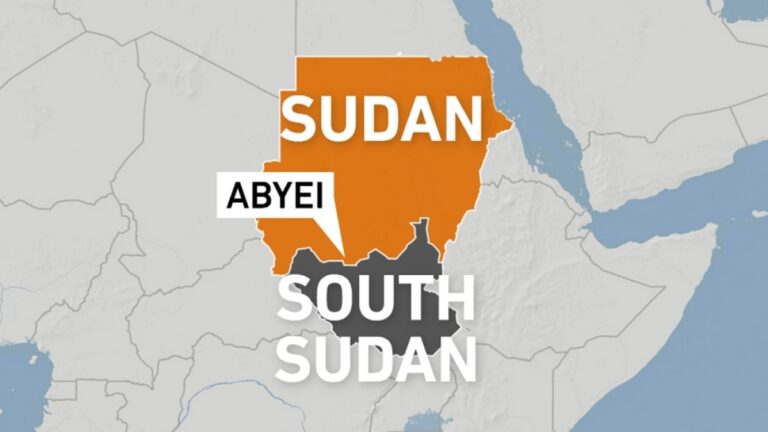
The United Nations Security Council has voted to renew a UN Interim Security Force for Abyei (UNISFA), the peacekeeping mission in the oil-rich disputed region between Sudan and South Sudan, for another year.

A 12-0 vote late on Friday, which saw Russia, China and Pakistan abstain, extended the mission until November 2026, but warned that progress on ending bloody fighting in the region would be crucial to any potential future extensions.

Recommended Stories

list of 4 itemsend of list

The United States submitted the draft resolution that renewed the mandate, which was due to expire on November 15, and said it “negotiated this draft in good faith, asking only for reasonable and common-sense benchmarks for this mission”.

Friday’s resolution stated that further renewal would be based on “demonstrable progress” by Sudan and South Sudan, including the creation of a joint police force for Abyei and the complete demilitarisation of the region, as agreed upon by the two sides in 2011 when South Sudan gained independence.

The 4,000 police and soldiers of UNISFA are tasked with protecting civilians in the region plagued by frequent armed clashes.

UN Secretary-General Antonio Guterres is now tasked with presenting a report by August 2026 on whether Sudan and South Sudan have made any tangible progress, which would also enable the Security Council to assess the consequences of reducing the peacekeeping force.

“These benchmarks will help describe the mission’s impact and provide a critical tool to hold host governments accountable for measurable progress,” said US representative Dorothy Shea.

UNISFA is a small but politically sensitive mission, operating in a region where clashes have displaced thousands and humanitarian access has often been constrained by a lack of security and dangerous road conditions.

Unrest in the disputed area with South Sudan also continues at a time when Sudan is devastated by a civil war that erupted in April 2023, when two generals started fighting over control of the country.

Sudan’s paramilitary Rapid Support Forces (RSF), which have been committing atrocities in Darfur and other regions, have also been active in Abyei.

Kabiru Bello, Warner Music’s Head of A&R for EMEA, announces departure from company

0

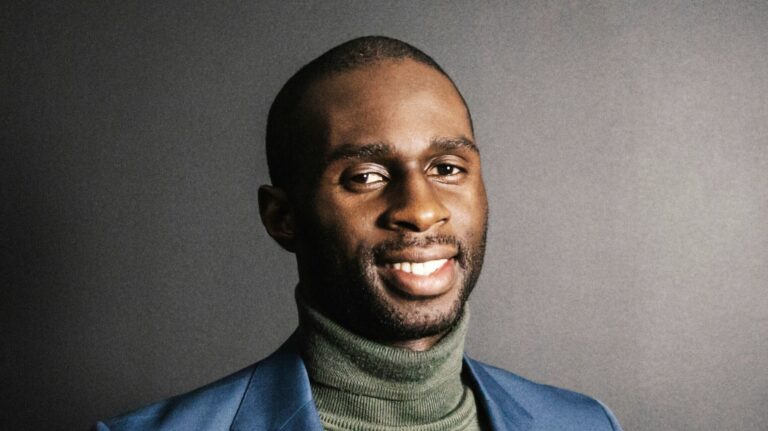
Kabiru Bello, Head of A&R, EMEA at Warner Music, is leaving the music company.

The exec confirmed the news in an internal note sent out on Friday (November 14) and obtained by MBW.

“After eight amazing years at Warner Music, I’ve decided to move on,” the note reads.

He added: “It’s truly been a journey from Sweden to the world with you all, and I just want to take a moment to thank every single one of you who’s been part of it along the way. The support, energy, and trust I’ve received throughout the years have meant more than words can express.”

The Stockholm-based exec, known as Bello, has worked at Warner Music Group since 2017, when he joined the A&R team at Warner Music Sweden.

In 2018, he launched Asylum in the Nordics, where he signed 1.Cuz, A36, Aden & Jireel, Black Moose, Casper The Ghost, Cherrie, K27, Leslie Tay, and Ricky Rich.

In 2022, he was promoted to VP of Global A&R, Warner Recorded Music, and Head of Asylum Records Nordics. He was most recently the Head of A&R, EMEA, Warner Music.

“From starting with an entrepreneurial mindset and the freedom to build Asylum Nordics into one of the most influential labels in the region, achieving massive success together, to stepping into the VP Global A&R and Head A&R International (EMEA) role, it’s been an incredible ride,” added Bello in the note.

“Bello has been nothing short of an A&R powerhouse for Warner Music.”

Simon Robson, WMG

A separate internal note was also sent out to Warner Music staffers by Simon Robson, President, EMEA, Recorded Music, on Friday.

In the note, also obtained by MBW, Robson said: “As you’ll have just heard, our friend and colleague Bello is set to take on his next adventure after eight years of truly impactful service to our artists around the world.”

Added Robson: “Bello has been nothing short of an A&R powerhouse for Warner Music. What’s defined his approach is the alchemy he consistently fostered: his unique ability to strategically partner artists from disparate backgrounds and cultures, helping them find organic connections, and create memorable music. He has truly raised the benchmark for cross-cultural collaborations in our industry.

“We’ll be genuinely sad to see him go, but I know you’ll join me in wishing Bello all the best as he writes his next chapter.”

Originally an artist, in 2008, Bello launched 20/20 Records, a Stockholm-based music company encompassing a record label, music publisher, and management division.

“I want to thank everyone for their support along the way, and Simon Robson and the rest of Warner Music’s leadership for always allowing room for entrepreneurship and independence. Having that open field to create and grow has been invaluable, and I’ll always be grateful for that trust.”

Kabiru Bello

Elsewhere in his note on Friday, Bello wrote: “My curiosity for different cultures, communities, and sounds has always guided me, and this role gave me the chance to turn that curiosity into something real, connecting artists, producers, songwriters, and teams across markets and shaping a truly global A&R community.

“In today’s landscape, the most powerful position is where music, technology, and human connection meet so working alongside our A&R teams, artists and managers all over the world has been one of my greatest privileges. You’ve inspired me every day with your openness, creativity, and work ethic.

“Together, we’ve built bridges between markets, championed collaborations that no one thought possible, and created something that feels different — a global culture where collaboration and culture drives everything we do.”

He added: “Even through moments of change, we’ve stayed united, creating a strong A&R culture built on respect for our artist, fans, and community. That spirit is what sets us apart. My hope is that you continue to carry that same energy forward, to keep being bold, curious, and collaborative, and to keep building local and global superstars with intention and heart.

“I want to thank everyone for their support along the way, and Simon Robson and the rest of Warner Music’s leadership for always allowing room for entrepreneurship and independence. Having that open field to create and grow has been invaluable, and I’ll always be grateful for that trust.”

 Music Business Worldwide

Trump takes aim at longtime MAGA supporter Marjorie Taylor Greene

0

President Donald Trump has withdrawn all support for Republican Congresswoman Marjorie Taylor Greene, a firebrand conservative who long supported Trump’s agenda but recently criticised several of his policies.

Trump said in a nearly 300-word social media post that the Georgia lawmaker had gone “far left”, and called for her to be unseated in next year’s midterm election by a Republican challenger.

The falling out comes after Greene questioned whether Trump was still putting “America First” on his agenda. She criticised his focus on foreign policy and handling of Jeffrey Epstein files.

Greene said Trump was lashing out to try and deter other Republicans from voting to release the files.

“All I see “Wacky” Marjorie do is COMPLAIN, COMPLAIN, COMPLAIN!” Trump posted, while en route to his home in Florida on Friday night.

He claimed that she turned on him after he suggested that she shouldn’t run for governor or senator.

“She has told many people that she is upset that I don’t return her phone calls anymore,” Trump said, adding, “I can’t take a ranting Lunatic’s call every day.”

Trump also said that voters in her district “are fed up with her and her antics and, if the right person runs, they will have my Complete and Unyielding Support”.

Trump has long faced criticised from both parties over his handling of the US Department of Justice’s files related to Epstein, the late financier and convicted paedophile.

Trump was a friend of Epstein’s for years, but the president has said they fell out in the early 2000s, two years before Epstein was first arrested. Trump has consistently denied any wrongdoing in relation to Epstein.

Greene is one of four House Republicans – including Nancy Mace, Lauren Boebert, and Thomas Massie – who joined Democrats in signing a discharge petition calling for the release of the Epstein files.

In response to Trump, Greene posted on X that Trump was trying to stop other Republicans from voting in favour of the Epstein petition.

“He’s coming after me hard to make an example to scare all the other Republicans before next weeks vote to release the Epstein files,” she posted, adding: “It’s astonishing really how hard he’s fighting to stop the Epstein files from coming out that he actually goes to this level.”

Greene has in recent days been attacking Trump for not doing enough to bring down costs for voters, and for his involvement in foreign conflicts, and tariff policies.

But she has also fiercely criticised his approach to handing the Epstein files.

“I truly just stand with the women, and I think they deserve to be the ones that we’re fighting for,” she told the BBC’s US partner, CBS News, earlier on Friday.

Challenge from Client

0


Client Challenge


JavaScript is disabled in your browser.

Please enable JavaScript to proceed.

A required part of this site couldn’t load. This may be due to a browser
extension, network issues, or browser settings. Please check your
connection, disable any ad blockers, or try using a different browser.