


Indonesia stocks lower at close of trade; IDX Composite Index down 0.53%
IDX Composite Index decreases by 0.53% as Indonesia stocks finish lower at the end of trading.
China’s Leadership Opportunity at G20 in Light of Trump’s Absence | Business and Economy News
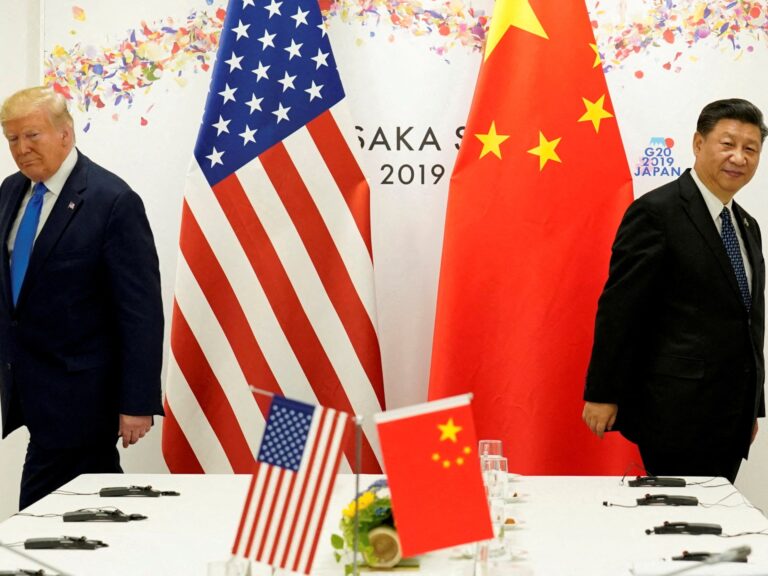
US President Donald Trump’s decision to snub the G20 summit in South Africa this year has handed an opportunity to China, as it seeks to expand its growing influence in the African continent and position itself as an alternative to the dangers of a unilateralist United States.
Washington said it would not attend the two-day summit set to kick off on Saturday over widely discredited claims that the host country, previously ruled by its white minority under an apartheid system until 1994, now mistreats white people.
Recommended Stories
list of 3 itemsend of list
South Africa’s President Cyril Ramaphosa hit back at Trump’s claim that hosting the summit in Johannesburg was a “total disgrace”. “Boycott politics doesn’t work,” Ramaphosa said, adding that the US was “giving up the very important role that they should be playing as the biggest economy in the world”.
By Friday morning, Trump appeared to have backtracked on his stance somewhat, when speculation that Washington might send a US official to Johannesburg after all circulated.
Regardless, the spat comes as Chinese President Xi Jinping sends Premier Li Qiang to represent him on the world stage. China’s 72-year-old president has dialled back foreign visits, increasingly delegating his top emissary.
“The US is giving China an opportunity to expand its global influence,” Zhiqun Zhu, professor of political science and international relations at Bucknell University, told Al Jazeera. “With the absence of the US, China and EU countries will be the focus of the summit and other countries will look for leadership [from them].”
But observers say that while Trump’s absence will direct heightened attention to Beijing’s statements and behaviour, it does not spell the end of the US-led order altogether.
Jing Gu, a political economist at the United Kingdom-based Institute of Development Studies, said the US’s failure to attend “does not automatically make China the new leader, but it creates visible space for China to present itself as a more stable, reliable partner in governance”.
“It reinforces the perception that the US is stepping back from multilateralism and the shared management of global problems,” she said. “In that context, China can present itself as a more predictable, stable actor and emphasise continuity, support for open trade and engagement with the Global South.”
Expanding influence in the African continent
This year’s G20 will, for the first time, have an African chair and take place on the African continent. The African Union (AU) will also participate fully as a member.
South Africa, which holds the G20 presidency, is expected to push for consensus and action on priority issues for African countries, including debt relief, economic growth, climate change and transition to clean energy.
Zhu, who also serves as editor-in-chief of the academic journal, China and the World, said South Africa’s themes were a “natural fit” for China, Africa’s largest trading partner.
“China aims to become a leader in green energy, and there’s a lot of room for China and African countries to work on that,” he said.
The African continent, with its mineral wealth, booming population and fast-growing economies, offers huge potential for Chinese firms. Li, China’s premier, travelled to Zambia this week, marking the first visit to the country by a Chinese premier in 28 years. The copper-rich nation has Beijing as its largest official creditor for $5.7bn.
Eager to secure access to Zambia’s commodities and expand its exports from resource-rich East Africa, China signed a $1.4bn deal in September to rehabilitate the Tazara Railway, built in the 1970s and connecting Tanzania and Zambia, to improve rail-sea transportation in the region.
“The Chinese economy and African economy are complementary; they both benefit from trade,” Zhu said. The G20 “is a great platform for China to project its global influence and seek opportunities to work with other countries”, he added.
Africa’s growing demand for energy and China’s dominance in manufacturing make the two a good fit, observers say. This is playing out. A report by energy think tank Ember, for instance, found Africa’s imports of solar panels from China rose a whopping 60 percent in the 12 months to June 2025.
According to Gu at the Institute of Development Studies, China will be looking to tap into this growing synergy with Africa and will deliver a three-fold message at this year’s G20.
“First, it will stress stability and the importance of global rules and regulations,” she said. Second, “it will link the G20 to the Global South and highlight issues like development and green transformation”.
Third, “by offering issue-based leadership on topics such as digital economy, artificial intelligence and governance, it will position itself as a problem-solver rather than a disruptor”, the economist added.
China as a bastion of multilateralism
An absence of American officials at this year’s G20 – after skipping the Asia-Pacific Economic Cooperation (APEC) meeting in Korea as well as the United Nations Climate Change Conference (COP30) in Brazil – would be “another opportunity for China”, Rosemary Foot, professor of politics and international relations at the University of Oxford, told Al Jazeera.
“It can contrast, yet again, its declared commitment to multilateralism and responsible behaviour as a major state versus the dangers of a unilateralist America focusing not on public goods but on benefits to itself only.”
China has been looking to expand its influence in Africa as a counterweight to the US-led world order. In stark contrast to Trump’s decision to end Africa’s duty-free era and slap 15-30 percent tariffs on 22 nations, Xi announced at the APEC summit last month a zero-tariff policy for all African nations with diplomatic ties to Beijing.
On that occasion, Xi emphasised China’s commitment “to joint development and shared prosperity with all countries”, stressing the country’s goal to “support more developing countries in achieving modernisation and opening up new avenues for global development”.
Similarly, Li, China’s premier, marked the United Nations’ 80th anniversary at the General Assembly in September by expressing the need for stronger collective action on climate change and emerging technologies, calling for greater solidarity to “[lift] everyone up, while division drags all down”.
His remarks were in stark contrast to Trump’s, who, in his speech, described climate change as the “greatest con job ever perpetrated” and called renewable sources of energy a “joke” and “pathetic”.
Foot said the spotlight will now be on Beijing as it seeks to strike a similar conciliatory pose – and in doing so, set itself apart from the US – at the G20. “Whether Beijing will have a major impact on the G20 agenda is more difficult to determine,” she said.
GLP-1s: A Potential Breakthrough as the World Tackles an Increasing Obesity Crisis, Could Become the First True Longevity Drug

GLP-1s are the hottest drugs on the market. While doctors have prescribed these drugs to treat type-2 diabetes for decades, these treatments broke into the public consciousness when they started to be used for weight loss.
U.S. approval of Novo Nordisk’s anti-obesity drug Wegovy and Eli Lilly’s Zepbound has fueled the meteoric growth of both companies.
Now, this lucrative discovery could offer a new benefit to patients: longevity.
“There are signals that GLP-1s could be the first true longevity drug,” Alex Zhavoronkov, the founder and CEO of Insilico Medicine, said Monday at the Fortune Innovation Forum in Kuala Lumpur, Malaysia.
Top scientists from both Novo Nordisk and Eli Lilly have suggested that GLP-1s could have broader effects than just tackling obesity and diabetes. “They found that the regular intake of this drug may reduce the incidence of many age-related diseases, including some CNS (central nervous system) disorders, liver disease, and kidney disease,” Zhavoronkov said.
Global spread
Obesity rates are rising worldwide as emerging markets grow wealthier, leading to greater food consumption and more sedentary lifestyles.
There’s an “obesity pandemic,” said Adele Wong, a dietitian and nutritionist from Nutrition Track, on Monday.
By 2050, over half of adults worldwide will be obese or overweight, predicts a study published in March by The Lancet.
Malaysia in particular is at risk. Just over half of Malaysians are already obese, thanks to a cuisine that relies on oily food, greater access to processed food, and the rise of a more sedentary, car-centric lifestyle as the country gets wealthier.
This costs the country 64 billion Malaysian ringgit ($15.4 billion) a year, due to treatment and care, the economic cost of premature death, and lost productivity, Wong said.
Still, emerging regions like Southeast Asia are slow to pick up GLP-1s. “It’s still in its early stages,” Wong noted. She pointed to a widespread stigma around both obesity and a narrative that weight-loss drugs are “the easy way out.”
“Obesity is a disease, and when you get sick, you do need medication. You do need treatment,” she said.
How GLP-1 drugs work
Technically speaking, treatments like Wegovy aren’t weight loss drugs. Instead, these treatments help obese patients suppress their appetites. Praful Chakkarwar, general manager at Novo Nordisk, says that this helps patients build and sustain healthy habits.
Wong echoed this sentiment. “Food noise…makes it harder for [obese people] to eat their vegetables and get out the door to exercise. But when they’re on these drugs, it’s amazing—they are able to actually do these healthy habits easier,” Wong said. “In my client’s words, it gives them hope.”
Looking to the future, Chakkarwar said the pharmaceutical industry is at the cusp of several GLP-1 related discoveries. Many companies are developing drugs to counteract side effects from GLP-1s, which include muscle loss and macular degeneration—an eye disease that may cause vision loss.
They are also working to make the intake of GLP-1s more convenient, he said, such as creating pills which can be consumed less regularly.
“A lot of these patients have other chronic conditions. They may have diabetes, dyslipidemia, or high blood pressure, so they are on multiple drugs. Some of them might actually be very happy to just take it [GLP-1s] once a week or once a month, rather than taking the tablet on a daily basis,” Chakkarwar said.
Fatima Bosch from Mexico wins pageant after walking out on organisers

Joel Guinto,in Singapore and
Panisa Aemocha,in Bangkok
 Getty Images
Miss Mexico Fatima Bosch has been crowned the new Miss Universe in Thailand on Friday – marking the end of an exceptionally scandal filled pageant season.
The 25-year-old contestant had earlier in November walked out of a pageant event after an official publicly berated her in front of dozens of contestants and threatened to disqualify those who supported her.
A week after, two judges resigned, with one of them accusing organisers of rigging the competition.
Miss Universe, founded in the US, is one of the longest-running beauty pageants on the planet. The recent controversies, analysts say, underscore the cultural and strategic differences between the pageant’s Thai and Mexican owners.
The pageant saw Thailand’s Praveenar Singh place second while the rest of the top five included Venezuela, the Philippines and Cote d’Ivoire.
Thailand is hosting Miss Universe for the fourth time and its delegate this year was considered a frontrunner by fan websites.
The crowning of the new Miss Universe, the 74th since 1952, signals the resolve of an organisation to stay relevant and evolve from a once-a-year television spectacle to a media brand that is ready for TikTok.

 EPA
EPADrama in Bangkok
The pageant events are being organised by Thai media mogul Nawat Itsaragrasil, who is known to fans as the founder and owner of Miss Grand International, a smaller Thai-based contest that is known for its loud social media presence.
Mr Nawat holds the licence to host this year’s Miss Universe pageant, while the organisation is being run out of Mexico by businessman Raul Rocha.
North, Central and South American queens dominated the contest in its early years, but recent decades have seen the rise of fandoms in South East Asia, most especially in Thailand, the Philippines and Indonesia, where pageant crowns have become a way out of poverty or an express pass for girls dreaming of becoming a celebrity.
But things took a dramatic turn at a pre-pageant ceremony early this month, when Mr Nawat told off Miss Mexico, Fatima Bosch, in front of dozens of contestants for failing to post promotional content.
When she objected, Mr Nawat called security and threatened to disqualify those supporting her. Ms Bosch then left the room and others joined her in solidarity.
The Miss Universe Organisation condemned Mr Nawat’s behaviour as “malicious” and Mr Rocha, speaking by video from Mexico, told his Thai business partner to just “stop”.
Mr Nawat later apologised and claimed that some of his words were misunderstood – but a delegation of international executives were sent to take over running the competition.
A week later, two judges resigned with one of them accusing organisers of rigging the selection process.
Lebanese-French musician Omar Harfouch, who announced his resignation from the eight-member jury on Instagram, alleged that an “impromptu jury” had pre-selected finalists ahead of the final on Friday. Hours later, former French football star Claude Makelele also announced he’d pulled out, citing “unforeseen personal reasons”.
The Miss Universe Organisation rejected Mr Harfouch’s claims, saying that “no external group has been authorised to evaluate delegates or select finalists”.
It suggested that Mr Harfouch may have been referring to the Beyond the Crown programme – a “social impact initiative” that operates independently from the main Miss Universe competition, and has a separate selection committee.
Then during the preliminary evening gown round on Wednesday night, Miss Jamaica accidentally fell onstage and had to be rushed out of the theatre in a stretcher. She is recovering in hospital.
Turbulence at the top
The string of controversies comes as Miss Universe transitions to a new leadership after Thai transgender media mogul Anne Jakrajutatip resigned as CEO just before the pre-pageant events and was replaced by Guatemalan diplomat Mario Bucaro.
Ms Jakrajutatip acquired the pageant from US entertainment company Endeavor in 2022. She made sweeping changes towards inclusivity, allowing transgender women, married women and women with children to participate. She also scrapped the age cap for contestants.
As audiences declined over the years, she sought to monetise the Miss Universe brand, stamping it on merchandise such as bottled water and bags.
In 2023, her entertainment company JKN, filed for bankruptcy, citing “liquidity problems”.
 Getty Images
Before she resigned, Ms Jakrajutatip brought in Mr Rocha from Mexico as business partner and later tapped Mr Nawat to organise the 2025 pageant.
It has been a “very rocky transition” for the pageant’s leadership, Dani Walker, an American beauty queen and pageant coach told the BBC. She said important roles were now split between leaders in Bangkok and Mexico.
The leadership structure was much clearer when the pageant was being run by Endeavor, and before that, Donald Trump, she said.
“For fans and outsiders, it’s very confusing. No one knows who the real leaders are or who to ask when they have questions, and that’s very damaging to the brand,” Paula Shugart, who served as Miss Universe Organization president under the previous two owners, told the BBC.
Thitiphong Duangkhong, a scholar of women’s and Latin American studies and an expert on beauty pageants, said those behind the pageant should be aware of their cultural differences.
“In our country, we use the Thai language to communicate with our fellow Thais. We understand the social context, we understand social structure, we understand the inequality of power in society, and we constantly try to negotiate with it using the Thai language,” he told the BBC.
Mr Thitiphong said Ms Jakrajutatip being a transwoman might not have sat well with some Latin American fans who subscribe to macho culture.
“There’s talk of women who aren’t women suddenly buying a pageant that’s supposed to be about women’s entertainment. What’s going to happen?”
What’s next for Miss Universe?
For years, audiences for the Miss Universe broadcast have been declining steadily as fans to shift on social media. On TikTok and Instagram, former titleholders, even runners up, maintain accounts with millions of followers, transforming them into influencers.
It is in this e-commerce universe that Mr Nawat’s Miss Grand International queens are expected to embrace – selling merchandise in live broadcasts – which he tried to introduce to Miss Universe.
But on the Latin American side, beauty queens are still regarded as glamorous television celebrities. A Miss Universe reality show was even staged for that audience and the winner – a Dominican crowned Miss Universe Latina – is competing in the main pageant in Bangkok.
 Getty Images
But while the controversies highlight the business side of Miss Universe, former queens continue to use their platform to promote their causes. The 2018 titleholder, Catriona Gray, urged her 13.8 million Instagram followers to help a charity bring safe drinking water to thousands left homeless by back-to-back super typhoons in the Philippines.
Pageants also continue to face constant criticism for objectifying women. But while majority of contestants wore two piece bikinis for the 2025 contest, those from conservative countries were allowed to wear full-body covering in the swimsuit round.
“Of course, it won’t be for everyone, and there will always be those who disagree. But as long as the core values are intact, I think pageants will always have a role to play in society,” said Ms Shugart, the former president.
She said empowering women should be at the organisation’s core.
“Miss Universe is nothing if you’re not empowering the women that compete.”
UK to implement ban on reselling tickets at prices higher than original

The UK government has announced plans for legislation to ban the resale of tickets to sports and entertainment above their original price.
In a statement on Wednesday (November 19), the government of Prime Minister Sir Keir Starmer said the new law “will destroy the operating model of ticket touts,” using the British term for scalpers.
However, the legislation is also likely to damage the business of secondary ticketing platforms like StubHub and Viagogo. StubHub shares fell 14% on Monday, when news first spread of the government’s plans.
The law will make it illegal to sell tickets to concerts, sports, theater, comedy, and other live events above the tickets’ face value. Ticket resale platforms will have a duty to monitor and enforce the rule.
The legislation will also limit the service fees that resale platforms can charge, and individuals will be barred from selling more tickets than they were initially allowed to buy on the primary market.
That last rule is aimed at the now-common practice of using bots to buy up large volumes of tickets during an initial on-sale.
The government says its analysis estimates that the new rules will save UK fans around GBP £112 million (USD $147 million) annually, increase the number of tickets sold on the primary market by around 900,000, and reduce the average price of a ticket, inclusive of fees, by around £37 ($48.50).
“For too long, ticket touts have ripped off fans, using bots to snap up batches of tickets and resell them at sky-high prices. They’ve become a shadow industry on resale sites, acting without consequence,” Culture Secretary Lisa Nandy said in a statement.
“This government is putting fans first. Our new proposals will shut down the touts’ racket and make world-class music, comedy, theatre and sport affordable for everyone.”
“Our new proposals will shut down the touts’ racket and make world-class music, comedy, theatre and sport affordable for everyone.”
UK Culture Secretary Lisa Nandy
Ticket resale platforms are warning that the law will drive ticket resales underground, potentially creating more problems for consumers than it solves.
“With a price cap on regulated marketplaces, ticket transactions will move to black markets,” said a spokesperson for StubHub International, which is a separate business from StubHub in the US, as quoted by the Financial Times.
“When a regulated market becomes a black market, only bad things happen for consumers.”
Not all secondary ticketing platforms agree. Tixel, which bills itself as an “honest” resale platform that caps prices on resale tickets, has come out in support of the legislation.
“The fear mongering around fair resale policies fueling fraud is just that – fear mongering. Price caps do not create fraud. Poor enforcement and unregulated marketplaces do,” a Tixel spokesperson told MBW in an email.
Banning touts was a part of the ruling Labour Party’s platform in the 2024 election. Earlier this month, a group of artists including Coldplay, Dua Lipa, Radiohead and Sam Fender sent a letter to the prime minister, urging him to make good on the promise.
“Introducing a cap will restore faith in the ticketing system, help democratize public access to the arts in line with the Government’s agenda and make it easier for fans to spot illegal behavior, such as ticketing fraud,” the letter stated.
“When a regulated market becomes a black market, only bad things happen for consumers.”
StubHub International
According to Let’s Stamp It Tout, an anti-scalping campaign launched by Virgin Media O2, touts are costing eventgoers an additional £145 million ($190 million) per year. About one in five event tickets sold in the UK ends up on a resale platform.
The Labour government’s planned legislation comes in the wake of a controversy surrounding the on-sale last year of tickets for Oasis’ reunion tour, in which UK fans complained of unexpected spikes in ticket prices on Tickemaster’s platform.
The spikes were initially attributed in the media to dynamic pricing, in which prices change in real time depending on the level of demand. However, the UK’s Competition and Markets Authority (CMA) concluded in September that Ticketmaster didn’t use dynamic pricing for the on-sale – but nor did it notify buyers that it was using tiered pricing, under which ticket prices rise after a certain amount has been sold.
Ticketmaster agreed to a commitment to change its sales practices so that consumers have at least 24 hours’ notice that a ticket on-sale will involve tiered pricing.
The UK government’s announcement on the new ticketing rules did not address the issue of dynamic or tiered pricing, but the government issued a call for evidence on the issue earlier this year.Music Business Worldwide
Search for Survivors in Ukraine as Peace Plan is Proposed

new video loaded: Ukraine Searches for Strike Survivors as Peace Plan Is Floated
The Trump administration has floated a 28-point peace plan to end Russia’s war in Ukraine as rescue crews continued to search for survivors of a deadly Russian strike in western Ukraine.
By Axel Boada
November 20, 2025
Challenge from the Client

A required part of this site couldn’t load. This may be due to a browser
extension, network issues, or browser settings. Please check your
connection, disable any ad blockers, or try using a different browser.
Roy Jones Jr recommends Terence Crawford to face one last opponent before calling it a career


Roy Jones Jr has encouraged Terence Crawford to secure one last lucrative showdown, even if it happens to be against a somewhat unconventional opponent.
Like many, the pound-for-pound legend believes that Crawford simply has nothing left to prove, and is perhaps just one fight away from calling time on his scintillating career.
Indeed, the three-division undisputed champion has already cemented his legacy, especially after jumping up two weight classes to dethrone Canelo Alvarez this past September.
Despite giving up a clear size advantage, and being widely pegged as the underdog, Crawford produced a masterful display to claim all four major titles at 168lbs.
A ninth-round finish over Errol Spence Jr, too, has only added to Crawford’s greatness, with his dominant victory back in 2023 seeing him reign supreme at 147lbs.
But now, it appears that the 38-year-old, who has recently expressed his interest in targeting a sixth weight division, could soon go one step further.
Just a few weeks ago, Crawford called out unified middleweight champion Janibek Alimkhanuly, who will look to claim a third title against WBA belt-holder Erislandy Lara on December 6.
But while this seems to be a serious option for Crawford, Roy Jones Jr has suggested that the Nebraskan should instead turn his attention towards UFC lightweight champion Ilia Topuria.
Whether this potential crossover matchup has any legs remains to be seen, but Jones has nonetheless highlighted Topuria as a possible opponent for Crawford.
In an interview with Titanplay, the multi-weight world champion said that ‘Bud’ should face the MMA star before sailing off into the sunset.
“If he retires next, it’d be the best thing. Had I retired after I beat Antonio Tarver the first time, we wouldn’t be having conversations about the greatest of all time. And we still shouldn’t, because facts are facts.
“But if Crawford does anything more, that’s what he should do [fight Ilia Topuria]. He deserves the reward at this time.
“Look how long he waited before he got the attention he has now. He deserves one more of those. If anything, that’s what he should do.”
A fight between Crawford and Topuria does seem unlikely, and nowhere near the money-spinner that was Floyd Mayweather vs Conor McGregor, with the potential clash against Janibek still seemingly the frontrunner.
Record for 1.1-kW Power Beaming Set by Star Catcher

Star Catcher Industries has set a new record for beaming power at a distance. Its Star Catcher Network technology beamed 1.1 kW of power at NASA’s Kennedy Space Center in Florida using off-the-shelf solar panel components.
In 1941, science fiction author Isaac Asimov introduced the public to the concept of beamed solar power from space, decades before it became a serious engineering proposal by Peter Glaser in 1968.
The concept was very simple. Instead of using up land on Earth to collect sunlight that won’t be equally available in all parts of the world, would be drastically diminished by the atmosphere and weather, and not available at all at night, why not go for an alternative? That is, put solar collectors in an orbit in space where sunlight is always on tap unimpeded and a collector can be of any size desired. Just collect the energy, convert it to microwaves, and beam it back to power-starved Earth.
Interest in the concept has waxed and waned over the decades, however, recently there have been serious efforts to find a practical application for beamed power. The giant collector stations of Asimov’s imagination are still, at the very least, decades away, but engineers are looking to beam power on a smaller scale, not to Earth, but from one spacecraft to another.
Star Catcher
This would help to overcome a limitation of current satellite design, which is that the electricity supplied to them by solar panels is a bit limited. That means that any attempt to generate more power requires adding much larger arrays with a corresponding increase in size, mass, and launch costs.
What Star Catcher is working on is similar to DARPA, which holds the previous beaming record of 800 W set in June 2025. Instead of generating microwaves, a grid of solar panels power an optical multi-spectrum laser that can be aimed at a client satellite. These carefully controlled wavelengths are optimized to best suit the target solar panels.
Put simply, this would be like holding a huge magnifying glass on the target spacecraft, greatly increasing the efficiency of the panels without having to enlarge or even modify them. According to the company, the increase in power generation would be between two and 10 times using off-the-shelf panel components.
The latest test used a variety of solar panel designs and was a run-up to a planned orbital demonstration in 2026.
“Our existing Power Purchase Agreements confirm that the market understands both the value and scalability of our technology to revolutionize power delivery beyond Earth,” said Andrew Rush, CEO and Co-Founder of Star Catcher. “These real-world results offer definitive proof of the soundness and maturity of our approach to building a resilient orbital power grid.”
Source: Star Catcher
Russia-Ukraine war: Recap of important events on day 1,366 | Latest updates on Russia-Ukraine conflict

Here are the key events from day 1,366 of Russia’s war on Ukraine.
Published On 21 Nov 2025
Here is how things stand on Friday, November 21:
Diplomacy
- Ukrainian President Volodymyr Zelenskyy’s office said he had “officially received a draft plan from the American side, which, according to the American side, can intensify diplomacy” to end Russia’s war on Ukraine.
- President Zelenskyy also said, in a post on Facebook, that he had discussed “options for achieving real peace”, as well as “sequencing of our work and formats for dialogue [and] new impulses for diplomacy”, during a meeting with United States Secretary of the Army Daniel Driscoll in Kyiv on Thursday.
- Zelenskyy’s office said the Ukrainian president had “agreed to work on the points of the plan in such a way that it would provide a dignified end to the war” during his meeting with Driscoll.
- Zelenskyy’s updates followed news reports that the US and Russia have drafted a new framework to end the Russia-Ukraine war, including a 28-point plan from US President Donald Trump.
- “It is a good plan for both Russia and Ukraine, and we believe it should be acceptable to both sides. And we are working hard to get it done,” White House Press Secretary Karoline Leavitt said.
- Commenting on the reported plan ahead of a meeting of European Union foreign ministers in Brussels on Thursday, EU foreign policy head Kaja Kallas told reporters: “Of course, for any plan to work, it needs Ukrainians and Europeans on board.”
- News of the US-Russia framework plan came as Ukraine convened a United Nations Security Council meeting following a deadly Russian attack on Ukraine’s Ternopil on Wednesday.
- US ambassador to the UN Mike Waltz told the UNSC meeting, “It is imperative to end this war and begin the process of rebuilding,” as Ukraine approaches its fourth winter “since Russia launched its invasion”.
- Waltz also said that the US, including Trump, had “invested at the highest levels … to end this war”, promising “generous terms for Russia, including sanctions relief”, and asking “Russia to halt its attacks and meet directly with Ukraine to negotiate a peaceful settlement”.
- Edem Wosornu, director of the Crisis Response Division of the UN humanitarian agency, OCHA, briefed the council on the humanitarian situation in Ukraine, where she said 3.7 million people are displaced and nearly six million are refugees.
Fighting
- The death toll from the Russian missile attack on an apartment building in Ukraine’s Ternopil on Wednesday rose to 27, Serhii Danilin of the State Emergency Service in Ternopil told Ukrainian news agency Ukrinform.
- Russian strikes on a warehouse in Ukraine’s Lviv city destroyed supplies intended for 600 hospitals and medical clinics, Oksana Gologorskaya, vice president of medical projects for US charity Nova, told the Ukrinform news outlet. The equipment damaged included ultrasound systems, medical consumables and surgical instruments, Gologorskaya said.
- Russian forces seized the Ukrainian village of Maslikovka and the Yampil settlement, near the town of Lyman in Ukraine’s Donetsk region, Russia’s TASS news agency reported.
- Russian drone strikes on energy facilities in several regions of Ukraine caused power outages, Ukrinform reported.
Sanctions
- The EU imposed sanctions on 10 “individuals responsible for serious violations or abuses of human rights and the repression of civil society and democratic opposition in Russia”, the European Council said in a statement.
- Those sanctioned included high-level officials from the Federal Penitentiary Service of Russia’s Rostov region, where the council said detainees, including Ukrainian prisoners of war, were “regularly subjected to beatings, suffered from severe food shortages, and had little to no access to medical care or legal assistance”.