1.6 C
New York
Saturday, February 14, 2026
Home Blog Page 143

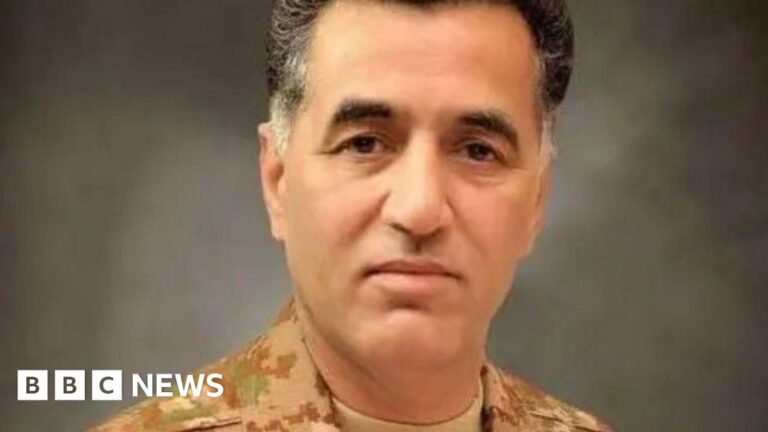
Former spy chief Faiz Hameed of Pakistan’s military sentenced to 14 years in prison

0

Pakistan’s former spy chief has been sentenced to 14 years in prison by a military court, on charges including violation of state secrets and interfering in politics.

Faiz Hameed led Pakistan’s Inter-Services Intelligence (ISI) agency from 2019 to 2021, during the tenure of now-jailed former prime minister Imran Khan.

He was known to be a staunch supporter of Khan, and took early retirement shortly after Khan was ousted in a no-confidence vote in 2022.

It is the first time that an ISI chief in Pakistan has been court martialled. His lawyer said he plans to appeal against the verdict.

The ISI chief is seen as the second most powerful position in Pakistan’s military.

According to a press release issued by the public relations arm of Pakistani military (ISPR), the 15-month-long court martial proceeding began on August 12, 2024, under the Pakistan Army Act.

Hameed was tried on four charges, including “involvement in political activities, violation of the Official Secrets Act which harmed the interest of the state, misuse of his powers and government resources, and causing harm to citizens”.

The ISPR statement added that Hameed had been given “the right to have a defence team of his choice” and that he has the right to appeal the decision in the “appropriate forum”, which would be the Supreme Court of Pakistan.

The exact details of the case are not public as the hearing was held behind closed doors in a military court.

The statement says that Hameed’s alleged involvement in fomenting political agitation and instability is being dealt with separately.

This is assumed to be regarding allegations that Hameed was tied to protests against Imran Khan’s arrest on 9 May 2023.

Hameed’s lawyer, Mian Ali Ashfaq, said his client was “1,000% innocent, but this is the court’s decision”.

“We were unaware of the judgement and only found out through the ISPR’s press release. We are now applying to the relevant forum for a copy of the decision,” he told the BBC.

“As soon as we receive it, we will review it and immediately file a petition to appeal. Right now, the first forum for appeal is the army chief, so that is what we will do. We are hopeful that at the next forum we will present our case and obtain justice.”

According to Charles Schwab, the Key to Wealth in America is $2.3 Million

0

“If I had a million dollars… I’d be rich,” the Barenaked Ladies sang in their hit 1988 song.

At the time, a million dollars felt like a lot. But as inflation and tariffs have made essentially everything more expensive, that amount of money doesn’t feel like all that much at all. In fact, Americans now think it takes an average of $2.3 million to be considered wealthy, according to a Charles Schwabreport.

The financial services firm surveyed 2,200 adults between the ages of 21 to 75 from April 24 to May 23, so a variety of generations offered their input. The average response for what it takes to be considered “financially comfortable” was $839,000. 

While the reported $2.3 million was a slight drop from last year’s Modern Wealth Survey at $2.5 million, it’s still 21% higher than the 2021 figure of $1.9 million.

Respondents also reported the bar to achieve monetary wealth feels as if it’s increasing, and 63% said it feels like it takes more money to be wealthy today compared to last year, citing the impacts of inflation, a worsening economy, and higher taxes.

Brad Clark, founder and CEO of financial advisory firm Solomon Financial, said these sentiments are relatively reflective of what he hears from his clients. There are a large number of millionaires in the U.S. when you factor in all assets, he told Fortune, but this typically includes their home, meaning their investable assets are typically less than $1 million.

“With so many middle-class Americans being considered millionaires, it stands to reason that the average individual would consider $2.3 million to be wealthy, as it may seem out of reach,” Clark said. 

But experts said being considered wealthy doesn’t necessarily equate being opulent in all life choices. 

The $2.3 million figure is “not luxury for everyone, but security. It’s wanting to have a house, retire well, have family, and have one’s time,” William “Bill” London, a lawyer and partner at Kimura London & White LLP who routinely handles high-net-worth families and individuals in divorces and estate cases, told Fortune. “Affluence is not about excess, but about reducing anxiety.”

What it means to be wealthy for different generations

The Charles Schwab survey showed when compared with other generations, Gen Z tends to set lower thresholds for what it takes to be wealthy and financially comfortable—$1.7 million and $329,000, respectively. Meanwhile, millennials and Gen Xers say it takes $2.1 million to be wealthy, and $2.8 million for baby boomers. 

That may have to do with how exactly different generations define wealth. Earlier generations like baby boomers more frequently frame wealth in terms of security, London said, with a focus on property, pension, and assets that get passed down. Younger generations, on the other hand, more frequently consider experiences, freedom from debt, and lifestyle decisions, he added.

“More of my younger clients are more concerned about breathing space and time than they are about a big house or pricey assets,” London said. “Their definition of wealth is more about lifestyle than about acquisition.”

But it could also be the fact younger generations have a harder time acquiring large assets like a home due to comparatively high mortgage rates and home prices. 

“Millennials and Gen Z are justifiably pessimistic about the prospects of home ownership, which historically was the most common way for Americans to build wealth,” Markus Schneider, associate professor and chair of the economics department at University of Denver, told Fortune. “There are lots of reasons why millennials and Gen Z may feel less secure about the world than the boomers did when they were the same age, and that may also impact how they feel about their wealth.”

Despite the differences among generations, experts agree it takes more than money to feel wealthy—and it shows in the Charles Schwab report. Some of the most popular personal definitions of wealth include happiness, physical health, mental health, quality of relationships, accomplishments, amount of free time, and material possessions.

“You don’t have to look too far to find a study that shows how depressed ultra-wealthy people often are. If you are defining wealth solely based on dollars, you likely will be disappointed when you achieve the number,” Clark said. “True wealth is being able to use your assets to free up your time to benefit those around you. The happiest people tend to be those with a greater purpose in life.”

A version of this story was published on Fortune.com on July 10, 2025.

Donald Trump: Venezuela’s crisis is not about oil, but about seizing power

0

On September 2, United States President Donald Trump released grainy footage of a missile obliterating a fishing boat off Venezuela’s coast. Eleven people died instantly. The administration called them narcoterrorists. Venezuelan sources identified them as fishermen. Since then, the US military has conducted at least 22 strikes, killing 87 people, with investigations revealing that the first attack included a second strike to kill two survivors clinging to wreckage — a potential war crime under international law. On Wednesday, the US went on to seize an oil tanker in Venezuelan waters, an escalation the Venezuelan government described as “blatant theft” and an “act of international piracy,” underscoring Washington’s shift towards economic coercion alongside military force.

The Trump administration frames all this as “counter-narcotics”. Critics call it regime change. But the most dangerous dimension of this crisis has nothing to do with Venezuela at all. It is about the consolidation of executive power at home.

The oil narrative does not add up

If this were about oil, nothing about the current approach makes sense. The US produces more oil than any country in history, exporting millions of barrels daily. Neither America nor Europe faces an oil shortage that would require military intervention. Venezuela, meanwhile, sits atop the world’s largest proven reserves — 303 billion barrels — but its oil infrastructure is severely deteriorated. Production has collapsed from 3.2 million barrels per day in 2000 to roughly 900,000 today. The country’s pipelines have not been updated in 50 years, and restoring peak production capacity would require an estimated $58bn in investment, underscoring how far the sector is from posing any strategic threat that might justify military force.

More tellingly, legal pathways to Venezuelan oil already exist. The US could lift sanctions, expand Chevron’s operations, or reopen the energy corridor — measures that require neither warships nor circumventing Congress. In fact, Chevron’s operations in Venezuela represent 25 percent of the country’s total production, demonstrating that commercial access is entirely possible within existing frameworks. This contradiction exposes how little the current strategy has to do with securing resources. Trump’s own Treasury Secretary Scott Bessent acknowledged the complexity, describing sanctions policy as a balancing act between displacing China and providing foreign currency to Venezuelan President Nicolas Maduro.

The fundamental shift in Washington’s Venezuela calculus has less to do with oil companies and more to do with private equity firms and defence contractors — interests focused not on barrels but on reconstruction contracts, mineral rights and territorial leverage in a post-Maduro scenario. Together, these dynamics make clear that the logic driving US policy lies outside the economics of oil itself.

What emergency powers actually enable

The Venezuela narrative serves a different function: it provides the pretext for expanded executive authority through emergency declarations. Since 2015, the US has maintained a continuous “national emergency with respect to Venezuela” under the National Emergencies Act. This declaration unlocks access to more than 120 specific statutory powers, including asset seizures, commerce regulation and military deployment — authorities that bypass normal congressional authorisation and operate with minimal legislative oversight.

Trump has systematically layered additional emergency measures. In March, he designated Tren de Aragua as a foreign terrorist organisation, expanded the legal definition of Venezuela’s government to encompass virtually any affiliated entity — from ministries to state-owned firms — and imposed 25 percent tariffs on countries importing Venezuelan oil. In August, he signed a secret directive authorising military force against Latin American drug cartels — a decision taken without coastguard involvement and relying solely on Navy assets, breaking with decades of maritime interdiction precedent and further consolidating executive discretion.

Defence Secretary Pete Hegseth framed the scope clearly when he declared that alleged drug operations “will not be controlled by cartels” and promised to “map your networks, track your people, hunt you down and kill you” — language more consistent with warfare than law enforcement. Secretary of State Marco Rubio went further, stating that the Maduro regime is “not a legitimate government” but rather “a transshipment organisation” that facilitates drug trafficking — a characterisation that redefines diplomatic relations as a criminal enterprise and justifies treating state actors as targets.

Congress abdicates oversight

What makes this deployment unprecedented is not its size — though assembling carrier strike groups, B-52 bombers, F-35 fighters, submarines and more than 15,000 personnel represents the most significant US military presence in Latin America since the Cold War — but the absence of congressional authorisation. Lawmakers from both parties have complained they were not provided with legal justification, target lists or evidence about those killed. The Senate has twice rejected resolutions to limit Trump’s military authority on Venezuela, leaving executive power in effect, unchecked.

Senator Lindsey Graham made the administration’s objective explicit, telling CBS that regime change is the goal and Trump “has all the authority in the world” to conduct strikes. Legal experts broadly characterise the maritime attacks as illegal under both US and international law. Yet classified briefings to congressional leadership — including recent sessions in which Hegseth refused to commit to releasing unedited strike footage — have produced no meaningful constraint on executive action.

The pattern emerging is one of expanding presidential discretion: once invoked, emergency powers become self-perpetuating tools that normalise unilateral military action. Rather than being used for targeted interdiction, they are increasingly employed to engineer confrontation and accelerate regime change — all without a congressional declaration of war.

The real cost

The most insidious aspect of this crisis is that it manufactures a threat precisely calibrated to validate expanded executive power. Oil does not provide that pretext — a foreign emergency large enough to activate military force — and label as terrorism does. This permits the exercise of authority without Congress, without oversight and, increasingly, without resistance.

Venezuela becomes useful not for its resources but for its role as a political prop in a constitutional drama. While Trump has openly threatened land strikes and stated that the airspace above Venezuela should be considered closed, the administration is quietly drafting day-after plans for what happens if Maduro is ousted — planning that proceeds regardless of congressional authorisation or international law.

The Venezuelan people, already suffering under economic collapse and political repression, now face the prospect of becoming collateral damage in someone else’s power consolidation project. More than seven million Venezuelans have fled abroad, and those who remain endure the escalating danger of a manufactured crisis designed not to liberate them but to serve distant political calculations.

This is not an oil grab. It is a power grab — one that uses Venezuela as a pawn while setting precedents that will outlast any single administration. The question is not whether Maduro’s regime deserves international condemnation; it does. The question is whether democracies should abandon their own constitutional principles to achieve regime change abroad. On the current trajectory, the answer appears to be yes — and that is the most dangerous precedent of all.

The views expressed in this article are the author’s own and do not necessarily reflect Al Jazeera’s editorial stance.


Charlotte Stahl, EMEA’s Head of Music Partnerships at TikTok, departs

0

Charlotte Stahl, who led music partnerships across Europe, the Middle East and Africa for TikTok, has left the company after more than five years at the company.

Stahl confirmed her exit via LinkedIn on Wednesday (December 10), saying her tenure at the ByteDance-owned social media app brought “more personal and professional growth than I ever imagined.”

She joined TikTok in 2020 as Artist Relations Manager for Germany. By October 2022, she had become Head of Music Operations for the DACH region (Germany, Austria, and Switzerland) and Central and Eastern Europe.

In the summer of 2024, she took on a broader role as Head of Music Partnerships EMEA, overseeing relationships with artists, labels, and music partners.

Before TikTok, Stahl worked at YouTube for over three years, Aviator Management, Germany’s Roba Music Publishing and at Sony Music Entertainment, where she started her music industry career.

“We helped artists, labels and music partners onboard and thrive, being the human and approachable faces of a new, powerful platform that became the world’s most important driver in music discovery and promotion.”

Charlotte Stahl

At TikTok, Stahl said: “We helped artists, labels and music partners onboard and thrive, being the human and approachable faces of a new, powerful platform that became the world’s most important driver in music discovery and promotion.”

The role involved managing what Stahl called “ambitious projects.”

Stahl credited her team and industry partners for her accomplishments at the company, saying: “None of this would have been possible without genuine collaboration, trust and open conversation with our amazing partners in the music industry — especially the artists and labels we worked with every day. It means the world to me that we got to build this together.”

TikTok hasn’t announced a replacement for Stahl’s role.

Her departure comes just months after TikTok expanded its SoundOn distribution and services platform to Germany after launching in the UK, US, Brazil and Indonesia, and Australia.

SoundOn has seen “hundreds of thousands” of acts release music and generate revenue on the platform, TikTok said in September. The launch in Germany allowed local artists to distribute their songs across major streaming platforms like Spotify, Apple Music, Amazon Music, YouTube Music, SoundCloud, Deezer, Pandora and more.

The development marks the latest executive change across TikTok’s global operations. Two weeks ago, TikTok appointed Ziad Ojakli as head of public policy for the Americas, a veteran government affairs executive, as the company races to finalize the sale of its US operations.

Music Business Worldwide

US seizes oil tanker near Venezuela as Caracas denounces ‘piracy’ act

0

Kayla Epsteinand

Ione Wells,São Paulo

Watch: Video shows US military seizing oil tanker off Venezuela coast

US forces have seized an oil tanker off the coast of Venezuela, President Donald Trump said, marking a sharp escalation in Washington’s pressure campaign against Nicolás Maduro’s government.

“We have just seized a tanker on the coast of Venezuela – a large tanker, very large, the largest one ever seized actually,” Trump told reporters at the White House.

Releasing a video of the seizure, Attorney General Pam Bondi described the vessel as a “crude oil tanker used to transport sanctioned oil from Venezuela and Iran”.

Caracas swiftly denounced the action, calling it an act of “international piracy”. Earlier, President Maduro declared that Venezuela would never become an “oil colony”.

The Trump administration accuses Venezuela of funnelling narcotics into the US and has intensified its efforts to isolate President Maduro in recent months.

Venezuela – home to some of the world’s largest proven oil reserves – has, in turn, accused Washington of seeking to steal its resources.

Brent crude prices inched higher on Wednesday as news of the seizure stoked short-term supply concerns. Analysts warn the move could threaten shippers and further disrupt Venezuela’s oil exports.

US Attorney General Pam Bondi, who leads the US Department of Justice, said the Federal Bureau of Investigation, Department of Defense, Department of Homeland Security, and the US Coast Guard co-ordinated the seizure.

“For multiple years, the oil tanker has been sanctioned by the United States due to its involvement in an illicit oil shipping network supporting foreign terrorist organizations,” the nation’s top prosecutor wrote on X.

Footage shared by Bondi showed a military helicopter hovering over a large ship, and troops descending on to the deck using ropes. Uniformed men were seen in the clip moving about the ship with guns drawn.

A senior military official told the BBC’s US partner CBS that the helicopters used in the operation launched from the USS Gerald Ford, the world’s largest aircraft carrier, which was sent to the Caribbean last month.

It involved two helicopters, 10 Coast Guard members and 10 Marines, as well as special forces.

Watch: Venezuela’s Maduro sings “Don’t worry, be happy” as he calls for peace with the US

Defence Secretary Pete Hegseth was aware of the operation, and the Trump administration was considering more actions like this, a source told CBS.

When asked by reporters what the US would do with the oil on the tanker, Trump said: “We keep it, I guess… I assume we’re going to keep the oil.”

Maritime risk company Vanguard Tech identified the vessel as the Skipper and said it believed the ship had been “spoofing” its position – or broadcasting a false location – for a long time.

BBC Verify has since confirmed that the vessel in the footage released by the Department of Homeland Security is the Skipper.

The US treasury department sanctioned the Skipper in 2022, CBS reported, for alleged involvement in oil smuggling that generated revenue for Hezbollah and the Islamic Revolutionary Guard Corps-Quds Force.

BBC Verify also located this tanker on MarineTraffic, which shows it was sailing under the flag of Guyana when its position was last updated two days ago.

A statement from Guyana’s Maritime Administration Department on Wednesday evening, however, said that the Skipper was “falsely flying the Guyana Flag as it is not registered in Guyana.”

The Skipper’s port of call log shows it called in Iran, Iraq, and the UAE from 30 June to 9 July this year. Its most recent stop, according to MarineTraffic, was at Soroosh port in Iran on 9 July.

That does not mean that it has not called at multiple other ports since then.

MarineTraffic shows it was last near Iran in mid-September before arriving off the coast of Guyana at the end of October and making minimal further movement since then. This data may be partial or incorrect because of spoofing.

MarineTraffic lists the beneficial owner and operator as Nigeria-based Thomarose Global Ventures Ltd and it lists the registered owner as Marshall Islands-based Triton Navigation Corp.

Watch: Trump says US has seized “large tanker” off Venezuela coast

The Venezuelan government issued a statement denouncing the seizure as a “grave international crime”.

Interior Minister Diosdado Cabello called the US “murderers, thieves, pirates”.

He referred to Pirates of the Caribbean, but said that while that film’s lead character Jack Sparrow was a “hero”, he believed “these guys are high seas criminals, buccaneers”.

Cabello said this was how the US had “started wars all over the world”.

Speaking at a rally earlier on Wednesday, Maduro had a message for Americans opposed to war with Venezuela. It came in the form of a 1988 hit song.

“To American citizens who are against the war, I respond with a very famous song: Don’t worry, be happy,” Maduro said in Spanish before singing along to the lyrics of the 1988 hit.

“Not war, be happy. Not, not crazy war, not, be happy.”

It’s unclear if Maduro knew about the seizure of the tanker before this rally.

In recent days, the US has ramped up its military presence in the Caribbean Sea, which borders Venezuela to the north.

The build-up involves thousands of troops and the USS Gerald Ford being positioned within striking distance of Venezuela, BBC Verify reported.

The move has sparked speculation about the potential for some kind of military action.

Since September, the US has conducted at least 22 strikes on boats in the region that the Trump administration says are smuggling drugs. At least 80 people have died in these attacks.

A thin, grey banner promoting the US Politics Unspun newsletter. On the right, there is an image of the Capitol Building against a background of vertical red, grey and blue stripes. The banner reads: "The newsletter that cuts through the noise.”

Follow the twists and turns of Trump’s second term with North America correspondent Anthony Zurcher’s weekly US Politics Unspun newsletter. Readers in the UK can sign up here. Those outside the UK can sign up here.

Challenging Client

0


Client Challenge


JavaScript is disabled in your browser.

Please enable JavaScript to proceed.

A required part of this site couldn’t load. This may be due to a browser
extension, network issues, or browser settings. Please check your
connection, disable any ad blockers, or try using a different browser.

María Corina Machado Emerges in Oslo After a Year of Seclusion

0

new video loaded: María Corina Machado Appears in Oslo After a Year in Hiding

María Corina Machado, Venezuela’s opposition leader, greeted supporters in the Norwegian capital, hours after missing the ceremony at which she was awarded the Nobel Peace Prize.

By Shawn Paik

December 11, 2025

Nikki Nixon’s Strong Performance in 200 IM at Winter Juniors East Day Two Prelims

0

By Jake Bridges on SwimSwam

2025 Winter Junior Championships – East

Thursday Prelims Boys’ Heat Sheet

Thursday Prelims Girls’ Heat Sheet

Day two of the 2025 Speedo Winter Junior National Championships has arrived, with the boys’ and girls’ 500 free, 200 IM, and 50 free set to be swum.

TAC Titan’s Nikki Nixon headlines the scratches going into the session. Nixon was set to swim the 200 IM and 50 free back-to-back, and was seeded 11th in the 200 IM with a time of 1:59.43. She has since scratched that event, making for space for the 50 free, in which her time of 23.55 seeds her 112th.

Nixon’s strongest events will come later in the meet. She is seeded 2nd in the 200 butterfly, behind only Audrey Derivaux, with a time of 1:54.91. Her time of 51.84 in the 100 fly seeds her 3rd in the event, just behind top seed Charlotte Crush and 2nd seed Mena Boardman. Nixon is committed to study and swim at the University of Georgia in the class of 2027-2028.

Only one other top-20 seeded swimmer, Laker Swim Club’s Walter Zeman, scratched an event ahead of Thursday’s prelims. Zeman will forgo the boys’ 50 free, in which he was seeded 18th with a time of 20.36.

Zeman, who is committed to swim at Michigan in the fall of 2026, is scheduled to swim the 100 fly (108th seed) and 100 free (34th seed) later in the meet.

Read the full story on SwimSwam: Nikki Nixon Scratches 200 IM Heading Into Winter Juniors East Day Two Prelims

Kiel Institute reports that German economy continues to experience modest growth phase

0

German economy remains stuck in meagre growth phase, Kiel Institute says

Supersonic Technology Addresses AI’s Power Issue

0

The hot trends of civilian supersonic flight and artificial intelligence collide as Boom Supersonic announces that, as a new revenue stream, the core technology of its Mach 1+ Symphony jet engine has been adapted to run power-hungry AI data centers.

Boom Supersonic has made great strides in recent years toward fulfilling its ambition to get its Overture supersonic airliner off the ground. The problem is that faster-than-sound aircraft aren’t cheap and there’s only so much investor money that a company can scratch up at any one time, so Plan B for Boom is to adapt its aircraft technology to make some earthbound lolly in the short term.

As luck would have it, another pioneering industry is badly in need of extra resources, only this time its raw power. AI data centers are springing up all over the place like dandelions on a poorly tended lawn. However, unlike dandelions, these centers are extremely power hungry both in terms of operating electricity and cooling. The amount of energy that data centers will need in the near future is estimated to at least double in the next few years and by 2035 they will be the single largest consumer of electricity in the United States.

A Superpower installation

Boom Supersonic

Small wonder then that many tech firms are scrambling to secure reliable sources of power that can run 24 hours a day, 365 days of the year without interruption, including going to such lengths as to reactivate decommissioned nuclear power plants and funding the construction of new ones.

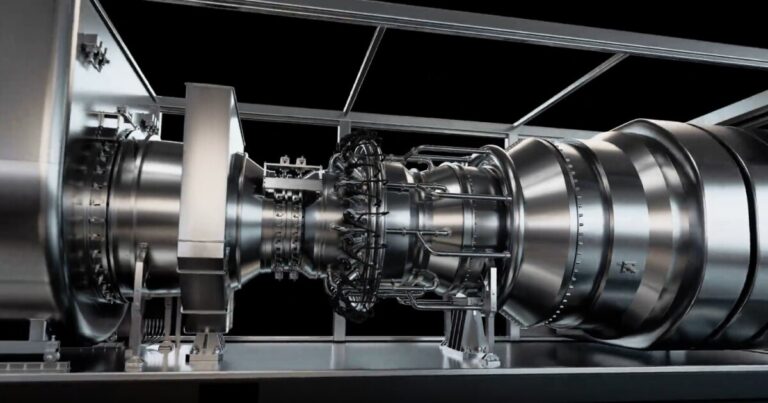
Boom’s contribution to feeding this digital behemoth is to repurpose its Symphony engine to create a turbogenerator that runs on natural gas or, in an emergency, diesel fuel.

Called Superpower, the new engine shares 80% of its components with Symphony. The main difference is that Superpower dumps the turbofan used for thrust and replaces it with additional compressor stages. In addition, there’s a free power turbine attached to generate electricity.

Superpower can fit in a standard shipping container

Boom Supersonic

Along with this, the Superpower doesn’t need cooling and can operate happily at ambient temperatures of up to 110 °F (43 °C). In all, it can generate 42 MW with a volume no larger than a shipping container, and it is claimed that the turbogenerator can be installed in about a fortnight once the foundations are laid.

Boom says that it already has an order for 29 Superpowers to produce 1.21 GW from AI infrastructure company Crusoe. The company hopes to be manufacturing 4 GW of capacity a year by 2030.

With this additional revenue, Boom hopes that its supersonic airliner plans will be more secure.

“Supersonic technology is an accelerant – of course for faster flight, but now for artificial intelligence as well,” said Blake Scholl, founder and CEO of Boom Supersonic. “With this financing and our first order for Superpower, Boom is funded to deliver both our engine and our airliner.”

Source: Boom Supersonic