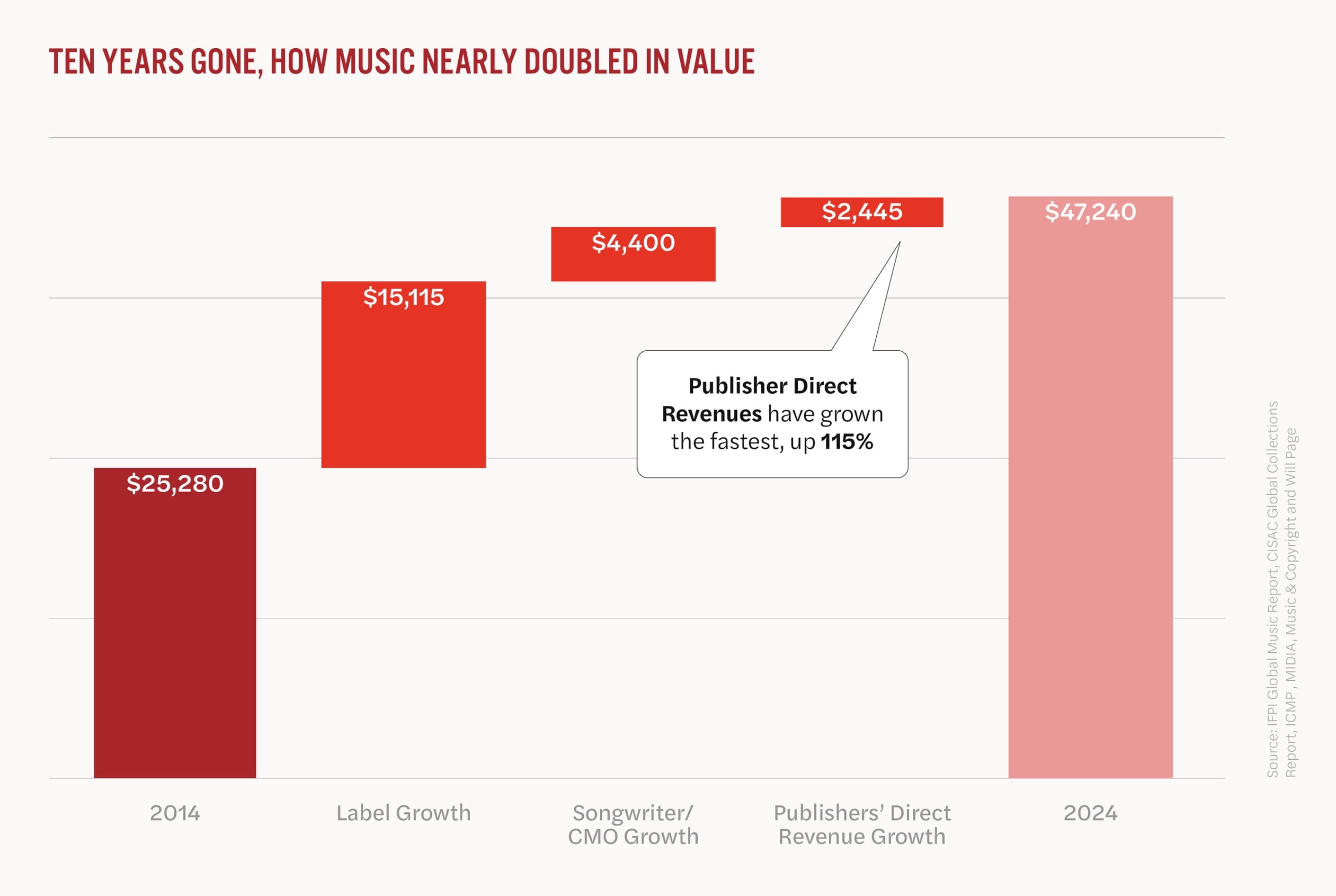
The global value of music copyright (both recordings and compositions) reached a new all-time high of $47.2 billion in 2024.
That’s according to a new report from Will Page, the former Chief Economist at both Spotify and UK collection society PRS for Music, published on Page’s website, Pivotal Economics.
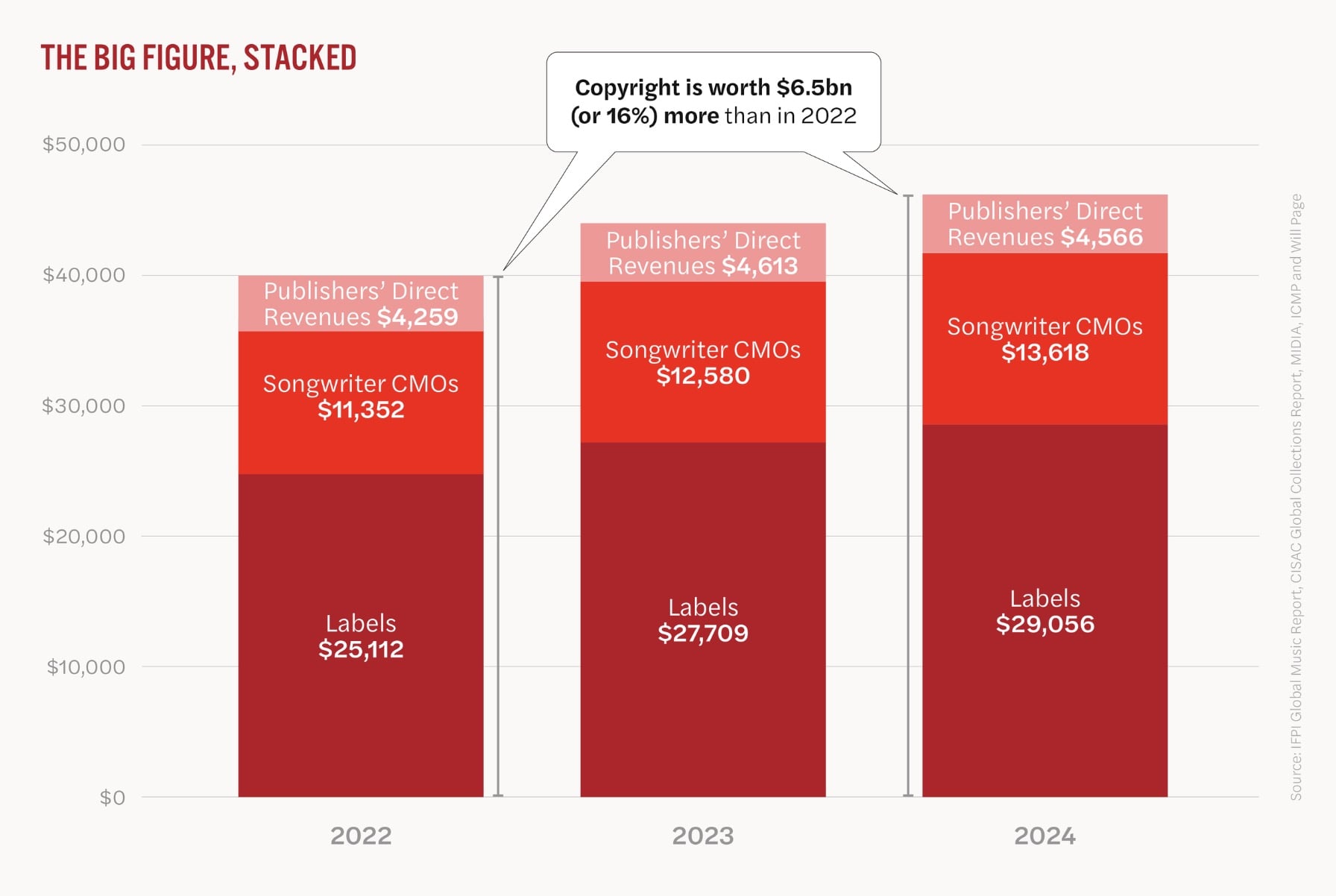
The 2024 figure was up just $2.3 billion (5.2%) on the prior year. According to the report, “growth is slowing largely because this is the first year where the pandemic effects have vanished”.
Of that total, $29 billion – or 61% – came from recorded music revenues (up 5% YoY), while $13.6 billion was brought in by collective management organizations (CMOs, up 8% YoY) and $4.6 billion in direct publisher income (down 1% YoY). Thus, compositions brought in 39% of the total.
MBW was first to publish Page’s global value of music copyright report back in 2015, when he calculated the figure at $25 billion for 2014 – making today’s $47.2 billion number a near doubling over the past decade.
Over that ten-year period, the three segments grew at dramatically different rates: CMOs expanded by 50%, labels doubled their revenues, and publishers’ direct revenues swelled by 112%. The report notes that “ICMP has long championed the ability of publishers to license their rights directly, circumventing the constraints of the collective, and this performance supports their argument”.
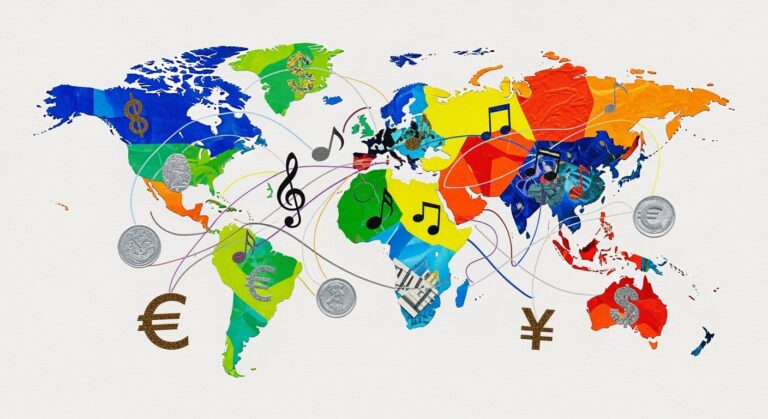
That growth has been driven by streaming’s continued expansion and the rise of what Page calls “glocalisation” – the phenomenon of domestic market strength reshaping global music economics.
However, Page’s analysis suggests the headline number only tells part of the story. While the industry celebrates crossing this milestone, the economist argues that more significant structural shifts are underway in how that value is being captured and distributed.
Streaming platforms have fundamentally altered the dynamics of music consumption, enabling domestic artists to achieve unprecedented scale in their home markets without necessarily achieving global recognition. This shift has profound implications for how the industry measures success, allocates resources, and projects future growth.
The report also identifies emerging threats and opportunities. From AI music’s potential to simultaneously create and destroy value across different sectors, to measurement gaps that suggest hundreds of millions of dollars remain uncounted, Page’s analysis presents a more complex picture than simple year-over-year growth figures might suggest.
Meanwhile, revenue time-lags between labels and publishers hint at cyclical patterns that could reshape near-term expectations for different stakeholders across the copyright value chain.
Here are five key takeaways from the report:
Photo Credit: ElenaR/Shutterstock
1. The $47.2bn milestone masks a structural shift in how value is captured
While the headline figure shows impressive growth over the past decade, Page argues the more significant story lies in where that value is being generated.
“The glocalisation of the value of copyright reminds us that the big figure that is calculated each year is being allocated across markets differently,” Page writes.
Page highlights trends from three markets, including “relatively small Denmark, medium-sized Korea, and large (or extra large) Brazil.”
In Denmark, the report notes, 16 of the top 20 albums last year were by Danish artists performing in Danish, despite the language being spoken by just 6 million people.
The report continues: “These three winners of glocalisation remind us that more of that value is staying within their domestic markets, as opposed to being repatriated back to international headquarters.”
The shift represents a fundamental departure from the broadcast era. “The free market of streaming has achieved what the regulated market of broadcast failed: domestic prominence,” according to Page.
Unlike traditional radio, which often favored international repertoire, streaming platforms have enabled local artists to dominate their home markets while occasionally breaking through to global charts based purely on domestic demand.
2. K-Pop’s dominance in Japan is blurring genre boundaries
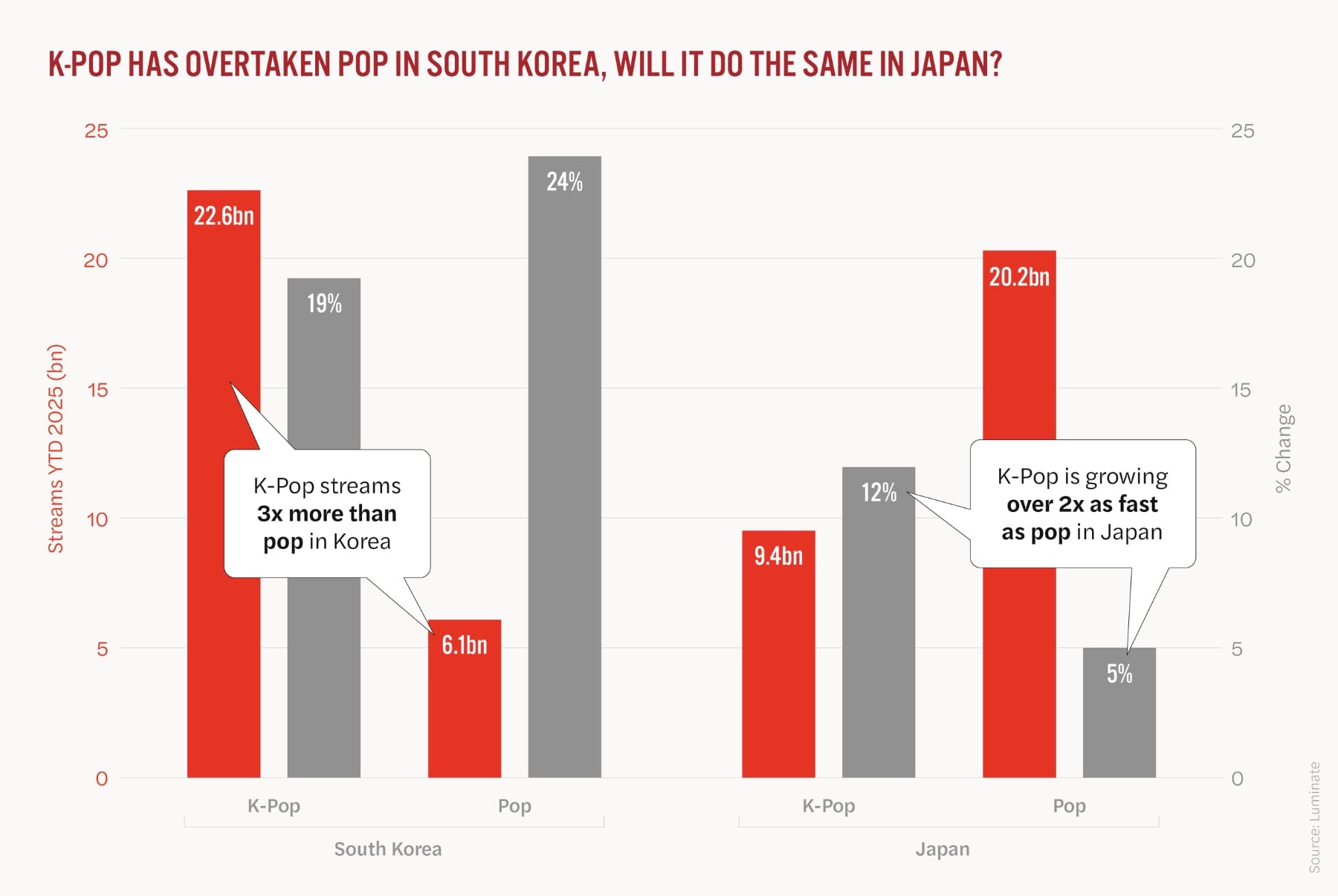
K-Pop has become so dominant in Japan that the genre classification itself is becoming meaningless. “Japan is Korea’s biggest export market, with 14 of the top 100 artists in Japan this year tagged as K-Pop,” Page writes. “The genre of K-Pop has overtaken pop in Korea, whereas it’s half the size of pop in Japan — yet its streams are now growing twice as fast.”
With BTS’s imminent return, Page suggests “we could see a tipping point where K-Pop overtakes pop in Japan.” Should this happen, he notes, “it raises more questions than answers — especially when it comes to syntax of the genre ‘K-Pop’.”
JH Kah, CEO of HYBE Latin America, frames the shift in stark terms: “Tower Records still thrive in Japan, that should tell you a lot! Indeed, an entire floor of their flagship Tokyo store is dedicated to K-Pop, however Japanese label culture suffered from decades of inertia whereas Koreans are inherently more hungry – our mantra is survive and thrive.
“That’s why you are now seeing Japanese labels hiring more Korean executives, and Korean labels going directly into Japan. The lines are getting blurred both on stage and backstage.” Japanese executives have even begun referring to the phenomenon as “J-K Pop,” highlighting the genre’s identity crisis.
3. Brazil’s domestic scale alone is powerful enough to break artists globally
Brazil’s market demonstrates the extreme end of glocalisation. “The YouTube top 100 artist chart for Brazil provides the litmus test for glocalisation: simply scroll from top to bottom and you will not see any international artists — no Spanish, nor English language, not even K-Pop Demon Hunters. It’s all Portuguese,” Page writes.
Yet despite this linguistic isolation, “these Brazilian artists are reaching the top of global charts thanks to (only) local demand.”
Roni Maltz Bin, CEO of Grupo Sua Música, provides striking examples: “Little Love by MC Cabelinho peaked on the Brazilian charts and reached No.2 on the Top Global Debut Album Charts — even though 99.5% of the album’s streams came from inside Brazil. Ditto Evoney Fernandes, who peaked at No.7 despite 97.4% of his streams coming from Brazil.
“Natanzinho Lima debuted in the same week as Bad Bunny and still reached #4 on the Spotify Global chart with 98.3% of all streams coming from Brazil. This shows the strength of the Brazilian market — it can break artists on the global charts even when their artists are only being streamed locally.”
4. AI music poses an asymmetric threat to the industry
“One headwind that needs no introduction is the rise of AI music,” Page writes. “The question on everyone’s lips: will this be complementary or cannibalistic to the existing $47.2 billion business?”
His answer suggests both outcomes are possible simultaneously. “This is where we can revisit our concept of ‘fair division’ and ask if the commercial prospects of recent deals with Suno and Udio might add value to B2C revenues, but wipe out value from the B2B business due to the displacement of production music libraries. If so, the impact of AI may be asymmetric.”
The warning is significant: while the headline $47.2 billion figure might continue growing through consumer-facing AI applications, substantial value could be destroyed in the professional production music sector, creating winners and losers within the same industry ecosystem.
5. The industry is missing hundreds of millions in unmeasured markets
Despite the $47.2 billion figure representing the most comprehensive measurement yet, Page argues significant value remains uncaptured. “The most obvious tailwind, meanwhile, risks of repetition, but remains salient as ever: global needs to mean global,” he writes.
“Of the 196 flags flying outside the United Nations building in New York, our industry yearbooks featured here capture barely a quarter of them. Ceteris paribus, the more we measure, the more value we capture.”
China illustrates the scale of the problem. “With $1.6 billion in recorded music revenues, it’s now ranked fifth in size by the IFPI and will soon overtake both Germany and the UK. But that’s not a complete picture of copyright,” Page notes.
“Industry experts estimate a further 15% should be paid to Chinese publishers — and this isn’t being captured in any of the yearbooks. That’s almost a quarter of a billion dollars currently not being calculated.”
The broader implication is stark: “How many more known-unknown examples like this are there? And if we did know, and measured these markets accordingly, how much bigger might be the global value of music copyright? This is why global needs to mean global when we measure music copyright.”Music Business Worldwide
The prime minister has said Russian oligarch Roman Abramovich must “pay up now” to victims of the war in Ukraine or face court action.
Mr Abramovich, the former owner of Chelsea Football Club, pledged in 2022 that the £2.5bn he made from the sale of the club would be used to benefit victims of the Russian invasion of Ukraine.
But there has been a delay in releasing the funds, which are currently frozen in a British bank account, due to a standoff over how exactly they should be used.
Sir Keir Starmer told the Commons on Wednesday: “My message to Abramovich is clear: the clock is ticking.”
The government wants the money to be used for humanitarian aid, but Mr Abramovich insisted it should be used for “all victims of the war” – meaning that Russians could also benefit.
The oligarch cannot access the money under UK sanctions but the proceeds from the Chelsea sale still legally belong to him.
Updating MPs, Sir Keir said the UK had issued a licence “to transfer £2.5bn from the sale of Chelsea Football Club that’s been frozen since 2022.”
And, in a warning to Abramovich, he said: “Honour the commitment that you made and pay up now, and if you don’t we’re prepared to go to court and ensure that every penny reaches those whose lives have been torn apart by Putin’s illegal war.”
And Foreign Secretary Yvette Cooper told the BBC Mr Abramovich “needs to honour that commitment, pay that money”.
Asked if a legal battle could drag out the process for years, Ms Cooper said: “I’m urging him not to try and pursue further court action.”
But she confirmed the government will take the matter to court if he does not act.
Mr Abramovich’s representatives declined to comment.
The Treasury said that under the terms of the licence, the money must go to “humanitarian causes” in Ukraine and cannot benefit Mr Abramovich or any other sanctioned individual.
Chancellor Rachel Reeves said: “It is unacceptable that more than £2.5bn of money owed to the Ukrainian people can be allowed to remain frozen in a UK bank account.”
Mr Abramovich – a Russian billionaire who made his fortune in oil and gas – was granted a special licence to sell Chelsea following Russia’s invasion of Ukraine, providing he could prove he would not benefit from the sale.
He is alleged to have strong ties to Russian President Vladimir Putin, something he has denied.
It is understood that Mr Abramovich has 90 days to act before the UK considers taking legal action.
On Thursday, EU leaders are set to review proposals to use proceeds from frozen Russian assets to support Ukraine’s huge budget and defence needs. Russia has fiercely opposed the proposals.
New York Knicks center Karl-Anthony Towns gave an update on his health after recent games, and fans are watching closely. Towns missed a game earlier this month due to left calf tightness, and the team listed him as day-to-day on the Knicks’ injury report. Trainers and coaches have taken a cautious approach to keep him healthy for the long season ahead.
Towns’ calf issue first showed up after a win over the Utah Jazz, and it became significant enough that he could not warm up fully for the Orlando Magic game on December 7. The Knicks chose not to risk further irritation, and that absence was his first missed game this season because of injury.
Body of Work This Season
So far this season, Towns has dealt with several lower-body concerns. Before the calf problem, he battled a Grade 2 quad strain in October, which made his status uncertain at the start of the year. He also played through other minor bumps and bruises, showing a willingness to contribute even when not at 100%.
Beyond the calendar year, his knee history stretches back further. Towns tore his left meniscus in March 2024 and underwent surgery. That knee still comes up in updates and remains something the Knicks monitor, though he has continued to play at a high level.
May 27, 2025; Indianapolis, Indiana, USA; New York Knicks center Karl-Anthony Towns (32) looks up at a scoreboard during the third quarter against the Indiana Pacers of game four of the eastern conference finals for the 2025 NBA Playoffs at Gainbridge Fieldhouse. Mandatory Credit: Trevor Ruszkowski-Imagn Images
Despite all this, the 29-year-old has been a consistent force. Over his time with the Knicks, he has delivered strong scoring and rebounding numbers that align with his All-Star pedigree. His double-digit rebounding streak and leadership on both ends of the floor have been key to New York’s positioning in the Eastern Conference.
Knicks Manage Minutes and Health
The Knicks have leaned on their depth while managing Towns’ minutes carefully. When he’s out or limited, players like Mitchell Robinson, Josh Hart and OG Anunoby have stepped up to fill the interior and big-man roles. This depth has helped the team stay competitive even in heavy stretches of the schedule.
Coach Mike Brown and the staff appear determined to avoid long layoffs for Towns. Their cautious handling keeps him available for critical games and the playoff push. At this point, Towns’ status remains game-by-game, and any return will likely come with careful monitoring.
What It Means
Towns’ updates matter because he is a core part of the Knicks’ title hopes. When healthy, his scoring, rebounding, and size shift how opponents match up with New York. The hope in the locker room and among fans is that he stays on the floor and avoids a more serious setback.
A required part of this site couldn’t load. This may be due to a browser
extension, network issues, or browser settings. Please check your
connection, disable any ad blockers, or try using a different browser.
Although they’re constantly improving, robots aren’t necessarily known for their gentle touch. A new robotic system from MIT and Stanford takes a unique stab at changing that, with a robot that uses vine-like tendrils to do its lifting.
The system the engineers developed consists of a series of pneumatic tubes that deploy from a pressurized box on one side of a robotic arm, use air pressure to snake under or around a specific object, then rejoin the arm on the other side where they are clamped in place. Once clamped, the arm itself can move, or the tube can be wound up to lift or rotate the object in its grasp. The ability to deploy the tubes and then recapture them is the real breakthrough here, improving on previous vine-based robots by allowing the system to close its own loops.
Thanks to its soft morphing arms, the robot can also handle gentle tasks like lifting and moving a fragile glass vase
Tony Pulsone, MechE
“People might assume that in order to grab something, you just reach out and grab it,” says study co-author Kentaro Barhydt, from MIT’s Department of Mechanical Engineering. “But there are different stages, such as positioning and holding. By transforming between open and closed loops, we can achieve new levels of performance by leveraging the advantages of both forms for their respective stages.”
In tests, which you can see in the following video, the team demonstrated that the system could lift round objects (0:18); objects in a cluttered environment (3:15); fragile objects like a glass vase (3:56), large objects like a bin from a distance (4:20); a group of objects like a bundle of metal rods (5:16); and a relatively heavy and odd-shaped object like a watermelon (10:50). While those are all impressive, the researchers say the real promise of their vine bot is to help lift human bodies in hospital and elder care facilities (which you can see at 7:30).
“Transferring a person out of bed is one of the most physically strenuous tasks that a caregiver carries out,” Barhydt says. “This kind of robot can help relieve the caretaker, and can be gentler and more comfortable for the patient.”
The most typical way of transferring patients today involves needing to rotate the person to both sides in order to get a hammock-like sheet beneath them, which is then lifted by a winch. This can cause pain to some patients and interfere with intravenous lines and other health-related inputs. Because the tubes can fit through extremely tight spaces, such as under a patient’s body, the robot vine system has the potential to make transfers more gentle and less jarring.
“I am very excited about future work to use robots like these for physically assisting people with mobility challenges,” adds co-author Allison Okamura from Stamford. “Soft robots can be relatively safe, low-cost, and optimally designed for specific human needs, in contrast to other approaches like humanoid robots.”
While the researchers were primarily motivated to create the vine-like robot for help in medical situations, they say it also has applications in the other fields, as demonstrated by the paces they put it through in testing.
“We think this kind of robot design can be adapted to many applications,” Barhydt says. “We are also thinking about applying this to heavy industry, and things like automating the operation of cranes at ports and warehouses.”
The invention has been described in a study published in the journal Science Advances.
The surviving suspect in the mass shooting at Bondi Beach in Sydney, Australia, on Sunday, in which at least 15 people were killed, has been charged with murder and terrorism, the police said on Wednesday.
The United States has dramatically intensified its military air campaign in Somalia, carrying out 111 strikes against armed groups, also killing civilians, since President Donald Trump returned to office, according to the New America Foundation, which monitors the operations.
In the most recent one, the US Africa Command conducted an air strike on December 14, approximately 50 kilometres (31 miles) northeast of the city of Kismayo, targeting what it said were members of the Somali armed group, al-Shabaab.
Recommended Stories
list of 3 itemsend of list
The escalation began in February when Trump launched his administration’s first strike in Somalia. Months later, a senior US Navy admiral said the US had carried out what he said was the “largest air strike in the history of the world” from an aircraft carrier, marking a sharp departure from the previous administration’s approach.
The strike total this year already surpasses the combined number carried out under Presidents George W Bush, Barack Obama and Joe Biden, and it puts Trump on track to potentially exceed even his own first-term record of 219 strikes.
The intensified campaign targets both al-Shabaab, an al-Qaeda affiliate that has fought Somalia’s government since 2007 and controls large areas of the south-central regions, and ISIL (SIS) in Somalia, a smaller offshoot concentrated in the northeast with an estimated 1,500 fighters.
Somalia’s war with armed groups was Africa’s third-deadliest over the last year, killing 7,289 people, according to the US-based Africa Center for Strategic Studies.
The United States has been allied with Somalia’s federal government, training elite forces and conducting air strikes in support of local operations. US troops have also been based in the country.
The surge in strikes follows a directive by US Defense Secretary Pete Hegseth that reversed Biden-era restrictions requiring White House approval for strikes outside warzones, giving AFRICOM commanders greater authority to launch attacks.
David Sterman, a senior policy analyst at the New America Foundation, told Al Jazeera there appeared to be “a demand signal from the White House for escalation” and “a willingness to allow more clearly offensive uses of strikes with less scrutiny and regulation”.
Sterman, who has monitored the strikes, identified two main drivers behind the increase.
More than half the strikes have supported a US-backed campaign by Somalia’s autonomous Puntland region against ISIL-Somalia, launched after the group attacked a military convoy in December 2024.
The strikes have shifted from occasionally targeting senior figures to sustained operations aimed at members of the group who have hemmed themselves into the caves in the mountains in northern Somalia, Sterman added.
The remainder focus on al-Shabaab’s advances against Somali government forces in the south, as US strikes support a Somali National Army that has faced setbacks on the ground this year.
The February 1 operation that opened the campaign saw 16 F/A-18 Super Hornets launch from the USS Harry S Truman in the Red Sea, dropping 60 tonnes of munitions on cave complexes in the Golis Mountains. The strike killed 14 people, according to Africa Command.
Somali civilians under US fire
However, the intensified operations have raised concerns about civilian casualties.
The investigative outlet Drop Site News reported in December that US air strikes and Somali forces killed at least 11 civilians, including seven children, during a November 15 operation in the Lower Jubba region, citing witnesses.
Africa Command confirmed conducting strikes to support Somali troops, but did not respond to Drop Site requests for comment on the civilian deaths.
The US military recently stopped providing civilian casualty assessments in its strike announcements.
According to the military publication Stars and Stripes, the pace of operations now exceeds even the US’s claimed counter-narcotics strikes in the Caribbean.
In the meantime, Trump launched racist verbal attacks earlier this month on Somali immigrants in the US state of Minnesota, as federal authorities prepared to launch a major immigration crackdown targeting hundreds of undocumented Somalis in the state of Minnesota.
His comments have been denounced in several quarters, from Mogadishu to Minneapolis.
As Amazon’s Zoox ramps up its bid to compete with Google’s Waymo, co-founder and chief technology officer Jesse Levinson says one key feature sets the self-driving robotaxi unit apart from its rival.
While a Waymo’s interior resembles a traditional car—with two rows of seats and a screen or steering wheel on the front left—Zoox’s vehicle features two rows of seats facing one another, a configuration Levinson says is better suited for groups.
“It’s just a much better experience, so your time in the vehicle is dramatically nicer,” he said at Fortune’s Brainstorm AI event in San Francisco earlier this month. “You have much more space. If you’re with friends, it’s dramatically more social, because you’re facing each other.”
Waymo has largely dominated the robotaxi space since its first public launch in 2020, with a fleet size of more than 2,000, which recently completed 100 million miles driven autonomously. The company reached 10 million rides across the five cities where it is operational in May, double the number of trips recorded five months prior. Zoox, by comparison, is playing catch-up. After launching its first public robotaxi service in Las Vegas with free rides on its app in September, Zoox will begin offering paid rides in Las Vegas in early 2026, and expects to do the same in San Francisco later in the year, Levinson said. A few weeks ago, the robotaxi service, with a test fleet of about 50 across the two cities, passed its one million-mile technical benchmark.
A new driver-less experience
Levinson suggested that what separates Zoox from Waymo and even Tesla’s Cybercab (which is slated to begin production in April 2026, according to CEO Elon Musk) is that it was never designed to have a driver.
“The cars that have been designed over the last 100 years are for humans,” Levinson said. “All the choices, their shape, their architecture, what components they have in them—they were all designed for human drivers.”
Zoox can create a more pleasurable experience for users because it is not a traditional car retrofitted for autonomy, Levinson argued. He also said the battery life is longer than competitors’, an added safety feature that increases the likelihood a passenger will arrive at their destination, even if a hardware component malfunctions.
While Waymo is partnering with companies like DoorDash to deliver takeout and groceries, Zoox is less focused on automated delivery—an area Amazon has been developing outside the subsidiary, particularly by optimizing last-mile delivery to lower costs and improve reliability. Instead, Zoox is focused on building what Levinson calls “a whole new category of transportation,” designed solely to move people from one point in a city to another.
“So they’d love to save money, obviously, but that’s not as exciting as creating this market,” he said. “And the addressable market for moving people around cities is just profoundly huge.”
South Africa has accused the US of using Kenyan nationals who did not have work permits at a facility processing applications by white South Africans for refugee status.
Seven Kenyans were arrested after intelligence reports revealed that people “had recently entered South Africa on tourist visas and had illegally taken up work” at the centre, said a statement from South Africa’s department of home affairs.
The BBC has approached the US State Department for comment.
While the US is trying to reduce overall levels of migration, it says that members of South Africa’s white Afrikaner community can get asylum because they face persecution – a claim South Africa’s government strongly rejects.
The US has reduced its yearly intake of refugees from around the world from 125,000 to 7,500, but says it will prioritise Afrikaners, who are mostly descendants of Dutch and French settlers.
This is one of the issues that have caused a sharp deterioration in relations between South Africa and the Trump administration.
South Africa says the Kenyan nationals arrested in Tuesday’s raid will now be deported and will be banned from entering the country for five years.
They had previously been denied work visas but were found “engaging in work despite only being in possession of tourist visas, in clear violation of their conditions of entry into the country”, the statement said.
South Africa also expressed concern that foreign officials appeared to have coordinated with undocumented workers and said it had reached out to the US and Kenya to resolve the matter.
The home affairs department said the raid showcased the commitment that South Africa shared “with the United States to combating illegal immigration and visa abuse in all its forms”.
No US officials were arrested and the operation was not at a diplomatic site, it said.
While the State Department is yet to respond to the BBC’s request for comment, in a statement issued to US publications, Tommy Pigott, principal deputy spokesperson for the State Department, said the department was “seeking immediate clarification from the South African government” on the issue and expected “full cooperation and accountability”.
“Interfering in our refugee operations in unacceptable,” US publication The Hill quoted Pigott saying.
The processing of applications by white South Africans is being done by two companies, RSC Africa and Amerikaners, according to the US embassy in South Africa.
RSC Africa is a Kenyan-based refugee support centre operated by Church World Service (CWS) while Amerikaners is a South African platform aimed at providing information to white South Africans interested in the US resettlement offer.
The BBC has asked RSC Africa for comment, while Amerikaners told the BBC they could not talk to the media.
US President Donald Trump has repeatedly claimed that Afrikaners are being subjected to a “genocide” in South Africa, even though there is no evidence that white farmers are more likely to be the victims of crime than their black counterparts.
He offered Afrikaners refugee status earlier this year after South African President Cyril Ramaphosa signed a law allowing the government to seize land without compensation in rare instances.
A first group of about 50 people flew to the US on a chartered plane – it is not clear how many others have moved, or are in the process of applying.
Because of the legacy of the racist apartheid system, the majority of privately owned farmland in South Africa is owned by the white community and South Africa’s government is under pressure to provide more land to black farmers. However, it stresses that no land has yet been seized under the new law.
South Africa has repeatedly tried to mend fences with the Trump administration, most famously when Ramaphosa led a high-level delegation to the White House earlier this year.
One video featured firebrand South African opposition figure Julius Malema singing: “Shoot the Boer [Afrikaner], Shoot the farmer”.
However, a South African court has ruled that this song, which Malema often chants at his political rallies, is not hate speech.
Last month, the US boycotted the G20 summit in South Africa and has said it would not invite South African officials to its meetings since it took over leadership of the grouping of the world’s biggest economies.