At least 16 files disappeared from the Justice Department’s public webpage for documents related to Jeffrey Epstein — including a photograph showing President Donald Trump — less than a day after they were posted, with no explanation from the government and no notice to the public.
The missing files, which were available Friday and no longer accessible by Saturday, included images of paintings depicting nude women, and one showing a series of photographs along a credenza and in drawers. In that image, inside a drawer among other photos, was a photograph of Trump, alongside Epstein, Melania Trump and Epstein’s longtime associate Ghislaine Maxwell.
The Justice Department did not say why the files were removed or whether their disappearance was intentional. A spokesperson for the department did not immediately respond to a request for comment.
Online, the unexplained missing files fueled speculation about what was taken down and why the public was not notified, compounding long-standing intrigue about Epstein and the powerful figures who surrounded him. Democrats on the House Oversight Committee pointed to the missing image featuring a Trump photo in a post on X, writing: “What else is being covered up? We need transparency for the American public.”
The episode deepened concerns that had already emerged from the Justice Department’s much-anticipated document release. The tens of thousands of pages made public offered little new insight into Epstein’s crimes or the prosecutorial decisions that allowed him to avoid serious federal charges for years, while omitting some of the most closely watched materials, including FBI interviews with victims and internal Justice Department memos on charging decisions.
Scant new insight in the initial disclosures
Some of the most consequential records expected about Epstein are nowhere to be found in the Justice Department’s initial disclosures, which span tens of thousands of pages.
Missing are FBI interviews with survivors and internal Justice Department memos examining charging decisions — records that could have helped explain how investigators viewed the case and why Epstein was allowed in 2008 to plead guilty to a relatively minor state-level prostitution charge.
The gaps go further.
The records, required to be released under a recent law passed by Congress, hardly reference several powerful figures long associated with Epstein, including Britain’s former Prince Andrew, renewing questions about who was scrutinized, who was not, and how much the disclosures truly advance public accountability
Among the fresh nuggets: insight into the Justice Department’s decision to abandon an investigation into Epstein in the 2000s, which enabled him to plead guilty to that state-level charge, and a previously unseen 1996 complaint accusing Epstein of stealing photographs of children.
The releases so far have been heavy on images of Epstein’s homes in New York City and the U.S. Virgin Islands, with some photos of celebrities and politicians.
There was a series of never-before-seen photos of former President Bill Clinton but fleetingly few of Trump. Both have been associated with Epstein, but both have since disowned those friendships. Neither has been accused of any wrongdoing in connection with Epstein and there was no indication the photos played a role in the criminal cases brought against him.
Despite a Friday deadline set by Congress to make everything public, the Justice Department said it plans to release records on a rolling basis. It blamed the delay on the time-consuming process of obscuring survivors’ names and other identifying information. The department has not given any notice when more records might arrive.
That approach angered some Epstein accusers and members of Congress who fought to pass the law forced the department to act. Instead of marking the end of a yearslong battle for transparency, the document release Friday was merely the beginning of an indefinite wait for a complete picture of Epstein’s crimes and the steps taken to investigate them.
“I feel like again the DOJ, the justice system is failing us,” said Marina Lacerda, who alleges Epstein started sexually abusing her at his New York City mansion when she was 14.
Many of the long-anticipated records were redacted or lacked context
Federal prosecutors in New York brought sex trafficking charges against Epstein in 2019, but he killed himself in jail after his arrest.
The documents just made public were a sliver of potentially millions of pages records in the department’s possession. In one example, Deputy Attorney General Todd Blanche said Manhattan federal prosecutors had more than 3.6 million records from sex trafficking investigations into Epstein and Maxwell, though many duplicated material already turned over by the FBI.
Many of the records released so far had been made public in court filings, congressional releases or freedom of information requests, though, for the first time, they were all in one place and available for the public to search for free.
Ones that were new were often lacking necessary context or heavily blacked out. A 119-page document marked “Grand Jury-NY,” likely from one of the federal sex trafficking investigations that led to the charges against Epstein in 2019 or Maxwell in 2021, was entirely blacked out.
Trump’s Republican allies seized on the Clinton images, including photos of the Democrat with singers Michael Jackson and Diana Ross. There were also photos of Epstein with actors Chris Tucker and Kevin Spacey, and even Epstein with TV newscaster Walter Cronkite. But none of the photos had captions and was no explanation given for why any of them were together.
The meatiest records released so far showed that federal prosecutors had what appeared to be a strong case against Epstein in 2007 yet never charged him.
Transcripts of grand jury proceedings, released publicly for the first time, included testimony from FBI agents who described interviews they had with several girls and young women who described being paid to perform sex acts for Epstein. The youngest was 14 and in ninth grade.
One had told investigators about being sexually assaulted by Epstein when she initially resisted his advances during a massage.
Another, then 21, testified before the grand jury about how Epstein had hired her when she was 16 to perform a sexual massage and how she had gone on to recruit other girls to do the same.
“For every girl that I brought to the table he would give me $200,” she said. They were mostly people she knew from high school, she said. “I also told them that if they are under age, just lie about it and tell him that you are 18.”
The documents also contain a transcript of an interview Justice Department lawyers did more than a decade later with the U.S. attorney who oversaw the case, Alexander Acosta, about his ultimate decision not to bring federal charges.
Acosta, who was labor secretary during Trump’s first term, cited concerns about whether a jury would believe Epstein’s accusers.
He also said the Justice Department might have been more reluctant to make a federal prosecution out of a case that straddled the legal border between sex trafficking and soliciting prostitution, something more commonly handled by state prosecutors.
“I’m not saying it was the right view,” Acosta added. He also said that the public today would likely view the survivors differently.
“There’s been a lot of changes in victim shaming,” Acosta said.
Every Saturday, sheep owned by Jewish settlers march through the olive groves that Rezeq Abu Naim and his family have tended for generations, crushing tree limbs and damaging roots. The extremist settlers, armed and sometimes masked, lead their herds to drink from the family’s scant water supplies while Mr. Abu Naim watches from the ramshackle tents of Al Mughayir, where he lives above the valley.
“I beg you, I beg you. God, just let us be,’” Mr. Abu Naim recalled telling settlers during a recent confrontation. “Just go away. We don’t want any problems.”
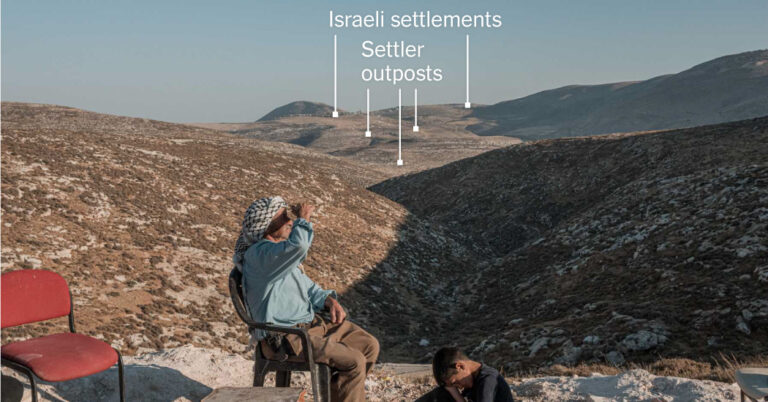
Vast stretches of his family’s farm and wheat have been seized by Israeli settlers who have set up outposts, illegal encampments that can eventually grow to become large settlements, on the nearby hills.
New roads cut through the land on which his own flock of sheep graze — and settlers routinely steal the animals, he said. Six months ago, a masked settler armed with a gun broke into his family home at 3 a.m., he recalled. He described raiders tearing through his son’s nearby home at night last December, slashing tents and stealing solar panels.
The family takes turns at night guarding their sheep against attacks from settlers. On a recent day, we found Mr. Abu Naim resting on pillows, a portable radio pressed to his ear listening for regional news.
Go away. Go away from here. Leave, Mr. Abu Naim said the settlers have told him repeatedly.
“I’m 70 years old, and I’ve been here all my life,” he replies. “But you came yesterday, and you want me now to leave, to go home.”
“This is my home.”
The fate of a farmer trying to wrest a livelihood out of a landscape dotted since biblical times by sheep and gnarled olive trees may seem distant from a modern world of clashing superpowers.
Even as the war in Gaza commanded the world’s attention over the past two years, the facts on the ground were shifting in the West Bank, intensifying the battle for control of the lands of Bethlehem and Jericho, Ramallah and Hebron.
For many Palestinians, they are the foundation of a future state of their own — and a future peace. But for many Jews, they are a rightful homeland.
Extremist Jewish settlers and Palestinian farmers are the foot soldiers in this endless conflict, an extension of the war in 1948 that accompanied the establishment of Israel. And since the Oct. 7., 2023, attack on Israel by Palestinian militants from Gaza, Israel’s far-right government has embraced a playbook of expanding settlements across the West Bank, transforming the region, piece by piece, from a patchwork of connected Palestinian villages into a collection of Israeli neighborhoods.
The unrelenting violent campaign by these settlers, that critics say is largely tolerated by the Israeli military, consists of brutal harassment, beatings, even killings, as well as high-impact roadblocks and village closures. These are coupled with a drastic increase in land seizures by the state and the demolition of villages to force Palestinians to abandon their land.
Many of the settlers are young extremists whose views go beyond even the far-right ideology of the government. They are not generally operating on direct orders from Israel’s military leadership. But they know the military frequently looks the other way and facilitates their actions.
In many cases, it is the military that forces Palestinians to evacuate or orders the destruction of their homes once settlers drive them to flee.
Accelerating violence and displacement in the West Bank
Sources: U.N. Office for the Coordination of Humanitarian Affairs; Peace Now (outposts and state land)
We attempted to speak to settlers near two of the West Bank villages that have been the targets of such pressure. None were willing to speak with us.
In a statement, the Israeli military said that its “security forces are committed to maintaining order and security for all residents of the area and act decisively against any manifestations of violence within their area of responsibility.”
The far-right Israeli government has been transparent about its mission: to sabotage what diplomats call the two-state solution and its goal of an Israeli and a Palestinian nation living side by side. “Every town, every neighborhood, every housing unit,” Bezalel Smotrich, the ultra-right-wing finance minister, said recently, “is another nail in the coffin of this dangerous idea.”
For years, the United Nations, the United States and much of the Western world have warned that the continuous expansion of Israeli settlements would eventually make the establishment of a contiguous Palestinian state impossible.
Across the West Bank, there is desperation among Palestinian villagers and farmers as they watch the takeover of their lands at a pace never seen before. And there is fear that the changes are already becoming irreversible.
We spent more than two months in a dozen villages in the West Bank, meeting with Palestinian families, local officials, Bedouin farmers and young human rights activists, often visiting from abroad. We watched as groups of young Israeli settlers showed up in Palestinian villages to harass or intimidate them.
We met a family in Tulkarm whose 21-year-old daughter, Rahaf al-Ashqar, was killed in February by an explosion set off by Israeli soldiers who raided their home, claiming they were looking for terrorists.
We saw a 16-foot fence covered with razor wire that was built this year in the town of Sinjil that now separates Walid Naim from his family’s orchards.
We watched settlers block the road and try to stop Palestinian farmers from leaving their land after harvesting their olive trees in October.
In October, after settlers and soldiers stormed the gate of Masher Hamdan’s farm in the village of Turmus Aya, he decided to evacuate his sheep, goats, lambs and poultry to save his livelihood.
The New York Times studied mapping data and court orders that document the expansion of claims by the Israeli government to land that had long been in Palestinian hands. We photographed the construction of Israeli roadblocks designed to limit Palestinian movements and saw the installation of fences that cut off farmers from their land.
The Israeli onslaught has all but vanquished a free Palestinian existence in the West Bank. While the Palestinian Authority governs part of the West Bank, the Israeli military remains the occupying power of the whole territory, and military law supersedes the authority’s rule.
There is little due process and villagers live at the mercy of vigilante settlers and members of military platoons who exert almost total power over them. Settlers, who are subject to Israeli civil and criminal law rather than the military’s jurisdiction, are rarely detained or arrested for extremist or violent actions, while the military routinely rounds up Palestinians with little explanation or justification.
In late November, the Israeli military launched what it called a counterterrorism operation in the West Bank city of Tubas, arresting 22 Palestinians. On Dec. 10, Israeli officials approved construction of 764 homes in three West Bank settlements. The day before, the military uprooted about 20 acres of olive trees in a village south of Nablus.
How to Empty a Village
The campaign to isolate Palestinians and drive them off their land is evident in Al Mughayir, about 20 miles north of Jerusalem. What used to be a thriving Palestinian village has been surrounded by Jewish settlements, and villagers like Mr. Abu Naim have been squeezed into increasingly smaller areas, cut off from their land and their livelihoods.
Al Mughayir is one of several small Palestinian villages clustered roughly in the center of the West Bank, all of which have been relentlessly targeted in recent months by settlers and the Israeli government.
This is the pattern that has played out across the West Bank, transforming the entire territory.
A Jewish outpost, not authorized under Israeli law, pops up — a small trailer, perhaps, or a large tent housing just a few young men. Settler attacks soon follow. Then come the military orders demanding evacuations of Palestinian communities and the installation of large, iron roadblocks cutting off Palestinian villagers from the rest of the West Bank.
Over weeks and months, the outposts grow and are often eventually authorized by the Israeli government. Settlers build homes, businesses, schools and roads to accommodate hundreds and eventually thousands of Jewish families. In the Palestinian villages, the opposite happens. Schools are shuttered, farmers are cut off from their lands, and homes are destroyed.
Destroyed Bedouin homes near Al Mughayir.
The campaign started in earnest after Prime Minister Benjamin Netanyahu returned to office in 2022 and accelerated after the war began. In 2024 and 2025, Israelis built about 130 new outposts, more than the number built in the previous two decades, according to Peace Now, an Israeli activist group that tracks settlement expansion.
Erasure
The flip side of the construction is destruction.
Across the West Bank, settlers and the military razed more than 1,500 Palestinian structures in 2025 — double the annual average in the decade before the war.
The dismantling of one long-established Palestinian community, East Muarrajat, began not long after a settler attack. On July 3, settlers, aided by members of the Israeli military, went house to house through the village where Bedouin families had lived for several generations in the white sand hills of the Jordan Valley, just north of Jericho.
The residents, who had already suffered years of harassment, decided that night to abandon their homes in the middle of the night when dozens of masked settlers, many of whom appeared to be drunk, showed up on four-wheeled ATVs. Some brandished guns as they raced through the village on the vehicles and circled crying women and children.
The settlers rammed the vehicles into people’s homes, then ransacked them, tearing down furnishings and throwing belongings outside while screaming obscenities.
“It was like the whole village was a compound of people screaming and yelling,” recalled one villager, Mohammed Mlehat. “We were afraid of things that are unspeakable, because they were dozens of young men who seemed to be drugged or drunk.”
A statement by the Israeli military said soldiers arrived in East Muarrajat that night after receiving reports of “friction” between Palestinians and settlers but “no violent incidents were identified.”
Fearful of more attacks, the villagers left that night, Mr. Mlehat said, and the destruction of the homes happened in the days and weeks that followed. His family now lives in tents without access to drinking water or electricity, just a few miles from where the village, now reduced to mostly rubble, once stood.
Among the few buildings still standing in East Muarrajat is an abandoned school that began operating in 1964. Through broken classroom windows, there are SpongeBob curtains still visible and school supplies scattered on the ground. A playground is littered with discarded hula hoops and backpacks strewn about.
Expelled villagers building makeshift homes.
An abandoned school in East Muarrajat.
A settler herding animals by Bedouin homes.
Mr. Mlehat’s nephew, Jamal Mlehat, said the attacks showed the hypocrisy of settlers who seek sympathy, saying they want only to establish homes for themselves. He cited a Bedouin proverb: “You attack with the wolf and you cry with the sheep.”
“This is what they did with us,” he said.
Unending Harassment
The episodes of intimidation rarely let up.
The number of attacks by extremist settlers in the West Bank has skyrocketed in the last two years. In October, there were an average of eight incidents per day, the highest since the United Nations began keeping records two decades ago.
That coincided with the start of the olive harvest in the West Bank, when many Palestinian farmers have just four weeks to secure their livelihoods from the ancient trees that cover the region’s valleys and hills.
We saw Yousef Fandi and his brother, Abed Alnasser Fandi, being attacked in a field of olive trees in the village of Huwara on the morning of Oct. 9. They told us later that day that they had been tending the family olive grove when they were surrounded by settlers.
One was on horseback, armed and masked. Two others walked beside him. A fourth carried an assault rifle.
“What are you doing here?” demanded the man with the gun, leveling the weapon at them, Yousef Fandi recalled.
The settlers took the men’s phones, ordered them to the ground and proceeded to kick them in the ribs and head for about a half-hour, a scene we witnessed ourselves. Blood spotted Mr. Fandi’s shirt as he later recounted the beating to us.
“I thought that they might shoot us,” he said.
Since Oct. 1, the United Nations reports, 151 Palestinians have been injured in more than 178 separate attacks on olive harvesters. About half were tied to settlers and the rest to soldiers, the organization said.
By the time the Israeli soldiers arrived that morning in the village of Huwara, southwest of the city of Nablus, a large group of villagers had gathered, joined by journalists and activists who had heard about the clash.
The soldiers told the settlers to leave — but bore bad news for the Palestinians eager to return to their harvest.
As the villagers pushed to gain access to the fields, one of the soldiers waved a copy of a military order. A map on the document showed the olive orchard in Huwara completely covered in red, indicating that Palestinians were not allowed in the area for the next 30 days.
“The order was signed following an operational situation assessment,” the Israeli military said in a statement in response to questions. “Accordingly, farmers were informed that they would not be permitted to harvest in the area at that time.”
Settlers attacking the Fandi brothers.
An Israeli soldier with the land-closure order.
Mohamed Suleiman, 76, with his olive trees felled by settlers.
Military orders have become a staple of the Israeli settlement drive in the West Bank, with the government often declaring territory to be “state land” and denying Palestinian claims to family-owned property.
The clash in Huwara that day ended the way many others did during the olive harvest: with the farmers denied access to their fields.
“I have the documents of this land,” Yousef Fandi protested. “This is my land.”
Deadly Confrontations
For Sayfollah Musallet, a 20-year-old Palestinian American, one of the clashes with settlers turned deadly.
One Friday in July, young Israeli settlers cascaded down from their hilltop outpost above Sinjil, armed and masked, instigating a clash with Palestinian farmers whose land the settlers claimed as their own.
A pickup truck driven by the settlers ran into a crowd of Palestinians and activists, breaking one man’s leg before speeding off, according to Jonathan Pollak, an Israeli activist who witnessed the incident. When a Palestinian ambulance arrived, settlers pelted it with rocks and batons, cracking its windshield, Mr. Pollak said.
During the confrontation, Israeli settlers beat Mr. Musallet to death, according to his family members and the Palestinian authorities. Mike Huckabee, the American ambassador to Israel and a staunch supporter of the Netanyahu government, called the death a “criminal and terrorist act” and demanded that the Israeli authorities “aggressively investigate” it.
Masked settlers hurled stones in Sinjil.
Soldiers kept Palestinians from their wounded.
Sinjil villagers were taken for treatment.
A second Palestinian man, Mohammad Shalabi, 23, was also killed during the clash. His body was found by villagers late that night with a gunshot wound and extensive bruising on his face and neck, according to his uncle.
Both men were buried at a funeral two days later that was attended by hundreds of villagers.
In the past three years alone, there were more than 1,200 Palestinian fatalities in the West Bank, nearly double the number for the decade before that, the United Nations reports.
A statement about the incident in Sinjil from the Israeli military said that “terrorists threw stones at Israeli civilians near the village” and said that the incident was being investigated.
Mr. Pollak, who was helping the Palestinians in Sinjil and was arrested by the Israeli military that day, said the violence by the settlers was part of a clear pattern.
“I want to say it was an inconceivable tragedy, but really, tragedy isn’t the right word,” he said. “You know, a tragedy is a force of nature. A tragedy is being hit by a lightning bolt. This is not what happened here.”
Renewed Attacks
For Mr. Abu Naim, the farmer in Al Mughayir, the threats to his family have not stopped.
On Sunday, Dec. 7, at 1:40 a.m., eight masked settlers armed with clubs attacked the caves and tents where Mr. Abu Naim and his nine children and grandchildren live. Six members of the family were sent to the hospital, including his 13-year-old grandson, who suffered cuts and bruises to his head.
The scene was described to us by activists, several of whom were sleeping at the home and were also injured. One of them, Phoebe Smith, who is from Britain, was wakened by screams, she said. When she went outside, she was attacked, too.
“I was outside of the tent, being beaten by them around the torso, the legs, the head,” Ms. Smith recalled as she recovered in Ramallah. “It was terrifying. Really terrifying.”
The Dec. 7 onslaught lasted about 10 minutes, she said. The attackers turned over furniture, grabbed three phones and used Ms. Smith’s laptop computer to beat several of the family members. They did not enter another tent, where Mr. Abu Naim’s daughter, nearly nine months pregnant, was cowering inside with two children.
A cave became home for some in the Abu Naim family.
Mr. Abu Naim guarding his sheep.
Some of the Abu Naim children playing near the cave.
Before heading out, the settlers issued a warning: Leave for good within two days, they said, or we will return and burn you in your home.
The Israeli military did not show up on Dec. 7. But three days later, on Dec. 10, settlers did return for another round of intimidation. Then a few hours later, activists said, five military jeeps carrying 20 soldiers and border police officers arrived with an order declaring the family’s compound a closed military zone.
Two activists were detained, and Mr. Abu Naim’s pregnant daughter and several children fled to safety. On Dec. 12, the military returned and extended the closure for 30 days. In a statement, the Israeli military said Palestinians instigated the Dec. 10 clash by throwing stones and rolling burning tires toward Israelis, which the villagers deny.
The statement said the area was declared a military zone on Dec. 12 “to maintain calm in the area following a prolonged period of tension.”
From the rocky edge of a cliff overlooking the valley, Mr. Abu Naim can keep an eye on his sheep. He can see the Jewish outposts that have sprung up in recent months. And he can try to spot any settlers headed toward his home to warn his children and grandchildren.
The war in Gaza, Mr. Abu Naim said, was a turning point.
“We used to come and go, mostly without any problems,” he recalled recently. “If we met the army, they would ask for our IDs. We give them. We went back and forth. We didn’t have the same problems.”
“But,” he added, “these guys are completely different.”
According to the announcement this morning (December 19), the deal will see the companies collaborate to “enhance music and commercial integrations across artist and fan experiences” on the platform.
UMG also said that this “collaboration reflects a shared commitment to responsible AI practices and to supporting the music and artists UMG represents”.
The deal includes the integration of commercial features designed to “drive increased engagement and revenue for artists and labels”.
Among those features is the ability for artists and labels to sell digital andphysical merchandise to fans on the platform using Shopify.
The ability for UMG artists and labels to use Shopify for digital and physical merchandise sales on the platform arrives amid the growing significance of D2C merch sales in the music industry.
UMG’s Q3 earnings revealed a 23.1% YoY jump in revenue from physical music sales, growing to €341 million (USD $398.31 million) in the quarter.
Universal’s leadership team also revealed on the company’s Q3 earnings call that two-thirds to 75% of vinyl sales come through UMG’s own D2C stores.
UMG’s new deal with Roblox arrives amid a period of “extraordinary growth” for the gaming platform.
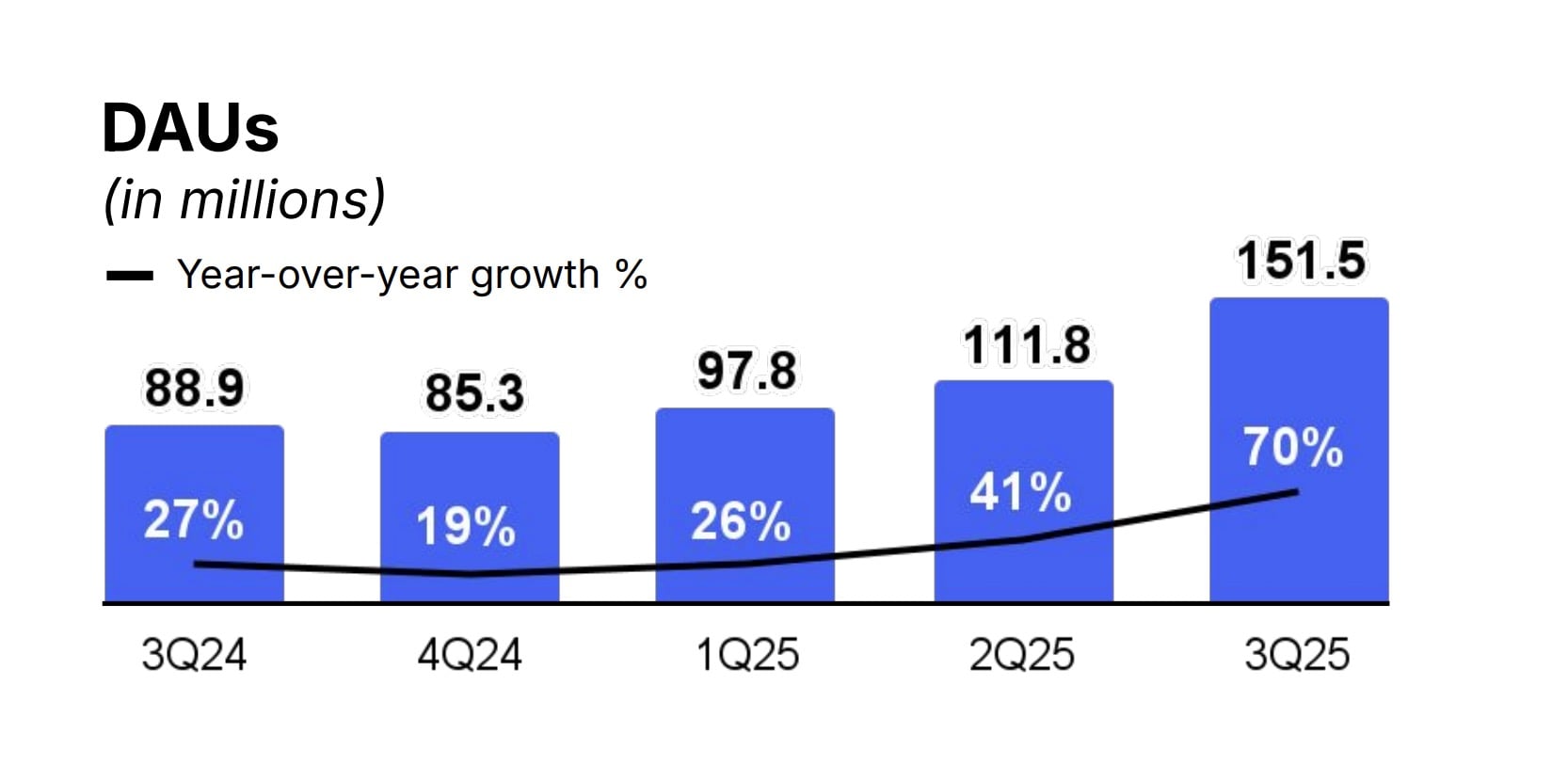
Roblox told its shareholders in October that it exceeded 150 million Daily Active Users in Q3, up 70% YoY (see below).
UMG and Roblox say that they will “work closely to streamline artist and label engagement within the platform, providing direct creative and operational support and access to new Roblox tools and beta features”.
The press release added: “By aligning on the best interests of creators, Roblox and UMG are ensuring a platform environment where participating creators can confidently leverage their intellectual property alongside evolving platform innovations”.
UMG said that it will continue to roll out a series of artist activations across the platform over the coming months, beginning with Stray Kids (JYP/Republic Records), which launches today.
Over the past two years, UMG claims to have launched “several innovative industry-first campaigns” directly on the Roblox platform.
These have included the launch of Beat Galaxy, UMG’s own curated space for music discovery in 2023, and last year saw the launch of Boombox, with Styngr, which allowed licensed music streaming to be integrated into gaming experiences within the platform for the first time.
Michael Nash, UMG’s EVP & Chief Digital Officer, also revealed today what he described as the “impending launch” of UMG’s flagship “Tastemaker experience” on the platform.
Roblox has “increasingly become a cultural hub for music fan engagement,” said UMG, citing recent artist activations from the likes of Yeat (Capitol Records), Lady Gaga (Interscope), Chappell Roan (Island Records), Glass Animals (Polydor Records/Republic Records) and Sofi Tukker (Virgin Music Group).
“UMG’s strategic relationship with Roblox is built on shared objectives of promoting innovation, empowering artists and deepening fan engagement.”
Michael Nash, UMG
In making the announcement, Michael Nash, EVP & Chief Digital Officer, Universal Music Group, said: “UMG’s strategic relationship with Roblox is built on shared objectives of promoting innovation, empowering artists and deepening fan engagement.
“With this new framework, we are strengthening our commercial, creative and operational collaboration and unlocking new opportunities for our artists and labels.
“Built on this foundation and highlighted by the impending launch of UMG’s flagship ‘Tastemaker’ experience, this agreement ensures that UMG continues to lead the industry in shaping the future of music in immersive environments.”
“This strategic agreement represents a major step forward in building the future of immersive entertainment, with this partnership significantly expanding the commercial and creative opportunities for UMG artists and labels on our platform.”
Enrico D’Angelo, Roblox
Enrico D’Angelo, Chief Business Officer, Roblox said: “We have worked closely with Universal Music Group over the years to bring some of their top artists to Roblox to engage with next-gen fans in innovative and creative ways.
“This strategic agreement represents a major step forward in building the future of immersive entertainment, with this partnership significantly expanding the commercial and creative opportunities for UMG artists and labels on our platform.”
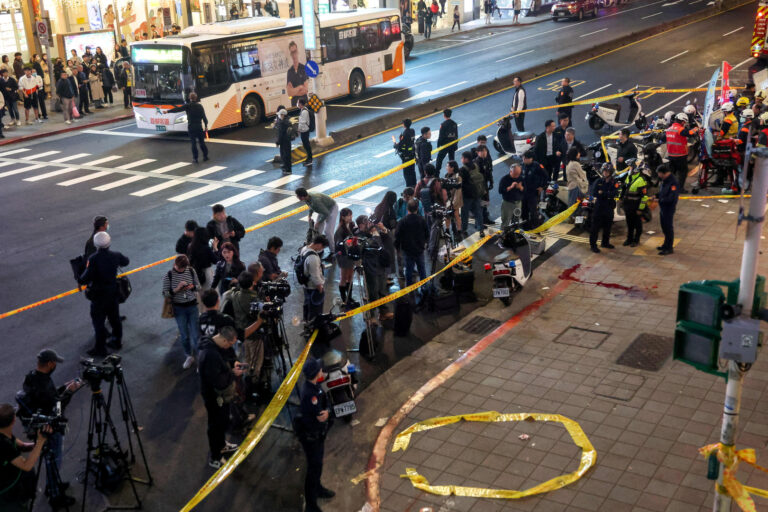
Taiwan’s president Lai Ching-te has ordered sweeping security reforms after a knife and smoke grenade attack killed three people and injured 11 in Taipei. The suspect, Chang Wen, 27, set fires and struck multiple sites before dying from a fall.
A required part of this site couldn’t load. This may be due to a browser
extension, network issues, or browser settings. Please check your
connection, disable any ad blockers, or try using a different browser.
Fitter and Faster Swim Camps is the proud sponsor of SwimSwam’s College Recruiting Channel and all commitment news. For many, swimming in college is a lifelong dream that is pursued with dedication and determination. Fitter and Faster is proud to honor these athletes and those who supported them on their journey.
Maeve Collins has announced her intention to swim for the University of California-Santa Barbara for the next four years. Collins made the announcement on Instagram, writing:
I am so excited and honored to announce my verbal commitment to continue my academic and athletic career at University of California Santa Barbara!! I would like to thank my friends, family, Coach Matt, Coach Adam and Coach Walker. Thank you Coach Jax, Coach Justin and Coach Mark for this incredible opportunity. I can’t wait to be a part of this amazing team!! #GoGauchos
Collins hails from Western Springs, Illinois, where she attends Lyons Township High School and swims year-round with RISE Aquatic Club. She’s primarily a butterfly specialist, strong in both the 100 and 200, who also competes in the 50, 100, and 200 freestyles, meaning she could prove valuable for all five collegiate relays.
Over the past year, Collins dropped from 54.92 to 54.73 in the 100 fly, 2:06.41 to 2:02.57 in the 200 fly, 24.43 to 24.20 in the 50 free, 52.50 to 51.96 in the 100 free, and 1:54.95 to 1:52.52 in the 200 free.
At the Illinois High School Association (IHSA) State Championships last month, she finished fourth in the 100 fly (55.22) after logging her second-fastest time of 54.74 in prelims. She also helped Lyons finish runner-up in the 200 medley relay (24.18 fly split) and contributed to seventh and eighth-place finishes in the 200 and 400 free relays with splits of 23.81 and 51.29, both well under her flat-start PBs. It was her third year qualifying for the meet; she finished fifth in the 100 fly as both a sophomore and junior.
Beyond high school competition, Collins is an NCSA qualifier, Winter Juniors qualifier, and Summer Junior Nationals qualifier. She also competed at the World Aquatics World Cup this past November, finishing 22nd in the 100 fly (1:01.23), her first time swimming the event in short course meters.
UCSB is a member of the Big West Conference, where its women’s team won last season, scoring 773.5 to UCSD’s 714.5.
Collins’ personal bests in the fly events would have placed eighth in both ‘A’ finals at last season’s conference meet. Her 100 and 200 free times would have squeaked her into the consolation finals, while her 50 free (24.20) is just under half a second off the 23.78 that was needed for a second swim.
On last season’s depth charts, she would have ranked fourth in both flys, fifth in the 200 free, seventh in the 100 free, and 14th in the 50 free. She could be an immediate factor on the squad’s 800 free relay if she can approach a sub-1:52 swim.
Samantha Banos, who won the 200 fly, 200 free, and 500 free at the 2025 conference meet, is graduating this May, making Collins’ arrival particularly timely. She will overlap one season with the team’s top all-around flyer, Sammie Hall (54.41/2:00.02), as well as Makena Leacox (52.80), the reigning 100 fly conference champion.
Collins joins a UCSB recruiting class that includes five other publicized recruits: Stela Sufuentes, Lillia Barlow, Lilli Perner, Melina Seider, and Viola Griebenow.
If you have a commitment to report, please send an email with a photo (landscape, or horizontal, looks best) and a quote to Recruits@swimswam.com.
About the Fitter and Faster Swim Tour
Fitter & Faster Swim Camps feature the most innovative teaching platforms for competitive swimmers of all levels. Camps are produced year-round throughout the USA and Canada. All camps are led by elite swimmers and coaches. Visit fitterandfaster.com to find or request a swim camp near you.
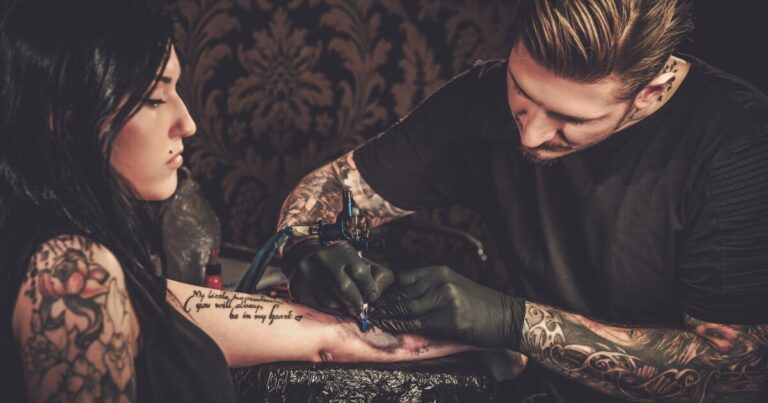
Tattoos have gained widespread popularity, with nearly one in three Americans having at least one. But beneath the colorful designs lurks a hidden journey. According to a new study, tattoo ink doesn’t stay in the skin; it travels and accumulates in the lymph nodes, potentially causing lifelong changes to the immune system. The findings offer no conclusion as to whether these changes are positive or negative, but suggest that pigment retention in lymph nodes can persistently alter local immunity.
“Tattoos are not only a cosmetic treatment, but they are also associated with some important problems like the presence of some inflammation in the immune system, which we need further study [of] in the future,” the first author of the study, Santiago F. Gonzalez, told New Atlas.
A complex admixture of the ink that is insoluble in bodily fluids grants durability to tattoos. While previous studies have linked tattoo ink ingredients to various health issues, research on the interaction of ink components with the immune response is scarce. To evaluate how tattooing affects the immune response, Santiago and his colleagues set up a mouse model.
The researchers tattooed a small 25-square-millimeter patch on the footpads of mice with three commonly used commercial inks (black, red and green). Using advanced microscopy, the team tracked the real-time transport of ink immediately after tattooing. The results revealed that the ink does not stay only in the skin, but gets transported to the lymph nodes. In the lymph nodes, macrophages – immune cells that destroy germs and damaged cells – capture this ink and initiate an inflammatory response.
Within 24 hours, researchers observed a “significant decrease” in the total number of macrophages, indicating that tattoo ink induced macrophage death. The traces of the ink in the lymph node were present even after two months.
The paper hypothesizes that the ink persistence and the macrophage death could affect the capacity of these cells to control the spread of pathogenic viruses and bacteria.
“We are, at the moment, in follow-up studies evaluating these possibilities,” Santiago told New Atlas. “We also have to further investigate and see the connection between tattoos and cancer.”
Since macrophages are critical to the generation of a robust immune response following vaccination, the team was interested to test vaccines. They injected an mRNA-based COVID-19 vaccine or a UV-inactivated influenza shot directly into the tattooed footpad. For the COVID vaccine, antibody responses against the spike protein weakened. Meanwhile, for the influenza vaccine, the opposite happened: the ink likely amplified the immune response.
Santiago explains that for mRNA-based vaccines, macrophages are needed to capture the vaccine and express the antigens that make the mRNA vaccine work.
“In the tattooed individuals, these macrophages are full of ink; therefore, the ink basically does not allow them (vaccine) to work as they should,” Santiago tells us.
In the case of the influenza vaccine, the response is directed by dendritic cells, not by macrophages.
“These dendritic cells sense the inflammation generated by the dying of the macrophages as some sort of an adjuvant,” Santiago says, explaining why an immune response is possibly amplified by tattoo ink.
Ultimately, Santiago suggested people should generally avoid getting a vaccine shot directly into tattooed skin. And more generally, he suggests people be cautious with the practice of tattooing. There are still a lot of unknowns yet to be researched.
“We don’t want to scare the population, obviously, but we want it to have at least some caution with respect to doing more tattoos,” he told us.
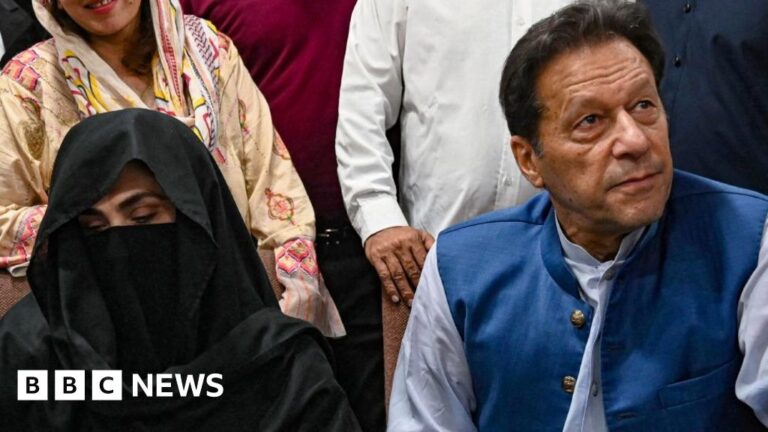
Former Pakistan Prime Minister Imran Khan and his wife Bushra Bibi have been sentenced to further jail terms following a fraud case involving state gifts.
They were convicted of breaking Pakistan’s rules on gifts after Bibi was given a luxury jewellery set by Saudi Arabia’s Mohammed bin Salman during a 2021 state visit.
The pair are already serving time in prison for earlier convictions, and the new sentences – 10 years for criminal breach of trust and seven years for criminal misconduct, and a fine – will reportedly run concurrently to their earlier terms.
Khan has described the charges as politically motivated and his lawyer told BBC News his team plan to challenge the verdict.
Speaking to the BBC after the hearing, the former prime minister’s lawyer, Salman Safdar, said Khan’s legal team had only been informed about the sentencing late on Friday night, after normal court hours.
They planned to mount a challenge to the verdict in the high court, Mr Safdar said.
He has faced charges inmore than 100 cases, ranging from leaking state secrets to selling state gifts. The BBC has been unable to confirm the exact number brought against him.
The jewellery case, referred to as Toshakhana 2 in Pakistan, concerns a Bulgari jewellery set given to Bushra Bibi by Saudi Arabia’s Crown Prince Mohammed bin Salman during a state visit in 2021, according to court documents.
Under Pakistan’s rules on state gifts, these items go to Pakistan’s Toshakana department (state treasury), but politicians are able to purchase the items back.
Khan is alleged to have asked a private firm to undervalue the jewellery set, before purchasing it back at a significantly reduced price.
In addition to their jail terms, the pair were handed a fine of over 16 million Pakistani rupees (£42,600).
Khan was also convicted in an earlier, different Toshakhana case – but he challenged that conviction, meaning his sentence is suspended until the outcome of his appeal.
He also has other cases outstanding against him.
These include terrorism charges relating to violent protests that took place on 9 May 2023, when he was previously arrested.
Khan was Pakistan’s prime minister until April 2022 when he was ousted in a vote of no confidence.
Although he has not been seen in public, his social media accounts have continued to operate with messages attributed to him on X often appearing after jail visits.
These have been highly critical of Pakistan’s current government and its politically powerful army Chief Field Marshall Asim Munir, including posts calling him a tyrannical dictator.
In November, he was denied any visitors for nearly a month.
After campaigning by his family and party, his sister was allowed to visit in early December; a few hours after she saw him, his account posted a comment credited to Khan calling the Field Marshall Asim Munir a “mentally unstable person”.
Khan has not been allowed any family visits since.
The judgement states the judge was lenient in sentencing because of Khan’s “old age”.
Update: This story was updated to clarify the latest legal status of Khan’s earlier, separate Toshakhana case.