
0.4 C
New York
Thursday, February 12, 2026
Home Blog Page 114

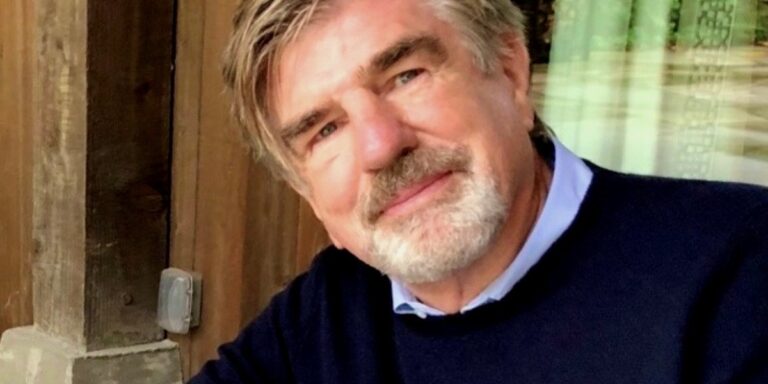
Tom Freston, the innovative executive behind MTV’s coolness for two decades, finds no consumer benefit in Netflix, Warner, or his former company.

0

Tom Freston has never been a typical media executive. Freston began with a countercultural spirit that shaped an adventurous career spanning from co-founding MTV to leading Viacom and Paramount Pictures. After spending 26 years at Paramount—now caught up in the $100 billion bidding for Warner Bros Discovery—he remains a defining figure in the evolution of modern entertainment.

The 80-year-old executive, who sounded remarkably youthful in a phone interview with Fortune, harkened back to the days in the 1960s and ’70s when “freedom was in the air.” The vibe was very different then: “It was like, I don’t want to work for ‘the man,’” he told Fortune, referencing a formative summer when he worked as a bellboy in Lake George in the Adirondack foothills of upstate New York. “I had sort of been on the traditional conveyor belt: go to college, get out, get a job. And then I met all these sort of bohemian characters who — their idea was, you didn’t have a career. You kind of improvise your life. You know, the idea was to kind of maximize experience and do interesting things and take some risks.”

Freston added that he was a big fan of both “beat” and libertarian literature, the former made famous by Jack Kerouac and Allen Ginsberg and the latter by Ayn Rand. They both had common themes, he said: “experience and being an individual were important.” As he writes in his new memoir Unplugged, this improvisational journey took him to Afghanistan and India, a business career that was “wild and fulfilling and for a long time profitable.” But it was also “really hard work” and was “really humbling,” adding that “humility is not a thing you see a lot of in the entertainment business.” He didn’t comment directly on the major figures in the current bidding war for Warner Bros., but the example of David Zaslav moving into famed producer Robert Evans’ Hollywood mansion is a prime example of the neo-mogul mindset.

Freston has long been semi-retired, advising media brands such as Oprah Winfrey and Vice while serving as the chairman of the ONE Campaign, the anti-poverty effort in Africa led by U2’s Bono (a friend, Freston said).

As Freston rolled back the years with Fortune and looked out on a much-changed media landscape, he briefly donned his antitrust hat to analyze the bidding war between Netflix and his old company Paramount for Warner Bros. Discovery and how things got to this point. “No matter which way it goes, there’s really nothing in it for the consumer,” Freston said with a sigh.

How Netflix followed in MTV’s footsteps

Freston observed that the media industry is now dominated by “monolith companies … increasingly run by tech people, where data becomes more important than instinct.” He highlighted A24 and Neon as two companies that remind him of the old, almost artisanal MTV, where refreshing the creative instinct became core to success, because Viacom’s once-dominant basic cable lineup appealed to a transient youth culture. “Our challenge was: how do we continue to innovate for these changing demographics that would pass through us, whether it be on [Nickelodeon] or on MTV or Comedy Central or whatever.”

Just 33 years old when he started leading MTV, Freston pointed out that the original audience was Baby Boomers like himself, which was then replaced by Gen Xers with different sensibilities, and so on. Talent can’t be overlooked, Freston argued, because he wanted a creative and “cutting edge” mentality that would stay hooked up to a youth culture that turned over every five years or less. “I didn’t put a salesperson in charge, which would be a traditional way in the television business. I had a creative person in charge.”

In many cases, MTV was someone’s first job, “and they’d learn some things and leave in a few years, and they’d be replaced with another younger person.” He argued that keeping the employee population young made it easier to reinvent the network periodically. When the end came shortly after the millennial generation’s heyday, exemplified by the Total Request Live program, Freston explained that the same forces afoot in Warner-Netflix-Paramount were leaving MTV exposed to the digital wave.

“We were precluded from using our music video library online,” Freston said, explaining that the same licensing deals that had enabled MTV to dominate youth culture for decades proved its undoing when YouTube disrupted how young people liked to watch music videos. “The real players turned out to be the social networks and it was hard to invent one,” he added. “You had to buy one of the ones that were out there, and the only one that ever really got bought was MySpace, and that kind of disintegrated.” The other social-media networks were able to build “unbelievable franchises because they were able to run at losses for years without Wall Street piling on, which would have happened for any of the legacy media companies.”

Reflecting on his own “missed opportunity” to bridge this gap, Freston recounted Viacom’s attempt to buy Facebook when the platform had only $9 million in revenue. He recalled Mark Zuckerberg’s visit to discuss a potential acquisition: “I remember he had a hoodie on and flip flops. It was February in Times Square. And he was younger than anybody on our young staff.” While Viacom was the first to make a bid for Facebook, Freston believes Zuckerberg was never serious about selling, more that he was “curious about, what’s a youth media company today look like.”

The MTV-Netflix cycle

Netflix and other platforms, of course, achieved massive scale by playing the upstart MTV role. “They were able to run at a profit because they were these new growth businesses. Wall Street turned a blind eye to losses for a long time. They got forgiveness on that score.” He added that they began to “vacuum up IP” without necessarily having deals in place. While Netflix went the more traditional licensing route when Hollywood didn’t see it as a threat, Freston noted that MTV was prevented from fighting YouTube’s viral videos with its own digital music presence, almost like a revenge of the record labels that wrote those terms into the licensing deals.

Freston said he doesn’t think any legacy media company distinguished itself in meeting the digital challenge with full force. “Disney did the best job, I think, which was basically tripling down on their content capabilities in trying to make themselves more invincible and more crucial for the streaming services and for the digital onslaught to build up the biggest array of IP.” He agreed that it was ironic in some senses that Netflix seems to be following that playbook with its pursuit of Warner Bros. He said he sees the same old cycle turning: “The forces for this deal seem to be inexorable. Consolidation seems to be the strategy for the moment.”

Today, Freston said he sees his former empire, MTV, as a cautionary tale of what happens when that emphasis on creativity gets severed. He lamented that leadership has “run it into the ground over the last 15 years” by replacing music-obsessed staff with “traditional kind of Hollywood showmaker type people,” replacing hungry, music-obsessed creatives with a shorter-term mindset. His most symbolic grievance is the removal of the words “Music Television” from the logo—a decision that “drove me crazy.”

Freston said he was grateful for his exciting ride at the helm of Viacom for many years, and grateful for some of the genuine friendships that emerged from his time running MTV. He highlighted Bono specifically, with whom he has worked in a chairman role for ONE and (Red), fighting poverty and AIDS in Africa. He said he knew a bit about Africa and poverty issues from his time working and living in Asia and also traveling in Africa, but he also mentioned good relationships with certain people he clicked with: John Mellencamp, David Bowie (a “fascinating character”) and Jon Bon Jovi.

In his laid-back style, Freston added that he wasn’t sure when he sat down to write that there’d by “any kind of reasonable narrative to my life, which at one point seemed to be all these disparate parts.” He came away thinking that his career had been in pursuit of a couple common objectives: trying to “live and exist off the mainstream, more on the edge of the road,” where things are more interesting and independent.

The “beat-poet” executive said he still believes in the MTV brand, and it could come back with some creativity, maybe by positioning MTV as a human curator to counter “algorithm-type music consumption.” But he knows he isn’t the man to lead it. “It’s really a young person’s business,” Freston said, suggesting the reins should be handed to a 25-year-old who can operate with the same risk-taking humility he learned decades ago on the roads of Asia.

Editor’s note: The author worked for Netflix from June 2024 through July 2025.
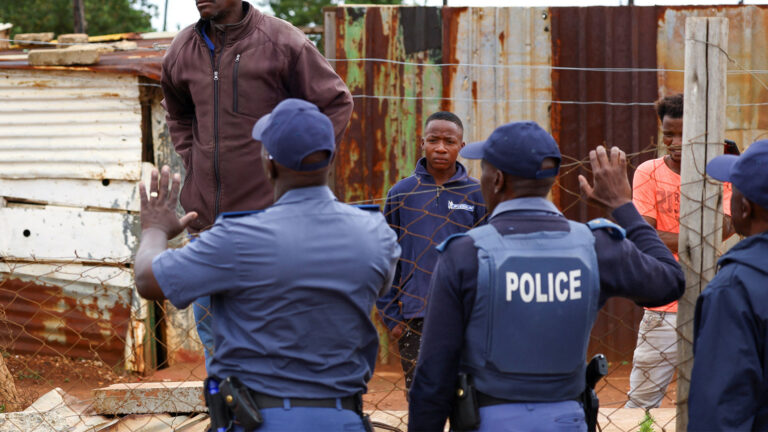
Police in South Africa launch manhunt following mass shooting in Johannesburg | Gun violence on the rise

0

NewsFeed

South African police say they have launched a manhunt in search of the suspects that carried out a mass shooting at a tavern in Johannesburg, killing nine people and injuring 10 more.

AEG sees 19% increase in events at London’s O2 Arena, reaching 239 in 2025; ticket sales rise by 11.4%

0

London’s O2 Arena saw a 19% YoY jump in arena performances to a new all-time high of 239 in 2025, as ticket sales rose 11.4% YoY to 2.9 million.

That’s according to figures published by the venue’s owner and operator, AEG, on Wednesday (December 17).

AEG said the venue also set a new attendance record when Radiohead drew 22,355 fans during a four-night run, exceeding the arena’s 20,000 capacity.

AEG attributed what it called “a landmark year for the venue” to reinvestment in live event technologies, enhanced premium ticketing options and diverse programming across music, sport, entertainment and comedy. The venue recently switched to 100% renewable energy.

First-time performers at the O2 jumped 34% YoY to 55 acts, including Sabrina Carpenter, Tate McRae, Pitbull and Tyler, the Creator. A number of these artists sold out multiple nights during their debuts. The venue also hosted its first performers from China, Singapore, Japan and Turkey.

The O2 topped Billboard‘s year-end charts for total attendance and number of shows while ranking second globally for revenue. It remains the only UK venue among the world’s top 20 arenas by these metrics, AEG said.

Commenting on the venue’s performance this year, Steve Sayer, Senior Vice President and General Manager, The O2, said: “2025 has been an extraordinary year for The O2, marking our third consecutive year of record-breaking success and firmly cementing our position as the world’s most popular live entertainment venue.”

“2025 has been an extraordinary year for The O2, marking our third consecutive year of record-breaking success and firmly cementing our position as the world’s most popular live entertainment venue.”

Steve Sayer, The O2

“Welcoming more events and more fans than ever before is a powerful reflection of both the continued strength of the live entertainment sector and the relentless dedication of our team, who work tirelessly to deliver best-in-class experiences for the millions of guests we are proud to host each year.

Sayer added: “Our 2025 program has been ambitious, diverse, and truly global, while The O2 continues to set the standard for innovation, fan experience, and sustainability. This year stands as one of the most successful in our history, and as we look ahead to 2026, our commitment to delivering world-class content and supporting the artists, partners, and communities we serve has never been stronger.”

The O2’s strong performance comes amid the continued rebound in live entertainment post-pandemic. In September, new data from industry group Live music Industry Venues and Entertainment (LIVE) showed that consumer spend on live music events in the UK jumped 9.5% YoY in 2024 to GBP £6.68 billion (USD $7.23 billion at the average exchange rate for 2024).

LIVE is a federation of 15 live music industry associations representing 3,000 businesses, 35,000 artists and 2,000 backstage workers.

“This year stands as one of the most successful in our history, and as we look ahead to 2026, our commitment to delivering world-class content and supporting the artists, partners, and communities we serve has never been stronger.”

Steve Sayer, The O2

The report noted that UK live music growth doubled that of the global recorded music industry, citing data from Goldman Sachs’ Music in the Air report showing that recorded music revenues rose by 4.8% worldwide in 2024.

However, LIVE flagged the ongoing problem faced by small and grassroots music venues, which have been shutting down at a rapid pace in recent years.

LIVE CEO Jon Collins said at the time: “While UK live music continued the post-lockdown trend of strong performance for the biggest names at the biggest venues… pressure built across our grassroots as venues closed, tours were cancelled or cut back and festivals called time.

Most recently, AEG said The O2 last week announced a three-year partnership with Music Venue Trust (MVT) that includes direct donations each time a new headliner performs at the arena for the first time. MVT represents hundreds of grassroots music venues across the UK.

To mark the start of the partnership, The O2 made an initial “six-figure donation” to MVT.

Elsewhere across AEG’s UK operations, AEG Presents UK on November 20 formally opened the booking diary for its new 3,800capacity music and events venue at Olympia London, unveiling British Airways ARC as the venue’s official name.

Overseas, AEG’s ticketing arm AXS formed a joint venture with Japan’s Lawson Entertainment in October and agreed to take a majority stake in Singapore-based SISTIC that same month.

Music Business Worldwide

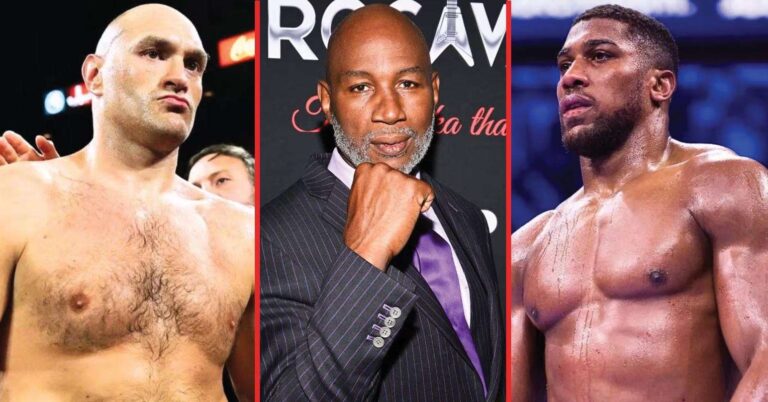
Lennox Lewis predicts Tyson Fury will win against Anthony Joshua: “I have to choose him”

0

Lennox Lewis has delivered his thoughts on a money-spinning encounter between Tyson Fury and Anthony Joshua, which is seemingly in the works for next year.

It was reported earlier this month that the long-awaited clash was being discussed for 2026, with Fury’s promoter Frank Warren then confirming that a Joshua showdown is being explored for next summer.

In the meantime, both former world champions are expected to enter ‘keep-busy’ fights in the coming months, with ‘AJ’ set to appear on a Riyadh Season show in February.

Fury, of course, has not fought since suffering a second points defeat to Oleksandr Usyk in December 2024, which came just a month before the unexpected announcement of his retirement.

But now, it would appear that ‘The Gypsy King’ could once again make a sensational comeback, with heavyweight contender Arslanbek Makhmudov being mooted as a possible opponent.

As for Joshua, he did what most expected and blasted out YouTuber-turned-boxer Jake Paul in six rounds last Friday in Miami.

That contest was the first time that Joshua has fought since his fifth-round stoppage defeat to Daniel Dubois in September 2024.

Should his fight with Fury materialise, then heavyweight legend Lewis, who shared his thoughts in a recent interview with Mail Sport, believes Fury would be the man to get his hand raised.

“I would have to say Tyson Fury. [He’d] just outbox him, Tyson Fury’s elusive he moves well.”

How Spiders Survive by Creating Self-Portrait Decoys

0

Step aside, Van Gogh. Some spiders are out here making self-portraits for survival. New research shows that several orb-weaving species construct giant web-mounted “doppelgängers” convincing enough to confuse potential predators. It’s an unexpectedly clever form of deception that blurs the line between instinct and ingenuity.

Deep in the Amazon rainforest of Peru, and on the slopes of Mount Kanlaon in the Philippines, some of the most unexpected “art” appears suspended in silk. In a recent study published in Ecology and Evolution, researchers report the first documented observations of orb-weaving Cyclosa spiders building life-like replicas into their webs, a behavior that appears far from accidental.

In both regions, researchers observed the same pattern: Cyclosa spiders constructing the replicas piece by piece directly into the web. The finished figures, often larger than the spiders themselves, occupied the center, while the living spiders positioned themselves nearby. These were not trapped insects or accidental debris, but structures that transformed the web into something that functioned as a decoy.

Two species of spiders have been observed building elaborate structures to trick would-be attackers.

George Olah

Up close, these doppelgängers appear strikingly similar to the spiders themselves. Each mirrors the basic spider structure, including a central mass with the suggestion of legs. To construct them, the spiders bind silk with nearby materials, including leaf fragments, insect remains, bits of old prey, and occasionally soil. Once completed, the spiders continue to maintain and modify the decoys, keeping them suspended near the center of the web.

These oversized replicas belong to a broader category of web structures called stabilimenta, decorative elements that many orb-weavers add to their webs. Despite decades of study, their function remains debated. Researchers have proposed several explanations, from preventing birds from flying through webs and attracting prey, to reducing the risk of predation. For Cyclosa, the evidence points most strongly towards a defensive strategy against predators.

One key threat comes from helicopter damselflies (pseudostigmatinae), which hover in front of webs and selectively target small spiders measuring 3 to 6 mm. Vertebrate predators, including birds and lizards, may also be deterred by the oversized silhouette, mistaking the decoy for larger, less manageable prey. The researchers suggest the structures function as a general defense against predators that rely on visual cues.

What makes these decoys so striking isn’t just their size, but the accuracy behind the artistry. Each one echoes the spider’s proportions closely enough to pass for a real animal at a glance, suggesting a level of spatial organization and material choice that goes beyond simple web upkeep. Cyclosa isn’t weaving random clutter into place. It’s assembling a shape that mirrors its own body, then scaling it up to shift how predators perceive the web.

Researchers have also found that it isn’t just one species, but multiple Cyclosa spiders across distant forests using the same basic strategy, hinting at a widespread evolutionary solution rather than a rare behavioral quirk. It’s behaviors like this that challenge the lingering assumption that invertebrate decision-making is rigid or purely mechanical.

A is a spider in the Philippines; C, D, and E are spiders in Peru; F is an unknown species of spider seen in Madagascar.

Olah et al, Ecology and Evolution.

In the case of Cyclosa, that challenge plays out not through changes to the spider’s body, but through changes to how it is seen. By shaping debris and silk into oversized replicas, the spiders alter the visual information predators rely on, gaining protection without confrontation. In the quiet geometry of their webs, survival may hinge less on strength or speed than on how convincingly a spider can render its own likeness.

In evolutionary terms, it may be one of nature’s most creative self-portraits. How the spider knows what it looks like is the mystery it leaves behind.

The study was published in the journal Ecology and Evolution

Source: ANU

Bondi Beach attack victims remembered with a minute of silence

0

Katy Watson,Australia correspondentand

Tiffanie Turnbull,Bondi Beach

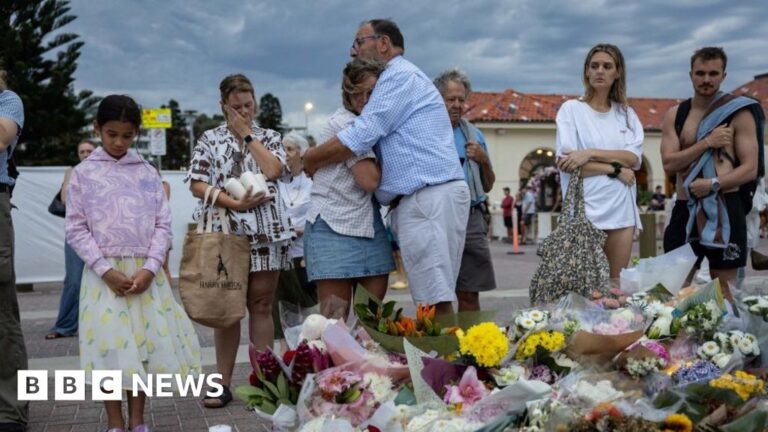
Reuters People in summer clothes mourn near floral tributes placed for victims and survivors of a deadly mass shootingReuters

Mourners in Australia have fallen silent in honour of the victims of the Bondi Beach attack.

The memorial was part of a national day of reflection to mark a week since the shooting in which two gunmen opened fire on an event celebrating the Jewish festival of Hannukah.

A 10-year-old girl, a British-born rabbi and a Holocaust survivor were among the 15 people killed during the attack.

Prime Minister Anthony Albanese was booed when he arrived at the memorial event – an expression of anger by Australia’s Jewish community against his government after a rise of antisemitic attacks over the past few months.

As the sun set over Sydney on Sunday evening, a minute’s silence was observed at 18:47 (07:47 GMT) – exactly one week since the first reports of gunfire at the famous beach.

There was heavy security at the memorial event. Some cordoned-off areas were guarded by armed riot squad officers who had their faces covered, while a police patrol boat was visible off the coast of Bondi Beach.

For many Australians, this level of security is an unfamiliar sight.

A large crowd – many wearing kippas [the Jewish skullcap] or draped in Australian flags – gathered to listen to speeches after the observing the silence.

Bee balloons floated in the wind in honour of the youngest victim of the attack, Matilda – a reference to her nickname, “Matilda Bee”.

And later in the ceremony, the crowd sang Waltzing Matilda, the song for which the 10-year-old was named.

Soon, they were chanting the name of another child – Chaya, a 14-year-old who put herself in the firing line to protect a stranger’s children. Shot in the leg, she used crutches to take to the stage and urge the nation to be brave and kind.

“If you guys get inspired by one thing, one thing on all this, be the light in that field of darkness,” she said.

The event ended with the lighting of the menorah – something the crowds gathered for Hannukah last week couldn’t do.

Sunday’s memorial was not limited to Bondi Beach – or the state of New South Wales. In a nation-wide gesture of “light over darkness”, the windowsills of countless homes were lined with candles.

Watch: Moment Australian PM Anthony Albanese booed at Bondi memorial

As Albanese arrived for the ceremony, one person in the crowd shouted: “Blood on your hands.”

The prime minister looked startled at the hostility, his wife Jodie Haydon grasping his arm in support.

At least one member of the crowd was tackled by police after moving towards the prime minister.

The Jewish community in Australia has repeatedly said this attack was a shock, not a surprise after a rise in antisemitic attacks in Australia since the 7 October 2023 Hamas attack on Israel and the subsequent military retaliation war launched by Israel in the Gaza Strip.

The overwhelming view is that more could and should have been done to prevent the Sydney attack from happening.

Albanese has acknowledged the criticism, saying “I accept my responsibility for the part in that as prime minister of Australia.”

More widely, Albanese has been accused by some of siding with the Palestinians over supporting Israel and the relationship worsened when he moved to recognise the state of Palestine earlier this year.

Israeli Prime Minister Benjamin Netanyahu has accused him – as well as the leaders of other countries that have recognised a Palestinian state – of rewarding Hamas.

After the Bondi beach attack last Sunday, Netanyahu said Albanese’s government “did nothing to stop the spread of antisemitism in Australia”.

In contrast to the reception for the Australian prime minister, Chris Minns, the Premier of New South Wales, was praised at the Sydney memorial service as an exemplary leader, partly for the speed with which he admitted government errors in the lead-up to the attack.

He also attended the funerals of several victims this week. Albanese was not invited to some.

“We are deeply sorry.” Minns said at the event. “We grieve with you, and with humility, I acknowledge that the government’s highest duty is to protect its citizens. And we did not do that one week ago.”

The shooting had “highlighted a deep vein of antisemitic hate in our community”, Minns said, adding: “This must be confronted.”

The president of the New South Wales Jewish Board of Deputies, David Ossip, was hailed with loud cheers as he called for a “Royal Commission which goes beyond New South Wales, to get to the bottom of how this catastrophe took place”.

Naveed Akram, 24, has been charged with 59 offences, including 15 counts of murder and one of committing a terrorist act. His father Sajid was killed during the attack.

Days after the attack, Prime Minister Albanese announced a raft of measures to crack down on hate speech and incitement to violence.

Before Sunday’s ceremony, he announced a review into the police and national intelligence agencies.

“The ISIS-inspired atrocity last Sunday reinforces the rapidly changing security environment in our nation,” Albanese said, using an acronym for the Islamic State group.

He has also said he will reform gun laws and the government has launched a gun buyback scheme – the largest since the Port Arthur massacre in 1996, which left 35 people dead and prompted Australia to introduce world-leading gun control measures.

Challenging the Client

0


Client Challenge


JavaScript is disabled in your browser.

Please enable JavaScript to proceed.

A required part of this site couldn’t load. This may be due to a browser
extension, network issues, or browser settings. Please check your
connection, disable any ad blockers, or try using a different browser.

Is the Jake Paul vs Anthony Joshua Match Beneficial for the Boxing Industry? | Digital Series

0

Samantha Johnson looks at how audience, attention and money are reshaping modern boxing.

Jake Paul is a YouTuber with a global audience. Anthony Joshua is a former unified heavyweight champion. And the two go head to head in Miami. But this fight isn’t about rankings or legacy. It’s about the audience, attention, and money. Samantha Johnson asks what does boxing value more today, titles or attention?

Weekly Street Calls

0


Street Calls of the Week

Survivors express caution and doubt over partial release of Epstein file

0

Watch: Images, cassettes and high-profile figures – What’s in the latest Epstein files?

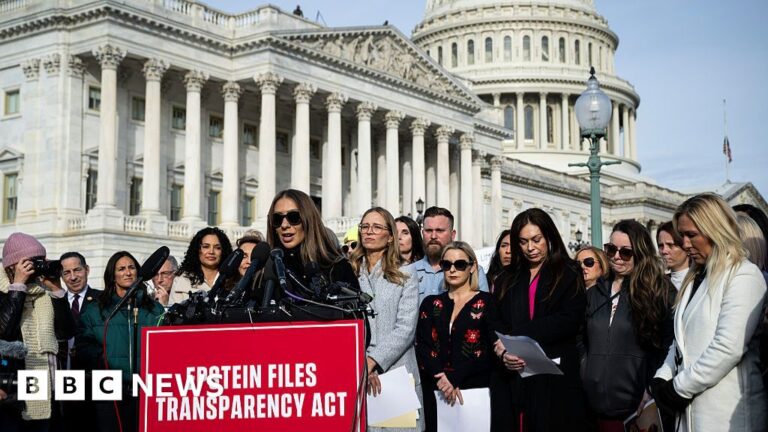
The release of thousands of pages of documents related to the late sex offender Jeffrey Epstein’s abuse by the US department of justice (DOJ) has left some who were anxiously awaiting the files disappointed.

By law, the DOJ had to make all materials public by the end of Friday. But only some have been released, many with numerous redactions.

The lawmakers who pushed for these documents to see the light of day have described the DOJ’s efforts as insincere, and some legal experts say that the redactions may only fuel ongoing conspiracy theories.

“We just want all of the evidence of these crimes out there,” Epstein survivor Liz Stein told the BBC.

Ms Stein told Radio 4’s Today programme that she thought the justice department was “really brazenly going against the Epstein Files Transparency Act” – the law that requires all the documents to be released.

Survivors are really worried about the possibility of a “slow roll-out of incomplete information without any context”, she noted.

Marina Lacerda, who was 14 when she was abused by Epstein, also told the BBC some of the survivors were “still nervous and sceptical about how they are going to release the rest of the files”.

“We are very worried that it will still be redacted in the same way that it was today.

“We are a little disappointed that they’re now still lingering on and distracting us with other things.”

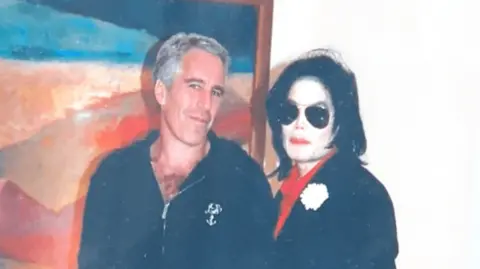
US Department of Justice Epstein poses with Michael Jackson US Department of Justice

Epstein poses with Michael Jackson

Among the latest released information is a photo of Epstein now jailed confidante Ghislaine Maxwell outside Downing Street – the UK prime minister’s office and residence – a document that claims Epstein introduced a 14-year-old girl to US President Donald Trump at Mar-a-Lago, and multiple images of former President Bill Clinton.

Other released photos show the interiors of Epstein’s homes, his overseas travels, as well as celebrities, including Andrew Mountbatten-Windsor, Mick Jagger, Michael Jackson, Diana Ross and Peter Mandelson – former UK Labour Party politician and ambassador to the US.

Being named or pictured in the files is not an indication of wrongdoing. Many of those identified in the files or in previous releases related to Epstein have denied any wrongdoing.

Trump has consistently denied any wrongdoing in relation to Epstein and has not been accused of any crimes by Epstein’s victims. Clinton has never been accused of wrongdoing by survivors of Epstein’s abuse, and has denied knowledge of his sex offending.

At least 15 of the released files were no longer available on the DOJ website on Saturday.

One of the missing files showed a mass of framed photos on a desk, according to CBS, the BBC’s media partner in the US. The photos showed Bill Clinton, and another was of the Pope. In an open drawer, there was a photo of Trump, Epstein, and Maxwell.

Other missing files included photos of a room with what appeared to be a massage table and nude photos and nude paintings.

It was not clear why the files were no longer available.

In a post on X on Saturday night, the DOJ wrote: “Photos and other materials will continue being reviewed and redacted consistent with the law in an abundance of caution as we receive additional information.”

The BBC has asked the DOJ for comment.

Deputy US Attorney General Todd Blanche said on Friday – the day the materials were released – that the department had identified more than 1,200 Epstein victims or their relatives, and withheld material that could identify them.

But many of the documents are also heavily redacted.

The DOJ said it would comply with the congressional request to release documents, with some stipulations.

It redacted personally identifiable information about Epstein’s victims, materials depicting child sexual abuse, materials depicting physical abuse, any records that “would jeopardise an active federal investigation” or any classified documents that must stay secret to protect “national defence or foreign policy”.

The DOJ said it was “not redacting the names of any politicians”, and added a quote they attributed to Blanche, saying: “The only redactions being applied to the documents are those required by law – full stop.

“Consistent with the statute and applicable laws, we are not redacting the names of individuals or politicians unless they are a victim.”

John Day, a criminal defence attorney, told the BBC he was surprised by the amount of information that was redacted.

“This is just going to feed the fire if you are a conspiracy theorist,” he said. “I don’t think anyone anticipated there would be this many redactions. It certainly raises questions about how faithfully the DOJ is following the law.”

Mr Day also noted that the justice department is required to provide a log of what was being redacted to Congress within 15 days of the files’ release.

“Until you know what’s being redacted you don’t know what’s being withheld,” he said.

In a letter to the judges overseeing the Epstein and Maxwell cases, US attorney for the Southern District of New York Jay Clayton, said: “Victim privacy interests counsel in favour of redacting the faces of women in photographs with Epstein even where not all the women are known to be victims because it is not practicable for the department to identify every person in a photo.”

Clayton added that “this approach to photographs could be viewed by some as an over-redaction” – but that “the department believes it should, in the compressed time frame, err on the side of redacting to protect victims.”

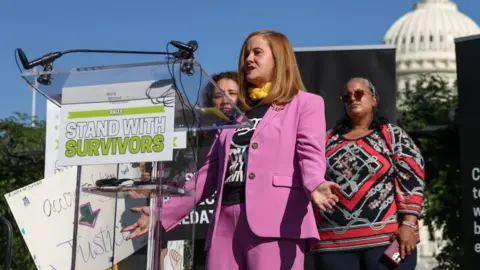
Reuters Liz Stein, who was a victim of late financier Jeffrey Epstein, speaks on the day of a rally in support of Epstein's victims, on Capitol Hill in Washington, DC, in September 2025. Liz is wearing a pink suir and standing in front of a podium with the word stand with survivors on a sign. Reuters

Epstein survivor Liz Stein has called for all of the files to be released

Baroness Helena Kennedy, a human rights lawyer and Labour peer in the House of Lords in the UK, said she was told the redactions in the documents were there to protect the victims.

“Authorities always have a worry” about “exposing people to yet further denigration in the public mind”, she told the BBC’s Today programme.

Many Epstein survivors seem “very keen” to have the material exposed, she said, but added that they “might not be so keen if they knew exactly what was in there”.

Democrat Congressman Ro Khanna, who led the charge along with Republican Congressman Thomas Massie to release the files, said the release was “incomplete” and added that he is looking at options like impeachment, contempt or referral to prosecution.

“Our law requires them to explain redactions,” Khanna said. “There is not a single explanation.”

Massie seconded Khanna’s statement and posted on social media that Attorney General Pam Bondi and other justice department officials could be prosecuted by future justice departments for not complying with the document requirements.

He said the document release “grossly fails to comply with both the spirit and the letter of the law” of the Epstein Files Transparency Act.

After the release, the White House called the Trump Administration the most “transparent in history”, adding that it has “done more for the victims than Democrats ever have”.

Blanche was asked in an interview with ABC News whether all documents mentioning Trump in the so-called Epstein files will be released in the coming weeks.

“Assuming it’s consistent with the law, yes,” Blanche said. “So there’s no effort to hold anything back because there’s the name Donald J Trump or anybody else’s name, Bill Clinton’s name, Reid Hoffman’s name.

“There’s no effort to hold back or not hold back because of that.

“We’re not redacting the names of famous men and women that are associated with Epstein.”

Additional reporting by Jaroslav Lukiv